Hi! Just popping in to remind you that I’ve started a newsletter, where I’m writing about all the people places and things I consider home. I’ve been publishing there weekly for about six weeks now. Please consider joining me there and help me clear 100 followers (I’m at 89 right now).
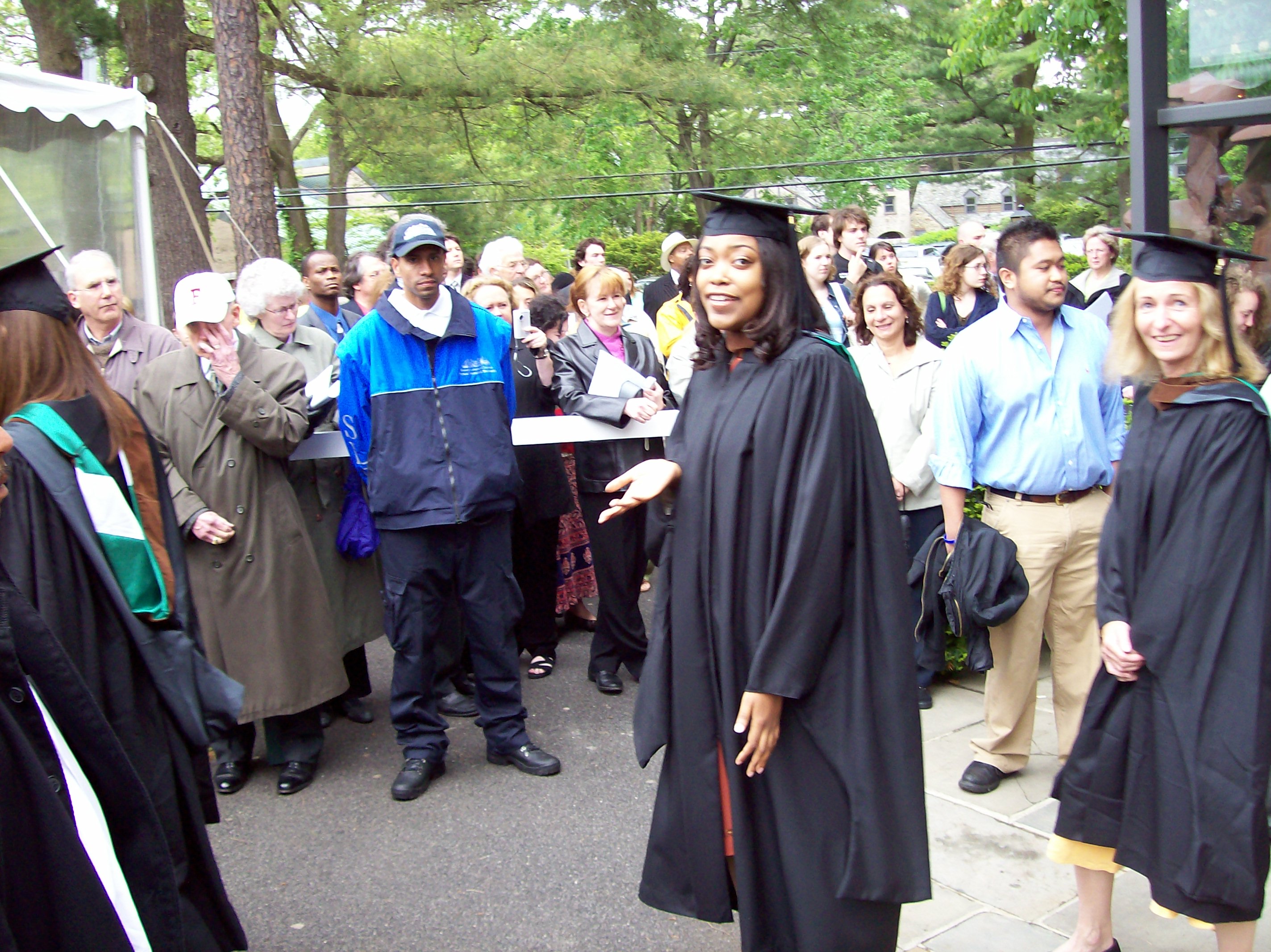
This photo is a bit of a cheat, as it’s from my grad school graduation, not undergrad, which is the experience I’m referencing in this piece. I didn’t have an undergrad photo readily handy. Anyway, me, getting a second degree, circa 2007– which wouldn’t have been possible without my undergrad experience.
I didn’t attend what would be considered a competitive university. It was never an ambition of mine to do so. I just wanted to go somewhere artsy and far away. But my educational achievement started flagging early, in 6th grade, and frankly, it’s a wonder I recovered enough ground by my junior and senior years of high school to apply to four-year colleges at all. I graduated with a 2.7 GPA, subpar SAT scores and no extracurricular resume to speak of; I would’ve been lucky to be accepted anywhere.
Because of this background, the discourse on affirmative action in higher education hasn’t been one in which I’ve had much investment. I wasn’t going to be applying to colleges where Black and Brown students were underrepresented. I was most likely to attend one where we were over-indexed: a state school, a community college, a non-competitive private institution incentivized to admit a high number of non-residential, part-time, local students of color, for whatever funding and endowment benefits that might be able to provide. Race wouldn’t have factored into my admission, anyway — at least not as a basis for exclusion.
In fact, I did attend a small, private college. It admitted me at the last minute when a (non-academic) scholarship elsewhere fell through. I’d applied to this school as a safety; at 45 minutes away from home, it was the closest I was willing to apply and I’d hoped not to have to attend because of its short distance.
In the end, it was my only option. And in the end, it was the right place for me.
Trinity Washington University (still known by its original name, Trinity College, when I was a student there) was founded in 1897 as the nation’s first Catholic liberal arts college for women. Obviously, it was predominantly white then and remained so for many years, its student body consisting mostly of middle-class white women until the 1980s.
Its demographics have flipped considerably since then. Like many colleges initially founded to serve marginalized groups, enrollment dipped at Trinity when the margins widened. Access to more competitive co-ed institutions meant less demand for an all-women’s experience. (The same enrollment dips can be observed at HBCUs post-desegregation.) And it should also be noted that white women seeking admission to those competitive, predominantly white co-ed colleges significantly benefitted from affirmative action policy.
Trinity, under the leadership of a new president, Patricia McGuire (who was there when I enrolled in 1997 and still serves as president of the university now) responded to that late 1980s decrease in enrollment by pivoting its recruitment strategies to include more active courting of students from D.C.’s public schools and working women with a desire to begin or return to college study. As a result, the school attracted a markedly more diverse population. So diverse in fact, that by 2020, its student body was 95% comprised of persons of color, with 65% of those being Black and 30% being Latina/x. Eighty percent of students qualify for Pell Grants.
Today the school is designated by the U.S. Department of Education as a Minority Serving Institution (MSI) and a Predominantly Black Institution (PBI) and, more recently, as an emerging Hispanic Serving Institution (HSI). It’s one of few schools in the nation to hold all three distinctions. Despite the addition of a co-ed school of education decades ago, ninety-four percent of the student body is still comprised of women.
I received a quality education at Trinity. Living on campus for 3.5 years was foundational to my coming of age experience. I was introduced to feminist study there. My understanding of the world around me — and of the city surrounding us — broadened. And over the years, holding a degree from the institution has opened professional doors what would’ve otherwise been closed. This is to say: I doubt I’ve ever had an employer scan to the education section of my resume and thumb their nose at the name of the school that conferred my degree. They were, instead, looking to confirm that I had a degree at all. I went into tens of thousands of dollars to attain it, as I would have at any other school that would’ve admitted me, as I had zero out-of-pocket tuition funds to contribute and no hope of an academic or merit-based financial assistance.
Today, as we reckon with yet another regressive Supreme Court decision, intended to roll back even the marginal identity-acknowledging gains this country has made in the past century, I’m reminded yet again of America’s bitter ironies.
Stripping away a racial consideration policy, under the guise of furthering equity, is moot in a country that holds racial consideration as one of its founding cornerstones. Race is always considered here. And just as race was used to dehumanize and exclude generations of non-white students from admission to white-founded and led institutions, it can also be used — as it was in the case of my college — to save those institutions from closure, when white folks desert them for “better,” more “elite” or “competitive” options.
So is it better to seek admission to an institution that is loath to consider your race as a (diversity) benefit of enrollment or one that welcomes you because of it (and/or because of the financial benefits your admission may represent)?
Both choices will leave you feel a bit manipulated. Neither shore up complete confidence that your enrollment was earned through “merit” or “achievement” or “academic superiority” to other applicants or whatever other gauge makes a person feel like their acceptance is legitimized.
Very little in life offers that sort of confidence. This is not an equitable nation, nor has it ever been voluntarily interested in equity. Equity, to the degree that the U.S. has ever pursued it, has been forced into consideration through public shame, promise of potential economic gain and the desperate alliances forged from “the enemy of my enemy is my friend” engineering.
Black and Brown people living here have always done well to keep this in mind when making decisions about where and how to show up. It’s never been fair for us to have to do this. It’s never been fair to approach the college acceptance process, knowing that our application will be weighted differently and that, should we decide to attend a predominantly White institution, at least one person (whether instructor or student) in each of your classes will wonder what you’re doing there there. With them. On “equal” footing. It’s never been fair that, despite being more welcoming to applicants of all races and of most academic standings, predominantly Black and Brown schools often have less funding to offer low-income students, less capital to offer professors and instructors competitive salaries and less funding for renovation, expansion and upkeep.
Fairness aside — and know that, as a person of color, fairness is quite often an aside — decisions about where to attend college should not be made based on degree of admissions difficulty. They should be made based on one’s individual, holistic needs — and those extend beyond academic rigor. The most affirming action we can take for ourselves is to remember that the best institutions to enter are the ones that welcome us with the least equivocation. The best ones to remain are the ones that continue to appreciate our investment, beyond what our presence means for them on paper.
i’ve started a substack newsletter. it’s a space to inventory the things we acquire to domesticate the spaces where we live. the things, both tangible and intangible, that make a place home.
i’ve been thinking about the act and art of home-making ever since my daughter and i left baltimore for durham back in march of 2020, just as the world locked down. it was the first time we’d ever lived alone, just she and i, and figuring out what kind of household i want to run is something i still work to reconcile, nearly 3.5 years later.
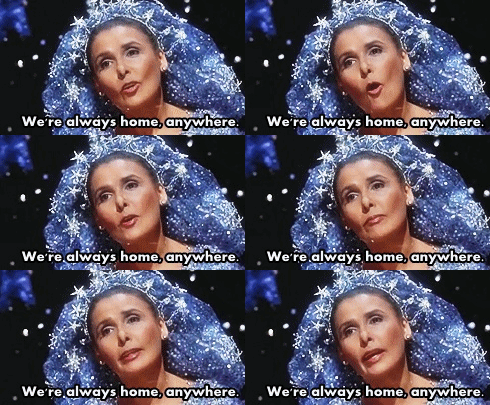
as glinda the good witch intones near the end of the the wiz, “home is knowing. knowing your mind, knowing your heart, knowing your courage.” the boundaries of each are tested when you set up house for the first time, when you’re the first and last line of defense, when every decision, colossal and inconsequential, is yours to make alone. what you know about yourself evolves and so, by necessity, does your sense of what it takes to make a home.
anyway.
it’s enough of a preoccupation that i decided it needed its own, separate platform for adequate exploration.
“It’s been a lot of years. Really think you’re getting one past me?”
—Beyonce
I can tell you this: I am not unhappy.
Not in that way that was overfamiliar, that aching way that twisted the sinew and clenched at the bone. I rarely despair in the new life I’ve built, not the way I did regularly three years ago, not about basic survival. Not over bills or the balances in bank accounts. Not as I would’ve when I would only allow myself to walk supermarket aisles with a hand cart in a futile attempt to trick my financial anxiety into confinement. I no longer tense at the price of yogurt. I do not lament the prohibitive cost of lump crab. I can fill a gas tank even when a station asks for well over 4 dollars a gallon. And where as recently as 2019, I could not imagine affording a two-bedroom apartment, my brain now occasionally braves the concept of a mortgage.
Someday isn’t quite so esoteric. Someday, if I wish it to, can very well exist on a calendar.
I still get sad. Still have days when angst resumes its reign. Still worry over all the things I’ve gotten wrong, am flailing at, will fail to do well in the future.
But I am not unhappy.
This presents a bit of a problem, as it relates to my writing. Unhappiness has, historically, seemed a necessary condition for my creative expression. I’ve favored a state of near-constant lament, of concentrated longing, of fear ululating in some sound-locked space just under the skin. Unhappiness: agitating, insistent, reliably inspiring.
In the absence of it, I have found my writing life quite quiet. I write in bursts. In streams that merely trickle. In stray words that fall from the stratus cloud of my mind like North Carolina drizzle, that misting precipitation inconsequential enough among the frequent sun showers and torrents that it barely rates mention.
Between attempts to write, I work words in more practical ways, ways visible to no one but me. Occasionally, while working, I find myself happy. Far more often I practice remaining content, something I am only just learning to do, now that a mental health professional has taught me a bit about how.
It is simple, I suppose, the practice itself. Every thought flows through a sieve. The health of the thought determines the ease of its journey. When we think the worst of ourselves and others, we cannot spare the expectation of a positive outcome, when the tool by which we measure our worth is any one other than the Scale of Existing, the pores of the sieve will clog. Very little passes cleanly through. And the labor of sorting all the impassable matter of low self-regard consumes far too much of our time.
A sieve too often muddied indicates some missing steps. An act of precognition, a thinning of unhelpful premonition, a liquifying of language, a pause before the pour. It has the simpler name—reframing—but I find that a longer arrangement of phrases better factors the effort the act requires.
If for 42 years, your thoughts have only known the work of sealing ceilings, razing bridges, bursting pipes, they cannot abruptly turn themselves the texture of water. They are novices at the positive, after years of medaling in negativity.
So in the past year or more, I’ve not made much of anything to read. But I’ve been working at words all the while. I’ve been training my brain to believe, if not yet the best, then at least, the better.
It begins with preempting, “You hurt me and therefore must never have loved me” then boiling it down to what feels more clear: “No one who loves me means me harm. I mean myself no harm. And when I am harmed, I can heal the impact without assigning ill-intent.”
It begins with catching, “You were miserable throughout middle school, so you’ll suck at helping your daughter make her way through it.” and pinching it between the pads of my fingers until it is more precise: “Because it was hard for you, you can make it much easier for her.”
It begins with, “I may never experience marriage” and strips it clean through to what’s pure: “There are infinite experiences of love. And every one of them is as accessible to you as you are to it.”
I will not insinuate that this isn’t an arduous work, reforming the refinery of the mind. It is tedious, painstaking. It siphons much of my time. But when the work is done well, its outcome is evident. Unhappiness can be alchemized. The thickest of our doubts can be made clear as vapor. When the worst threatens to warp our sense of what is and what, perchance, may be, we can believe, if not the best, then at the very valuable least, the better.
Even now, I’m not sure why I did it. I’d say it wasn’t like me but that would only be half-true. I’d forgotten what I was like—or perhaps I never quite knew—and by the time we got here, I was becoming something else altogether.
That is often a function of relocating, of looking for new cities in which to settle, new soil to turn and plant roots. When you leave who and where you’ve been, you are hoping for a home, a place to thrive and surprise yourself, a space to make wide, open, and safe enough to mitigate the bigger risks you intend to take.
I owe you an explanation, for you were the only witness. You were here, not just to see what happened but to be exposed to it. And it was an unexpected exposure, one for which I am solely responsible.
Adult decisions should be durable enough to withstand the inquisition of a child. And more mothers should hold themselves accountable to their children, not only when those children are old enough to articulate the impact of our parenting, but also in the moment, where help and potential harm may be two sides of the same coin.
Because a child does not wait to feel the weight of their mother’s choices, they should not have to wait to hear why those choices have been made. I know well that you are a child who clings to narratives, who turns them on her tongue and tosses them out like skittering stones on a river. So I have already told you some version of this, a version appropriate for 11-year-old ears. But there is always more to tell, always more it may help an older version of you to hear.
I did not move with the intention of meeting a man. It is not as if I’d heard fables of fine Black princes growing in North Carolina, alongside their crops of sweet potatoes and collards (I have learned, since arrival, that there is some truth to this, though that is not a part of this story).
We came here for the reasons I told you, to be at once alone and together, to stop sharing a spare bedroom with my mother in her mother’s apartment, to sleep in ways that weren’t head-to-foot in a twin bed flush with a wall. We’d been living that way nearly all of your life and for just as long, I’d been vowing to change it.
We moved only when I was sure I could afford to, when the work I procured wasn’t part-time or contractual, when the pay would arrive on a reliable monthly schedule, when the salary was high enough to secure us a home.
The convergence of those qualifications just happened to fall at the end of February of 20-20, when I found out I would be hired for a full-time job five hours south of Baltimore.
We moved to Durham in March, as our lives were closing in and a hush fell over all inessential movement in the outside world. In March all we had were our beds and our WiFi, a box of books and toys, our hangerless, dresserless clothes. A masked trip to Target yielded dishes, sets of glasses and silverware, our wash clothes and towels. Slowly, over our first locked down months, we populated our rooms with creature comforts, with couches and pillows, a Fire TV. I finally unpacked the appliances Nana gifted us; they’d been sitting in our trunk: a toaster, a can opener, a hand mixer.
We ordered our groceries and ate too much takeout. In the absence of in-person hours for school and work, bedtime became an abstraction. Screen time, which I’d never been keen to restrict, was without regulation or boundary. The limit did not exist.
And as for the separate bedrooms I’d promised you, where I would finally be able to tuck you in, dim the lights and duck apart, you were loath to sleep in yours, much preferring the familiar cozy crowding you got, sleeping right next to me. In those early months, your twin bed went unused and only a sliver of my queen was imprinted with our sleepy weight.
When we came here, I did not know how to tell you no, did not know how to get you to hear it, did not have time, between acclimating to a new workplace I’d never seen after hire and trying to keep you occupied in a time where you were one of few children enrolled in no school at all, having left third grade in Baltimore just as school in Durham shut down.
I’d dreamt of the space our own place would afford of us, the sprawling stretch of several rooms rather than half of just one. But in this 1,145-square foot apartment, we were never apart, and the structure I hoped to provide you seemed as nearly as distant as it was back at Nana’s.
I suppose this provides some explanation. When a long-held dream comes true, you do not always know how to just rest in it. You do not always trust that you belong to it. You believe you’ll wake up to find it disintegrated. No pinch in the world is powerful enough to dispel that worry, especially as daily life within that dream feels warped and unwelcome in practice.
Living alone with you, being your only mother, after nine years spent living in a three-matriarch household, did not feel liberating as I’d hoped it would.
Maybe I thought it needed more. Mediation. Distraction. A balance.
That, I think, may be why I sought the man.
I met him in May, via Tinder, a dating app I hope will have evolved by the time you’re old enough to use one. I was drawn to the ease of his smile. He was sitting in the sun, on a stoop outdoors, dressed in blue plaid and light jeans. And his smile just… looked like he’d earned it, that he’d fought through something to make it that bright, that he’d learned to laugh just because it felt good to, after years of doing so to keep from crying.
I know that is hard to believe, that a single photo on a dating profile could convey so much about someone we’d never met. But many months later, as many a minor challenge arose, I drew on the promise of that picture, and more often than not, as tension subsided, he’d smile and that promise was kept.
After several weeks of texting, both words and voice recordings, along with a few awkward video “dates,” one in particular spent watching a romcom in tandem while stealing glances at one another as the onscreen romance unfolded, we met him in person at the end of May.
I drove us just a mile to a wine store parking lot. He pulled up in his Black Chrysler 300 and smiled his Tinder profile smile, before masking up and opening his door. He reached into the backseat for two bouquets, and you leaned forward in the passenger seat to get a better look at home.
Though I tried to keep cool, I questioned the wisdom of the entire exchange. Should you be meeting a potential suitor at the same time I was? Was he trustworthy enough to be near us?
He was the first person we’d met in person since moving to this city? Was he safe? Sanitized? Unexposed. It would be several months before even the hint of a vaccine. He was risk upon risk upon risk.
But that had always been the point. After putting my thirties in a jar that protected us both from the precarities of freelance writing life: unstable housing, threat of eviction, mounting debts and loans, after living with relatives who kept you at home while I slipped off on occasion to pursue the one casual relationship I’d started in the nine years since you were born, a connection made only of offsite trysts and the occasional overheard mention of a strange man’s name, one you’d never come to know, I was 40 now. And you were turning 10.
We’d subsisted long enough on cloistered sips of air. We were ready to catch real wind. We were ready to soar.
2.
If moving was our leap from a great height, meeting Quan felt like the moment a parachute opened. I didn’t know it at the time, not in that parking lot, but I was about to embark on my first real romantic relationship as a mother. It would move quickly, pressurized within the parameters of a pandemic. At any moment, it would ask far more of me than I would have, under normal circumstances, been prepared to give. It would ask much of you, too, in the way of maturation.
Gone would be the days of bursting into my room unannounced or forgoing nights spent in your own bed in order to burrow in mine. No more were the limitless loops of videos, of time ceasing all shape and dimension.
We would become, without much warning, ensconced in the disruptive rhymes and rhythms onset by the arrival of a man.
3.
It is one thing to live in a house full of women, deferring to the tacit rules of age, allowing the elders to set or raise or change your stakes. It is another to strike out on your own and find the experience both freeing and wanting, unable to stabilize a life left, for so long, as unstable.
It is a different life altogether to meet a stranger, grow enough trust to let him move in and test, every day, the sturdiness of that trust, even as its benefits grow more and more evident by the day.
Quan helped me homeschool you. He cooked balanced dinners. He walked the aisles of megastores during the grocery buying and budgeting that have always made me miserable. He traveled to your hypothetical worlds with you so often that, at Christmas, he thought it prudent to purchase you a book of Would You Rathers, so we’d all have more concise questions to answer than the ones you came up with on your own. We went for walks together. And raised your reading level by restricting your iPad time. We logged onto family Zoom calls, where he subjected himself to the surveying questions of cousins, aunts and uncles, and my father.
We intended a kind of future. At least, we did for a time.
For just as long, just over a year, you saw your mother being loved. You saw me extending love, too, though as the beneficiary of so much of mine, that part was less of a foreign concept. At 10, you had yet to see someone’s heart in their eyes when they looked at me. You’d never heard my voice lift a whole three octaves, under an intoxicant called flirting. You’d never seen me sidle up to someone as he cooked in the kitchen and wrap my arms around his waist, warming my cheek on his back. Even the little pecks hello and goodbye, the random close-lipped kisses we deigned to deliver in front of you… those were all new to you, too.
It didn’t last. Not all good relationships do. Sometimes they’re meals meant to nourish and serve, first plump and decadent then picked clean till there is only the gristle and bone.
But there is much to be made of the bones. We are only beginning to figure out what’s left of their purpose. And even if the result of their reading is that only the two of us have made a more stable home, the year we spent as three will have been worth it.
4.
When we are not careful after taking a risk, regret writhes its tentacles around even our fondest memories. The best laid plans of our better angels are buried under the burden of second guesses.
I am trying, as ever, to be careful, to teach you that a well-reasoned risk is worth the disappointment of its outcome. We are still wandering together, still working our way through the whys. You have seen my heart swell and then be broken. Some days, that’s left me embarrassed but never ashamed. For even though our home has been altered in his absence, it is no less ours to reshape and reclaim. What I set out to give you remains intact and for whatever our journey has taught you, I hope this is what you retain: when love abounds, it betters and when it recedes, we survive.
Anemics are always cold. It’s an affliction of extremities, of icicled fingers and toes, of lightheadedness after standing too long in a chilly concert hall or at a sweltering summer festival, of darkness crowding the corners of the eyes in warning: find a seat, drink cold water, or succumb to blacking out.
Sometimes, when my heartbeat is at its most irregular, I feel like I’ve inadvertently shoulder-checked Mortality and now it’s ready to box me barehanded.
I don’t know how long I’ve been anemic or what caused it. I only discovered it when I visited an ER in October of 2019 and found myself admitted to the stroke ward. The hospital kept me for three days, for a half-dozen blood draws and a series of blood thinners injected into my stomach, a CT scan, an MRI that required the shooting of squid-like ink into my veins beforehand, and a series of sobriety-test-adjacent physical prompts: blink one eye, now both, raise one hand, now the other, touch your knees, now your nose, walk the length of the hall in a straight line.
The staff ruled out a stroke. They stopped short of calling the drooping right side of my face Bell’s palsy. I knew as little about why my left eye bulged wider and blinked on a second’s delay as I did when I was admitted.
By discharge, the only new thing I knew about myself was that I was anemic.
It didn’t come as much of a surprise. The signs had long been there. In my late teens, I started eating less and less, until I trained my body to get by on coffee and a pastry (and sometimes just the coffee, or less often: nothing at all) in the morning and a small dinner 10-12 hours later. I still eat that way, sparingly, only satisfied if my stomach feels concave when I’m lying on my back alone in bed at night, if the rumble and burn of self-denial can be felt under the flat of my palm.
That couldn’t have helped, all those half-starved years. Deprivation never helps.
2.
When we were all required to close in on ourselves, for fear of catching a debilitating virus from one another, the world felt anemic, withholding, all the good drawn inward, sequestered and secreted, the pulse of normal life growing faint.
That was when I knew to look for love. Wherever I could find it.
3.
In the stroke ward, the nurses stagger-stepped at the threshold of my room.
“You’re young,” said the night nurse as well as the one who took over the mornings, though I was sure they saw in my chart that I was one month shy of 40.
I felt haggard, half my face weakened by a force unseen. Before then, I’d always been in decent health, the kind even a hypochondriac could almost take for granted, but wasn’t landing here evidence that youthful vitality was a breeze blown by? Wasn’t I aging now? Wasn’t this the incarnation of oldness?
I didn’t understand until those straight-line walks down the hall, where all that could be seen behind the half-drawn curtains in each of the neighboring rooms were heads of white hair, dark veins under mottled skin, parted lips stuttering toward speech.
Sometimes, a sounded clatter. Other times, a weary yell.
Those strokes weren’t suspected. Those were real. And as it turned out, I was young.
4.
He had a gravitational smile, the only pull in a sea of local profiles, the only grin great enough to stay my swiping hand. I stared at it and instinct suggested it was genuine, as warm and mirthful as it looked, and just as nourishing.
I needed to be nourished. I swiped right.
A pandemic is the only time when it makes sense to stake your heart on something as simple, as potentially deceptive, as a smile. Lockdown is the only condition under which that sort of risk pays off.
In a plague, you’re not looking for much, only someone willing to wait with you and listen for a hitch in your breath. Someone whose lips can confirm that you haven’t lost your taste, whose nose would seek your scent with the very last use of its smell.
He was more than that, refreshingly more. We ate and laughed and nursed something nascent and fragile till it felt hardy, thickened, like blood infused with iron and given room to breathe.
5.
I spent those three days in the hospital alone. My nana who’d driven me to the emergency room hadn’t returned. My mother, who stopped in before I was admitted to pick up the keys to my car, which she’d borrow until my release, hadn’t been back, either. They took turns caring for my daughter, who at 9, was too young to visit the stroke ward.
A guy I spent years hooking up with off and on sent a text when he saw a tweet I’d posted in a pique of loneliness. The text read something like, “Everything okay?” Despite our insistence on referring to each other as friends, we didn’t have enough of a relationship for me to feel comfortable reaching out to him in a crisis. It was just as awkward to only be discussing one with him, because he’d chanced upon a tweet I’d posted to no one in particular.
I may have texted to notify my daughter’s dad or maybe my grandmother did. He called and we chatted in the brief, inconsequential way that we do unless there’s something heavy going on with our child. Surreally, my only visitor was his mother, who stopped by unannounced on her way home from work, the first night of my stay. She sat with me for an hour and we talked about God and politics, the common ground we find easiest to tread, as we share a religion and a portion of ideology, in addition to the daughter I have with her now-married son.
I was grateful for her company but more comfortable in the silence that followed her departure. It yawned and stretched its way through the room. It slept far better beside me than I did.
I may have been young, but here I could see a familiar future: an empty nest, cold bed, no intimates, an affliction of extremes.
6.
I moved away from Baltimore for Silence. It had proven itself quite loyal. I’d been living amid the noises of a home that wasn’t mine for the better part of a decade. Silence deserved her own space and so did I.
But even Silence pines for companionship when the world has shut down. We found it in him, this smiling man who learned us fast and laughed so easily, who loosened our inhibitions and made us believe he’d keep us from ever reaching the depths of our discontent again.
We wanted to keep him even after the inoculation, ride next to him through the reopened world, and be as new as our regenerative months inside had made us.
We wanted that more than we could know until it was clear we wouldn’t have it.
7.
It might be foolish to expect that the person who you meet when you think you could die at any moment is the person who’ll suit you best in the long-unfurling years after that imminent threat subsides.
But other pandemic couples have persisted. Some have gotten engaged. Others have already married.
It was possible for us.
Possible, but perhaps too easy for someone like me, who spent her whole life skirting exactly this kind of cliff edge, afraid not of the heights but of the plummet.
I deserved ease, though, didn’t I? For all these years spent hiding from new heartbreaks, for choosing a partner who loved so freely and who it felt so simple to love?
I’d been living on too little for so long. Too little food, too little affection, too fleeting friendships, even a shortfall of blood cells. And he was feeding me, enfolding me, and being my best friend in a foreign land. Enough, then maybe too much, a ship taking on too much water, a vessel floating away.
8.
My daughter still mentions him often.
“I’m an optimist,”’she deadpans, unaware of how her mispronunciation of the word has made her claim all the more adorable.
“I know,” I answer, stopping short of confessing that I’m becoming one, too.
The man I dated for 15 months and lived with for 11 moved out of our apartment 8 weeks ago. He isn’t likely to come back, and I’ve stopped pining for him to. It may have been improbable to find someone I trusted so much, so quickly, and it may have ended in him leaving me to contend with the dozens of deprivations and abandonments I spent the pandemic avoiding.
But I know myself better for having loved him. I apply the notes I took as I watched him loving me. I eat, sometimes even at midday. I at least look at the iron tablets on the counter now, though I still forget to take them far too often. I try to get a better night’s sleep, be kinder to myself in the mirror. The boundaries I set now are the ones that keep me calm. I gather all my courage and enforce them.
I am alone but I am without regret, undiminished. He left the air around me electric. It crackles, voracious, just under the silence.
I don’t regret it which, I guess, is the unrefined gold. I don’t regret it because he was good to me, because for a time we were so happy, we would giggle in the middle of the day and drink each other in till we were full to bursting, unabashed and grateful for the grace of having found each other. I don’t regret it because I get to carry the scent of him in a corked and slender vial, on the near-empty shelf of recollection I reserve solely for the things I wish to revisit.
Not regretting it is the parting gift I’ll give him. Because I know he doesn’t mean to leave me; he only means to leave. We should need ourselves slightly more than the ones we love. And when we feel ourselves fraying in ways no one else can restitch, it is wrong to stick around long enough to resent our significants for not being seamstresses.
And aside, toward the end I saw it coming. I suppose that’s the parting gift he gave me, a gentle tearing away that felt like a slow unspooling, suggesting, soon, he would ask me to let go of the long end I was holding while there was still such generous slack and nary a hint of tension.
Nothing feels quite as we expect it to. At intervals, a mental pinching is required.
We must be sure we did not dream what we lived. There were apocalyptic pockets: spots where suffering was disproportionate, whole families halved in a matter of hours, workers and students and childbearers whose entire ways of being were obliterated overnight and over months, for well over a year.
That happened.
It happened.
It is still happening.
But there was nothing so definitive as an Earth’s End. For many — for those who were not required by vocation or extreme need to place themselves at impossible risk for (often ungrateful) others — there was merely an extended suspending of animation. There was waiting and watching and facial obfuscation. We were told to vaccinate. A number of us did. We were told that when we did, we were free to move about the cabin of our country.
The fasten-seatbelt signs are off.
And we are moving, but through an existence molecularly altered, one we entered, perhaps, without children, and are emerging as parents. One we entered believing ourselves better off single and are emerging, peculiarly, partnered. One we entered not understanding the capacity of our bodies — their vital, unfelt functions, their threshold for thrashing and healing — and are emerging quite staggered at the daily deteriorating marvel of meat and bone, the dogged but delicate grind of organ and sinew.
Nothing is where we left it. In our tentative venturing, we’re seeking out our certain our points of origin and finding instead empty divots on a dirt road. We yearn to return to a place of precedents but along the planes of our new boundaries, not a single one is charted. We want the bearings of civilization, because we’re burdened now by knowing exactly where civility ends. Give us back our benign smiles, the ones that mask how well we know who wanted to move unmasked among our most vulnerable. Give us back the frivolities we cherished before we knew that what we failed to cherish would be what we’d be forced to mourn.
Of the opportunities lost to us forever let us forge new opportunities. May we cobble together something better than civility, something closer to lasting compassion. If we managed to build anything meaningful amid the ruin, may our structures be sturdy enough to shelter us even when we’re not confined to one place.
Let us ascertain afresh what it is to be alive. Let us make new. May we be made new.
In 2020, I made many swift transitions. I relocated, began and learned a new job, lost that job (but not employment altogether) and learned I would need to originate a new position within the company. I met a man in May. He sort of moved in* in August. We’ve quarantined together, along with my daughter, from then till now. I’ve gained considerable weight — and had to change my relationship with my body because of it. I’ve lost a significant amount of hair and had to reconfigure how I regard myself in mirrors because of it. I’m raising a ten-year-old who I’ve moved away from her village: her dad, his wife, their baby who made her a big sister this summer, my mother and hers — the women who’ve helped me with the hands-on work of raising her from the moment she was born. And in so doing, I’ve made good on half a promise (that we would make a home of our own) and unexpectedly reneged on the other half (that we would live alone).
I cannot imagine what it must be like to be my daughter, unable to leave home without cloth cloaking two-thirds of her face, unable to bond with her classmates because she’s not once spent time in the same room with them, unable to grasp about half the concepts of fourth grade because the pandemic made it impossible to finish third. Both homes having changed up on her near-simultaneously. Nearly ten years as an only child gave way to her being the eldest of two. And after just a few months living alone with me for the first time ever, she has to deal with a mother she doesn’t recognize, a mother she’s never met, a mother in love.
I have been meaning to write about making the decision to love someone this year and how a pandemic challenges what we once assessed as risk and as fear.
For context, you should know that I used to be terrified of partnering while parenting a child who’s still school-aged and living at home. I thought that I might disrupt some delicate dynamic, that in making room for one more, my daughter may feel displaced or, worse betrayed. I thought I should forfeit the luxury of romantic love after full-heartedly accepting the charge to raise a child.
It seems silly now, irrational. Over time, several people told me it was. I just couldn’t see it any other way, having made a mess of the relationship that resulted in my child in the first place, and having been raised feeling displaced and disrupted myself when my own single mother married (incidentally, when I was ten years old). I thought I owed my daughter my undivided attention and I didn’t want to risk its division for a man with whom I might split, just as she was bonding with him or warming to the idea of the three of us together.
Until this year, I was terrified of taking that sort of risk. This is the year when we learned what risks are actually not worth taking. As it turns out, widening my sense of possibility beyond the perimeter of past pain is not on that list.
Leaving home without wearing a mask is. Leaving home to gather with unmasked people is. Kissing our loved ones living in other households, without knowing for certain if that kiss is one of brief illness, long hospitalization or untimely death… that is on the list of risks not worth taking**.
Starting a relationship seemed far less daunting by comparison. And moving quickly once committed to that relationship, which would’ve seemed counterintuitive in the Beforetimes, seemed to reduce risk instead of raising it.
My partner and I met on a dating app I joined on a lark one night, shortly after moving to Durham. From what I understand, this is how a significant number of pandemic partnerships began. It’s the safest way, physical distance and abundance-of-caution being encouraged, typical “don’t match with me just to text” impatience being a huge red flag. We sent paragraph-long texts for weeks before meeting, masked, in a parking lot after a month. He brought flowers for me and for my daughter, whose guileless, curious, eager expression I still remember as she leaned forward in the passenger seat of my car to wave at the first man she could remember her mother ever introducing her to***.
We disclosed where we’d been and with whom we’d been in contact before we spent time together, trust-building acts that initially made me feel exposed and susceptible and, on some days, when we disagree on whether or not someone’s decision to leave home is “essential,” still do.
What I realized early was that proximity to my partner made me feel less anxious, more patient. Having him here gave my daughter someone new to talk to, someone new to investigate, interrogate and entertain. She and I bicker less with him as our buffer. He fell in easily with our motley duo and there are times when I suspect that he arrived just in time.
Though my daughter and I didn’t have many months to ourselves before I met him, though I did not get to mother her “on my own” for very long, I had just enough time to know that we were not off to the best start. All those years of living with the constant in-home oversight of two matriarchs had taken its toll on both of us. My daughter had never learned to look to me as the adult in her home who had the final say; she had two other, older mothers she could turn to for a second or third opinion. And I had never learned to be more authoritative with her than I was alternately affable or annoyed. Before this year, my daughter often told me I was, “kind of like a big sister,” though she’d always follow up by reassuring me that she knew I was her mom (occasionally with a [maddeningly] placating pat on the shoulder).
I thought relocating might help, but that trend continued here. I do not know for certain whether it would’ve worsened with time, whether I would’ve been able to break the decade-long mother-sister dynamic I had with her or simply reinforce it. All I know is that we were living a bit like wildlings in the beginning. Though we had the run of an entire apartment, she rarely wanted to leave my bedroom, day or night, and she rarely drifted off to sleep before midnight. Without a school day to regulate her or schoolwork to ground her, while I was trying to find the rhythm of working a new job remotely in a city neither of us knew, day and night had little demarcation. Takeout was king. Screentime was plentiful. We barely remembered routine.
Along with all the other reasons, I avoided real relationships as a mother because I had long considered my way of mothering as vaguely chaotic. I did not feel like I was in full control of it, and I did not know how to regain control of it. Until I did, it made no sense to enfold anyone new into our family. What if he judged me for my failure to run a tight ship? What if he boarded with a strong sense of reform?
I will not pretend that this relationship has rendered all my reticence moot. It has not. Some of my dating-as-a-parent worries were founded.
But I think what laid at the root of all my worry was fear of how much things would change. Things have changed. Significantly. It is my first serious relationship since having my daughter. And it bears zero resemblance to any relationship I was in before having a child. Adjustment was inevitable.
When someone chooses to date a parent raising children, especially if they spend significant time inside the parent and child’s home, that someone will not be a silent observer. They will not remain agnostic to the goings-on they witness. They’ll pitch in where they see that it may help. They’ll lean in and fall back, in accordance with what the cadences of that household require. They will do so voluntarily, freely opting into a lifestyle their partner cannot opt out.
They are yielding to something larger than themselves. And if all goes well, so are the parent and child.
This is as it should be. But I would have never given myself permission to learn that without a pandemic raging beyond our walls, reminding me each day of how fragile it all is, how fleeting our attachments are to everything but faith.
No matter how this pans out in all the months to come, I will not regret relocating or meeting someone in the middle of a kind of world’s-end or moving quickly with him or introducing him to my only child. I am better for it. I believe my daughter is, too. And I have only this harrowing, clarifying year to thank for it.
* He still has his own place.
** Please do not read any judgment here. I’ve road-tripped three times since March. Twice to see the matriarchs in Baltimore. Once to meet my partner’s family in Virginia. Though we quarantined beforehand, masked up when meeting anyone in passing, kept distant and disinfected as best we could, we knew that it would’ve been safest just to stay home. Risk is risk is risk.
*** She “met” the one other man I dated, but she was two or three at the time.
The world has gone both cacophonous and quiet, both chaotic and eerily still. Each person’s experience is wildly disparate. Contagion calls both for unanimity and for splintering.
If we are to live — not to stay alive, but to value life, not to test negative, but to live — we must all first decide that we are all worth saving; only then can we all reach a shared conclusion that sequestering ourselves is worth the effort. More than a median of us must agree that cottony muzzles cannot be avoided, that mouths must remain unseen, that breathing now requires a counterintuitive covering of our noses.
Those are our imperatives. For nine months, those have been our imperatives. But as a nation, as a culture, as a society, we are still too disinclined to meet them. It is difficult to reach the same conclusion — that we have some role in our own survival, that a force beyond our control may render our efforts moot, but we must still decide each day to make an effort — when the variables between us are so vast.
In the final accounting, I imagine we will not arrive at the same conclusion. Those of us who walk away will do so with far different precepts in their pockets. This is no fictive apocalypse where collective emphasis remains on survival. In a real population-altering pandemic, survival will not be lesson.
I know fewer than a handful of people who’ve tested positive. I know of people who’ve lost their parents and children and spouses. I have had the extreme privilege to work from home and supervise my daughter’s online instruction. And from home, for work, I have spoken with families who’ve sent their elementary schoolers to re-opened schools where teachers and children have contracted the virus and, in one case, where a principal has died. I have spoken to the custodial staff at colleges where adequate PPE was not distributed until COVID clusters cropped up on undisclosed patches of campus. I have heard the courage that crisis exacts from those already too accustomed to crisis.
The horror itself is a Rorschach. Our perception of what is inked individuates. For some, the blot is incompetence, an infection of avarice and callousness made sentient. For others, the blot is community spread, a natural disaster exacerbated by our bottomless craving for closeness. Long before this, we knew that we cannot exist alone. And now we know there is at least one circumstance where we cannot exist together. Not safely. Not without risk far too intense for the taking. The blot is an unending grief unfurled. It is carnivorous. It consumes futures. The blot is an instigator, an organelle of pointed fingers, an unending mitosis of blame. The blot is biological warfare or else a hoax; a conspiracy that mutates among the most dogged deniers, even as confirmed cases continue to climb past the millions.
We are told we have rounded a corner. Competing companies vie for bragging rights to the highest percentage of their vaccine’s effectiveness. We are told they will offer it at cost; that we can all begin to have it as early as March. I have little choice but to believe it, just as I believe that no plague lasts forever, just as I believe that as stubbornly as some humans have elected not to protect themselves and those they know, others are just as stubbornly committed to protecting perfect strangers.
That is the infuriating paradox of our species. At our most susceptible, we behave as though we are invulnerable. At the very moment when Life decides to prove that nothing we’ve amassed can protect us from its ravages, we intensify our sense of entitlement.
What I will remember was that no one protected us from each other. No one protected us but each other. What I hope is that when God created us, if indeed He did so in His image, God was as much a contradiction as we are. And it is that contradiction, rather than any temporal consensus or uniformity, that will work to keep what’s left of us alive.
 stacia l. brown