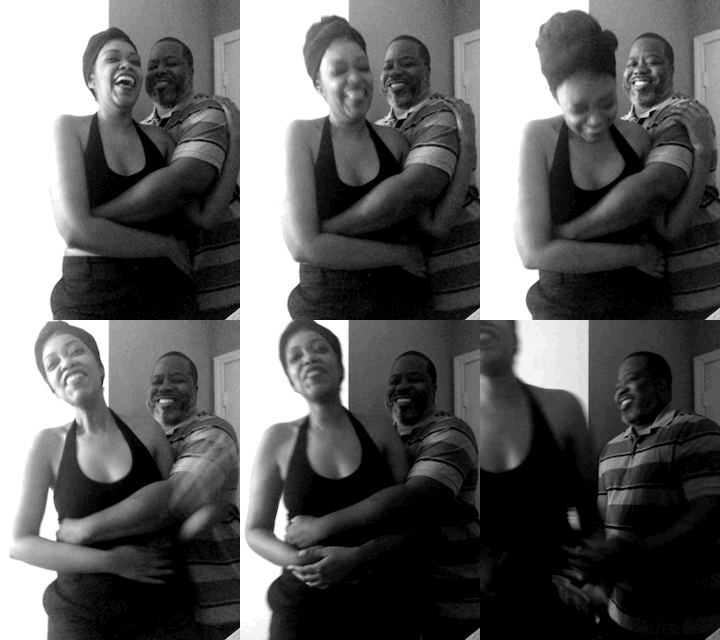
What We Mean When We Say Amicable.

I don’t regret it which, I guess, is the unrefined gold. I don’t regret it because he was good to me, because for a time we were so happy, we would giggle in the middle of the day and drink each other in till we were full to bursting, unabashed and grateful for the grace of having found each other. I don’t regret it because I get to carry the scent of him in a corked and slender vial, on the near-empty shelf of recollection I reserve solely for the things I wish to revisit.

Not regretting it is the parting gift I’ll give him. Because I know he doesn’t mean to leave me; he only means to leave. We should need ourselves slightly more than the ones we love. And when we feel ourselves fraying in ways no one else can restitch, it is wrong to stick around long enough to resent our significants for not being seamstresses. 

And aside, toward the end I saw it coming. I suppose that’s the parting gift he gave me, a gentle tearing away that felt like a slow unspooling, suggesting, soon, he would ask me to let go of the long end I was holding while there was still such generous slack and nary a hint of tension.


2 responses to “What We Mean When We Say Amicable.”

  1. How incredibly beautiful your writing is

  2. An exquisite statement, made so eloquently, while wearing the most elegant big girl panties I’ve ever seen!

Leave a comment

about stacia

Stacia L. Brown was born in Lansing, MI at the very end of the 1970s. She grew up in Baltimore, MD–the county, not the city. She graduated from Trinity College (now Trinity Washington University) in DC with a BA in English and worked a few office gigs, while trying to jump-start her writing career, before moving to New York for grad school.

At 27, she finished an MFA in fiction at Sarah Lawrence College. She spent the next six and a half years working as an adjunct writing professor first in Michigan at Grand Valley State, Kuyper College and Grand Rapids Community College, then in Maryland at The Community College of Baltimore County and, for one dazzling semester, at MICA, while also working as a freelance writer for various publications, including The Washington Post, where she currently serves as a weekly contributor, New Republic, Rolling Stone, The Atlantic, and others.

In 2010, she became a mother.

For a semi-complete list of Stacia’s online publications, visit her bylines page.

Her short story, “Be Longing,” was selected for publication in It’s All Love: Black Writers on Soul Mates, Family, and Friends (Doubleday/Harlem Moon 2009), edited by Marita Golden. Her poem, “Combat,” appears in Reverie: Midwest African American Literature. Her essay on adjuncting as a single mother appears in the Demeter Press title, Laboring Positions: Black Women, Mothering and the Academyedited by Sekile Nzinga-Johnson.

Stacia served as the 2013-14 Editorial Fellow for Community Engagement at Colorlines. In June 2015, she was part of the inaugural Thread at Yale class. She was a 2015 participant in Women’s Media Center’s Progressive Women’s Voices training program. She was a 2019 Tin House Scholar and a participant in the Cambridge Writers Workshop in Paris, also in 2019.

In addition to her work in print, Stacia is also an accomplished audio storyteller. In November 2015, Stacia became the creator and producer of Baltimore: The Rise of Charm City, a radio and podcast series that tells intergenerational stories of place and memory in Baltimore City. Baltimore: The Rise of Charm City is part of the Association of Independents in Radio (AIR)’s 2015 Finding America: Localore project and is produced in partnership with WEAA 88.9.

She is the creator of Hope Chest, a collection of audio essays written to her daughter and present in podcast form at SoundCloud and Apple Podcasts. Hope Chest has been featured on BBC Radio 4’s Short Cuts and the Third Coast International Audio Festival podcast, Re:Sound. It was named one of Audible Feast’s Best New Podcasts of 2017. She also created and produces a micro-podcast for middle-grade book reviews, which her daughter narrates and hosts. It’s called Story on Stories.

In 2018, Stacia landed a gig at WAMU, as a producer of the NPR-syndicated daily news program, 1A. In 2020, she relocated from Maryland to North Carolina, where she produced radio and podcasts (including the incomparable Great Grief with Nnenna Freelon) for WUNC, North Carolina’s NPR station before moving onto other sonic endeavors. In 2022, she served as an advice columnist for Slate’s weekly parenting advice column, Care and Feeding.

Stacia resides in Durham with her amazing daughter Story.

Newsletter