Crushes and Sundry: Advice in Advance of Your Second Birthday.

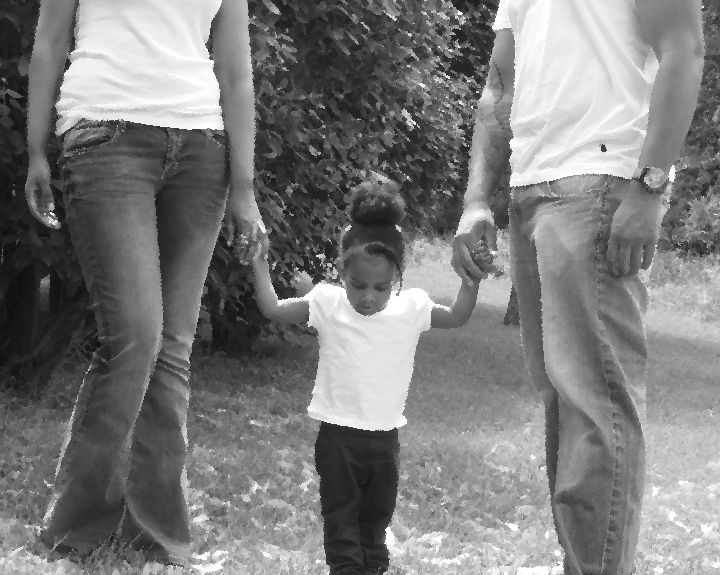
Beloved, as easily as if we were following a template of icing and gingerbread, we’ve erected an affectionate home. Lips brush skin here, as if it were canvas. I feel the daily tug of your arms ’round my neck. On occasion, out of nowhere, you place your palms on either side of my face and force my head forward so that we are eye to eye. You stare like a clairvoyant, hold my skull like a crystal ball, and kiss me square on the lips for as long as you see fit. Mmmwah! you exclaim afterward, wearing an expression that suggests you’ve just confirmed something for yourself.

It is not that you are loved; this needs no mouth-to-mouth reiteration. You feel love when I stroke your hair near the long, even part your granny has made. You feel it in the careful cornrows she weaves of your cottony tresses at night, hear it in our clicking, meticulous searches through a barrette tin for the perfect, color-matching clips to fasten to your ends. You are certain of it when you march up with urgent eyes and our hands stop, mid-motion, to direct food into your mouth rather than our own. And you listen with contentment to the melody of Ls, collect the uttered loves, stringing them ’round your neck like a strand of singing birds. You wrangle what’s left into a cage: love as a raging aviary. When that is overcrowded, the excess curls and crawls above our toes, wraps our wrists and stains our fingers: love as an intricate mendhi.

No, you needn’t kiss my lips to confirm my love–but you do it often, smiling secretly, knowingly, a punchline tucked behind your pucker. Perhaps you really are a seer; you understand that lips are to be read. In the blink of time between the buss and sound effect, you’ve ascertained a future.

Mine are the first in a line of lips you’ll kiss. A mother’s is merely the first of the many loves you’ll feel.

I will tell you this: crushes are the stones that skip seven times before sinking. They are never too heavy; they linger on a beautifully rippling surface. And when they leave your sight, any sadness you feel fades quickly.

Consider the older boy you met last week in Old Navy. He was four and alarmingly free, having broken away from his beleaguered parents and flirted his way through the children’s section, favoring brown girls with wrangled clouds of hair. I noted how close he got to the girl nearer his age, how he circled her, eager to impress, and how reticent her banter seemed by comparison.

When he lost her to the checkout line, he set his sights on you, bounding toward us with intense eyes and a delirious smile. This, you will find, is a tactic of boys at all ages.

Hi! he cried. Hi! you chirped back. He asked your name, asked your age, asked if you wanted to play. Hi, you said again, adding the string of nonsensical chatter you always employ back home. There was a pause when you’d exhausted your vernacular, and it was rapidly filling with the helpless disappointment that attends all language barriers.

Mmmwah! you declared, leaning toward him.

This wasn’t your first time attempting befriend an unfamiliar child with a kiss. You’d tried it on a tiny girl at the library and I’d pulled you gently back as horrified confusion rushed to her face.

This time, you tried something more intercontinental, opting for the cosmopolitan air kiss so popular in parts of Europe. This boy was similarly bewildered (but definitely not horrified), as I rushed you toward the flip-flop section.

When you’re older, I’ll assure you that it isn’t an error to make the first move but in the rare case when you do, it’s imperative you do not make the second.

The four-year-old we’d left behind caught up to us. He only looked away from you for a moment, and that was to turn his adorable face up toward me to ask in a tone both accusing and curious, “Where you going?”

I started talking to him like I would someone my own age. (I’ll admit having you hasn’t made my interactions with other children any less awkward.) But as I launched into a lengthy explanation about all the areas in the store we hadn’t hit yet, he was inching closer and closer to you. Before I knew what was happening, faster than I could react, he’d kissed your cheek.

Technically, it was your first non-family kiss. Technically, you and the four-year-old boy in Old Navy had just gone through an entire arc of courtship rituals in less than three minutes.

When you’re twelve, you will think I’m crazy, but this was a major McFly moment. In a flash, the future was now.

You will know your wiles early, will wield them with coyness, not cruelty. Men won’t be the mystery to you that they are to your mother. But seeing your own beauty as clearly as I do will not come as easily. It is simple for me: you are startling, the same as your father was. One minute, you’ve the stock cuteness all children hold. The next, at an angle, with a twinkle of eye or a baring of teeth, you are gorgeous in ways that will keep me up nights well into your thirties.

I am telling you this, my wondrous girl, because you’ll need to know it. In nine days, you’ll be two, and in what will feel like the space between sunrise and nightfall, you’ll be twenty. The rules do not change:

Be equal parts open and aloof. Do not falter in following your agenda; when you are valued, you are always followed forward. If an action is objectionable, protest then and there, but never pretend offense where there is none (you didn’t yelp at the kiss and because of that, neither did I). Mind your mother; more often than not, she knows of what she speaks. But above all, pay attention. Part ways when the time seems right, and do not think to tarry. 

The fact is that the time and the person will come from which you will never wish to part.
Carnival.

In the gray Nissan Versa that’s hard to afford, my mother sits behind the wheel, our daughter in her lap. I am sprawled behind them, next to the car seat our girl has abandoned for a better view of the lot before us.

For the past ten days, the lot has been transformed from the desolate patch of asphalt outside a mall so skeletal the community keeps vigil around it, waiting for word of its death, to a blinking neon festival of thrills and frights and views from epic heights.

This is its last night in town. We have pulled up and parked just outside the wire fence that surrounds it, our last stop on a customary post-church evening joy ride.

Though we’d planned to bring Story here to see the lights and laughter, the curious gadgetry, acrobatic and colorful, we had no plans to enter. We’d decided she’s still too young. Even the carousel horses seems meant for bigger children. And truth be told, I am relishing the vestiges of her babyhood: the incoherent babbling that still overwhelms her plain-speech; the consternation that crosses her face when confronted with lid-less cups; the way her steady gait becomes a toddle when mounds of grass crumple under her feet. I am often relieved at how the brevity of her attention span exempts us from kids-movie-showings, and so too the carnival feels thankfully premature, the longer we watch the older children prance and twirl and cavort.

But it is the length of time we sit and keep watch that unravels me. The longer we’re there, the more I notice the single fathers, hoisting a child onto their shoulders or pushing a stroller toward lines, entering and exiting Ferris wheel cabins, tucking massive toys under their arms–all the spoils of overpriced games they’d battled and conquered. The longer we’re there, I am inundated with nuclear families: a father, a mother, a toddler and teen; two parents, their twins, and a goldfish.

It’s almost more than I can take, some days, your absence. And this may be because we hear from you each day. This may be because your voice echoes through us as though we are caves. Your email and texts and packages punctuate a kind of loss.

I know to be grateful; I know the work of practiced contentment. It is arduous and long. But it is fashioning within me a bemused patience, a poker face, so we can’t feel the rawness of nerves.

This is my predominant stance, but today there will be no masquerading. Today, the house of mirrors I’ve constructed, so my face will reflect the expressions of those who greet it, is closed.

I crawl out of the car and round the perimeter of the fence. My mother and I have spotted a ride within that is suitable for a girl as small as ours. It’s a series of green baby dragons that rise and go round and round. Each dragon’s hollowed torso holds a mother and child. This is a ride meant for us, a gargoyle built for two.

But I know, even as I near the ticket booth, that I can’t afford this, that I’ll remain on a strict and worrisome budget until my summer adjunct work begins in weeks to come.

Still, I squint at the signs. I take in the pricing: 15 dollars for a modest spool of tickets, 25 for a day-long wristband that would be useless two hours shy of closing.

I stand there, amid excited children, their capable parents, the cars where others sit weighing their options. And I am there far longer than it takes me to do the figuring. This requires no calculus: tonight, the carnival is a luxury I simply cannot afford.

Back in the car, it’s hard to read our daughter’s face. She is unnervingly precocious. Is it possible she’s old enough to be disappointed? Could she comprehend the ways that we have failed her?

It is just a carnival. Questionable rides, paltry parting gifts, empty calories. But is a microcosm of the world I want to give her, the world that recedes as we pull out of our parking spot moments later.

Once we are home, I write a scene in my latest attempt at a novel about conjoined twins wandering a carnival with their mother alone to insulate them. When the last word is typed, I send it to you. You call, having read it, and ask the inspiration. I tell you we stopped at a carnival. I tell you I nearly cried. But it’s hours before we finish the conversation.

— Why’d you almost cry at the carnival? you text.

I type back the description of fathers. I tell you about the budget and resignation.

— Next time, I can send you what you need for the cost of admission. Next time, you should come to me with this.

That isn’t entirely the point, I retort. In some ways, entering the thick of it would’ve been worse than not going in at all.

— It would’ve been a perfect storm of inadequacies.

How Deep the Mother’s Love for You?

I think that, now, you may love me more. It is possible that the older you get, the more you understand our relationship, and how it’s predicated on the faith you seem, at times, to know far better than I do.

I have watched you at church, where I didn’t regularly take you until you were well over 18 months old. When you raise and wave your hands and your face is awash in beatific reverence, I know that you’re mimicking nothing, that whatever gestures of worship you extend are yours, untaught and unrehearsed. To your guileless toddler mind, I will never leave you or forsake you is less a stray line of dialogue in a holy narrative and more an earnest incantation, a promise, a governing tenet, a truth.

With every day that you open your eyes and find me here, inches away in a bed we share, your confidence grows. I can be your dim earthly reflection of God. Ours can be a fixed and unquestioned bond. Your mother can be immovable.

This confidence has been slow, gradual, earned, but the affection that now attends it is unabashed. I have waited for you to comprehend the fathoms of what I feel for you. Every embrace is an echosounder; every kiss is understood as another nautical mile. But I suspect it will be years yet before you discover the truth of this mystery.

How deep the mother’s love for you? Like the Father’s (and your father’s), it is floorless.

In just over a month, you will be two. But if anyone were to ask me, you’d be 200, a Highlander, a water sprite, a warrior, iridescent and timeless. You have been with me a kind of forever. This is the thing so few really know about children. You presage yourselves, whirling around in the twisters of DNA and dust that compose us. And we know, long before we know, that you might someday be and also that you may never exist as more than the cells that encase the nuclei of promise we could never live long enough to see fulfilled. In this way, when we are aware of ourselves and invested in you, we will always know more of you than you know of yourselves.

Every day, mothering you takes fresh meaning, issues new instruction. Consider, for instance, the meals and how we divide the portions. We eat in genial silence, exchange smiles around our chews. But when our allotments dwindle, you do not entirely trust that I will leave you with more than you need. You stuff all that remains into your tiny mouth, so that you become, for a moment, a puffin. Your eyes grow wide and unsure. You wonder if I will be angry, if I will mistake your self-interest for greed. You needn’t fear; it’s my job to know that you are not selfish, but hungry. It’s my mission to feed that which quickly hollows, a longing that is not meant for food.

At this age, you are insatiable, acquiring time, numbers, language, love and hoarding them for a future you’ve no way to know. I am beginning to understand that more than anything, my role is to reassure you:

I am not here to take but to give. 

And Our Little Child Will Lead Us.

First confront the shame. Shame is the behemoth, the Goliath. Fell it, and anything else insurmountable will shrink to scale. The great transmogrifier, Shame takes any form you let it. It may shapeshift into a messy divorce, into unmarried coupledom gone awry, into the solemn head-shake of a disappointed God and the gloat of His more judgmental congregants, into pitying married couples arranging blind dates as though the sight of you alone is as heartbreaking as a one-eyed limping animal in an ASPCA commercial.

Shame, for me, is a vapor: insidious, poisoned, barbed. It is a twin air, near-indistinguishable from oxygen. In order to lessen its paralysis, I have fashioned an elaborate mask, a filter. It traps negative observations and complaints; it purifies the dark confession. It clears the air. But there is always seepage, in places where air is its thickest, in rooms with invisible elephants, in restaurants and grocery stores that become mini-high school reunions.

When the air is too thick to be cleared, when smugness is acute enough to smother, when the task of answering pointed questions threatens to close your throat, it is best to remove the mask. If Shame intends to suffocate, let it come. Let it stifle if it must, but hold deep with yourself, in flattened diaphragm, in taut, expanded lung, in blood that pounds what’s truest through the heart, the knowledge that you can withstand it.

Once you learn to circumvent the shame, develop convenient amnesia. Curtain the crueler scenes, the ones which hinder progress and impede impartiality. Do not rehearse the ugly dialogue, nor swell with the indignation necessary to deliver a self-righteous soliloquy. Forget the well-dressed set, with its four poster bed center stage, where you spent months weeping and rehashing in the fetal position. Retire the ticks you cling to, the shorthand you use to decide on an appropriate emotion. These things will not serve you well in the upcoming acts. Take a red pen to the past. Slash all things that do not matter. They will be many. Focus on the empty pages before you, on the ending that as yet unconceived.

This is how you’ll fill them: start with the loveseat you sat in together last weekend, with your toddler between you, turning bony somersaults across your laps. She stops and glances first at you, then at her father; she has only seen you together at length a handful of times, but never quite so cozily curled as the three of you are right now. She does a double-take, eyebrows raising, and the wisdom of all of her 21 months converge in the knowing curl of her lips. The smile she gives you both–appraising, befuddled, approving–speaks volumes of her expectations.

She wants you civil. Relaxed. At genuine peace with one another. She wants you statuesque and grinning within the white-edged confines of photos. She is not here for your bittersweet memory or mourning, cannot conceive of a life spent reminding each other of wrongs. What she wants is the loveseat. And she will not split hairs about the kind of love it offers, will not scrutinize whether her parents’ affections are romantic or filial, as long as their love for her is unconditional.

This is what you owe her, a relationship as uncomplicated as sitting. This is not something you would’ve been able to give her at birth. It has taken failed previews, missed openings, and more rewrites than you’re capable of counting. It has taken a meticulous removal of the cataracts of offense, which warp and color everything according to their own pain. It has taken admission of your own fault, of the strange revelation that there is more than one way for the two to become one flesh, of the recognition, stranger still, that your incarnation of one flesh streaks through sprawling fields of grass. She casts glances over her shoulder and expects both of you to follow.

As you do, first tentatively, then with reckless, laughing abandon, you forget all the rules you’ve assigned yourself. You are, more than a former couple, more than realigning allies, more than two people who’ve hurt each other profoundly. Your daughter has reminded you that, above all, you are a family.

In this manner, she will ever be your guide.

Things We Whisper, Things We Shout.

There are the nothings, either sweet or scolding, offered in the cool of an afternoon or hissed in the heat of a moment. There are the alleluias, the Celtic Gloria, the antiquated verses of crescendoing hymns. There is the fact that you are beautiful–without modifier, without exception–and that you are also capable. There is the secret to accepting compliments: be gracious and thankful; feel no obligation to volley them back to their givers. Your only imperative is not to be smug. There is the advice my mother gave me: there will always be someone more skilled or more lovely than you. And there is my amendment: that is an inconsequential thing. There are confessions, of risk, of a fluid faith, of profound uncertainty. (I do not often deal in absolutes; I have been, too often, proven wrong.) There is God as we imagine Him, in visions: yours is of a massive hand stroking the crowns of children’s heads and leaving streams of gold dust in its wake; mine is of a listener, a philosopher, whose riddles will woo and thrill and confound me well into eternity. There is the confession that I do not mind not knowing, that though I trade in scholarship, daily darkening the halls of academe, I feel safest when I am unsure, when I am not so arrogant as to claim that I know better than others what should be right for all. And there are the scraps that swirl on the wind, debris upon which the wisdom of ages is scrawled. We catch them, like lightning bugs, like butterflies, pull them apart, read their wings. Sometimes, love is haggard, one tells us. Its garments are sooty and tattered. We nervously pass it on sidewalks, afraid to open our purses as it dares to ask alms. It retreats into alleys under our scathing gaze. We deny it its work and its glory, unable to recognize it as it is, unwilling to touch it long enough to brush the embers from its medals. Love rarely comes in gleaming armor. Love hobbles up, discharged from war.

These are the things we whisper, when you’ve climbed my legs and torso like a tree, used my arms as sturdy limbs, and dangled.

The things we shout are fewer. We need only raise our voices in accordance with the stakes. And too few things in the life I’m fashioning for you prove dire enough to necessitate the noise. Still, we are more than able of turning ourselves into cannons. Our hearts are as volatile as powder kegs; they are riled by hate, ignited by injustice. We do not like to be told who we are; when we are underestimated, we are ferocious. If ever your rights are threatened, know that I will roar for you–and that sound that will escape this bodily cage where I’ve kept it corralled, will be like nothing you have heard or are likely to hear again. Of a truth, the time is nigh, the day is close at hand, when I will lower you from the limbs where you love to perch and tuck you safely into the cavern I’ve prepared. You will dip your fingers into the well of a mortar and streak my face with the indigo you find. We will kiss and, before we part, we will howl like Dahomey, like wolves up toward the open ears of moons.

A Refuge Among Amazons.

I am always allowed to ease in, a toe-swirl, a finger under a temperamental spigot, a cube of store-sample cheese in a paper cup: trial before the error inherent in commitment.

This has been no different.

The child slides out of you, glittery with water and blood, and that should be that. No slow dawning, no grace period, no casual distance.

Single mothers are typically dropped right into the throes—in medias res. Before the baby, there was languidness, was leisure; now there is chaos and combat.

But this was not the case for me. I’ve had my mother. First, she moved into a home I had other help to make, with its rooms meant for one and its meager resources stretched thin, and when the bough broke there and the cradle did fall, we moved in with her mother, where we remain.

We are a kind of convent, a cloister: three women, one girl, all sequestered. The role of Mother Superior vacillates with the caprice of wind. There is something each needs from the other. An electric support, high voltage and warming but open and crackling, is conducted between us.

This way I am raising the girl is also the way I was raised, generations of doting women, tending her needs in a home absent the filament of fathers.
I am allowed to fail here, allowed to gingerly approach the hot and whirling core most mothers eventually capture. I am not required to run at it, top speed with flailing arms. I need not be singed and disoriented, do not have to isolate my daughter through a series of  miscalculated scoldings, an irreparable tangle of hair, an insomnia born of my inability to sleep-train, a tantrum escalated rather than quelled.

There is always someone here. I am never alone. This is the cure and the curse of it.

Now that she is nearing two, I want more of her, more of the deference to a mother’s voice than I have, more of the adoration she sections and cores and passes in equal share like a snack made of apples in preschool. I want to be the lead matriarch in this as-yet-unfinished play, but often–especially at night, when after I’ve scrubbed her to a lotion-slicked gleam, she scurries away to be rocked into slumber by my mother, or when she awakens irate and our standoff is decided by my grandmother’s anticipation of a need I have yet to recognize (breakfast)–I feel relegated to understudy.

Of course this is vanity, is ego. It’s unimportant who’s on first if she’s healthy and tended, and she most assuredly is. And there is no way to calculate whose voice she heeds first, whose heart she holds dearest, whose arms she’ll seek out before all others when in distress. She is dearest to us all: I passed her into the world; my mother cut her cord; my grandmother shelters us, each one.

I shudder to think what our relationship would be if I’d been left alone with her lo, these 21 months, forced into a crash course in motherhood that wouldn’t have been aided by instinct.

I am not much of a test-taker. And the relationships–their inception, their solidifying, their maintenance–do not come easily to me.

I am grateful for women, for mothers, grateful for her father’s frequent phone calls, grateful for time, for do-overs, for concave nets and cushioned mats into which I can topple, if need be.

And I know that the day will come, as it did for my mother and hers before her, when I will be pushed from the nest, darling girl in tow, and expected to rebuild a residence of my own. There will be no reading a novel while she meanders into other occupied rooms, no writing while my mother braids her hair, no child care without fee while I teach, and no escaping her impatience at my clumsy attempts to pacify her.

Soon, this play at boot camp will be over. And I will be wistful for their graces when the true battles will come.

*The title, “A Refuge Among Amazons,” refers to the matriarchal society revered in Greek mythology.

Reconsidering Mary, Mother of Jesus.

My mind can finally fathom Mary. Not her bypassed virginity nor the angel that quelled her fear, not her courage, her confidence in God’s peerless, perfect will nor the charm it must’ve taken to cajole her husband into journeys and mystery and a cessation of questioning.

It is in but one way that I can access her—finally, after all these years of believing her to be beyond my grasp—and this way seems the most significant of all.

I know her by her surrogacy, by the way it feels to give birth to a child to whom she believes she can never stake full claim. I recognize the oddness of feeling a strangulating sense of impermanence, even as I bathe her, feed her, infuse her language with manners, even as she becomes a warm somersault in her sleep, her tiny hard-heeled feet using my body as her gymnast’s mat. Even then, in her sleep, when she feels closest, if only by proximity, I never settle into an impression that she is entirely mine.

Instead, there’s a strangeness, an isolation, in loving a small, breathing parcel who feels so unfamiliar, so separate, so intended for a purpose that sits apart my own, so certainly on loan, and so expected to grow impatient with my heart as her holding pattern, as a velvet-lined cage with a door that will surely stick.

I cannot imagine raising Jesus. This is where Mary seems preternatural. This is our point of departure, for I know that even with a husband who loved me enough to completely overlook that his firstborn is a changeling whose presence is owing to a God he’s never actually seen, and even with the other, more normal children I could pin to the ho-hum, incontestable work of biology, I would not have known how to behave like a mother to him. I wouldn’t have known how to chastise him, wouldn’t have believed I needed to, him understanding God and thus understanding His expectations far more fluently than I. I wouldn’t have known how to love him with reckless abandon.

This is difficult enough with my daughter, who came to me in the most undramatic of ways. No tangible angel preceded her. No voice from heaven boomed. She is not the Son (or Daughter, as it were) of Man and so I can’t possibly feel the pressure Mary must’ve felt to get raising her “right.”

But I feel pressure just the same, not to smother her or to grow too dependent on her company or to make myself her barnacle. She is happy and well-loved; of this I make certain. And she cannot know how motherhood feels, not like an all-encompassing state, not like an eclipse of the light that shone before it, but at times, like only a sliver, like a condition that constantly moves so that it is difficult to pin down, to apprehend, to treat.

And so, I suspect that I do what Mary must’ve done. As often as I can, I abandon the morrow and ignore, for now, the woman I see in the eyes of the girl. I listen to her, noting the cadence and questions that lift at the ends of her prattle. I listen, so that I might know her and, in knowing her, earn her lifelong confidence. When she is ready to flit off into a life I cannot imagine, I believe I will understand why. This is far more important than feeling like she is a wind that I can possess.

I invest, for even my shortcomings have something to teach her. I warn her of the world that awaits beyond my arms and our door. And more than a daughter, I interpret her as an ally–for this is a relation that can remain unwavering. This is a kinship we are never meant to outgrow.

Get Real, Get Right.

Like Truman, I had walked to the end of a soundstage, expansive and domed, a manmade construct where I’d dwelled since the day I was born. I followed a once-holy script, so weighted with rewrites the original text seemed illegible, and in its appendix, a map of circuitous arrows. This was a province governed by a trumped-up paranoia, a place where God watched like a hawk with the imperative to smite at any time. He sat high and looked low and, though he was love, He was also a wielder of swords; just the threat of one’s wing or the promise of another sword’s knighthood, whole lives could be held in check. Though the God they’d confined to this land necessitated lifelong service to the poor, the men and women who believed themselves His ambassadors amassed wealth at the people’s expense and boasted often of their riches to impoverished congregations.

These leaders were not like John the Baptist, wild-eyed eccentrics momentarily stricken with doubt but ultimately willing to die for their gospel. They were not like Moses, weary and at times uncertain but obedient even after 40 years of wilderness.

They were more akin to Ananais and Sapphira, apportioning unto themselves not just money, but truth and hope, compassion and power, which belonged to an uncompromised God and, in turn, to an underserved people.

At the edge of the world, at the age of 25, I clawed free, broke through an uncharted dimension. On the journey, many people passed by, headed into the land that I’d left.

I didn’t warn them of the sanctimony that would meet them there, did not tell them that though its pew-sprinting, alter-fainting, frothed-mouthing practices may seem the height of religious freedom, they were not headed for liberty but instead a new snare.

Beyond the only world I’d known, I met many obstacles. Uncharted terrain is always treacherous. I stumbled through jungles, nearly missing the garroting vines. I fielded the unbidden questions, the doubts, the stalking of betrayals so intense I longed for amnesia. And eventually, it came.

I forgot the kind of God I used to worship, a deity diluted and delivered on tin trays through the slats of a confined life. I forgot how it felt to be shackled.

There were seven years of vertigo. Mostly silence. Neither God nor I seemed angry, but we made little effort to connect.

I emerged with a girl, tiny and worshipful in ways that reignited memory. She sways at the lilt of a hymn, lifts her eyes toward a heaven she recognizes, stretches her lithe little arms at the crooning of cantors, opens a door.

I know that, in order to effectively mother her, I must talk to the God she knows, must engage in a faith like hers, must love without suspicion.

So I take her to–of all places–a VFW hall, where men in robes make the sign of the cross over their hearts and minds. A jazz guitarist and his wife lead songs that initiate conversations with God, rather than discussions with each other about how they should converse with God–or how they should feel while doing so. The holy eucharist is shared every week, and questioning is welcome. It is an entirely unfamiliar place. I approach it as the refugee I am, with guardedness and more than a little fear. But louder than the din of my doubt is the prospect of hope.

I am learning unabashed belief from the little girl, whose eyes grow wide during worship, who ceases her busy tinkering during prayer, who smiles at the priest who crosses her before I partake of the sacrament.

These days, I follow her lead. Later, she will follow mine. And someday, she will walk to the edge of the world and feel confident she knows the God who is beyond it.

Bunkers: A Meditation on Post-Obama Parenting.

The president’s daughters look like you.

Malia, the oldest, is remarkably tall for a thirteen-year-old. She’s reserved and is said to have her father’s measured, pensive temperament. Perhaps as a rite into adolescence, she has taken to wearing silk blouses with built-in neckties, like a miniature executive. The youngest, Sasha, has been called the firebrand. Her smiles are grander, freer. Candid photographs of her suggest that she’s not above giving her father last minute tips on his stump speeches and the occasional State of the Union address. They attend school in a city with one of the most embattled, economically depressed systems in the country.

But, as students at one of the capitol area’s most prestigious private institutions, they will never be touched by that affliction.

Should their father win a second term, they will be nearly-grown women when you are six. One will have selected a college–painstakingly and likely with attention to public opinion. The other will be visiting drought-stricken villages and delivering assembly speeches at foreign academies and orphanages where the children’s faces—but not their experiences—seem familiar to her.

Like their mother, both will be conducting this business in couture fashion.

Their second term will find them at the fore more often than this first. As they grow, their doings will become increasingly difficult to keep hidden from our collective gaze.

In this way, you will be fortunate. You will spend your formative years observing two prominent black girls become prominent black women, observing two prominent black parents govern our country. You have a fleeting vantage, one to which no generation before yours has been privy and, if the nation’s reception of this family is any indication, one that is unlikely to be granted to our immediate successors.

And here is where it becomes critical for me to adjust your lens.

Since, at six, you won’t fully grasp the import of what you’re witnessing, it will be left to me to interpret the times. And the times are, above all, perilous.

Concurrent with the ascendancy of the first black first family, the country has entered a regressive twilight. The hellhounds we thought we’d outrun–hooded menaces turning our loved ones from rib and rising lung to conjecture and corpse; the Great Blue Shield with its selective sight and hearing, with its billy clubs and snarling dogs, its hoses; the branding and the lash—have circled back, baring the fangs that the progress of polite society had been keeping muzzled.

No one’s holding back anymore. The lip service paid to past injustice is reduced to little more than a murmur. The governmental apologies for the African blood soaked into this country’s crop-bearing soil: for the thousands of charred, swinging bodies, for centuries of suppressing literacy, wage-earning, the vote, have all but ceased. And the so-called corrective measures that policymakers swore were being implemented to “level the playing field” are constantly circumvented.

Regardless of era, we’re used to broken promises, to freedoms dangled then yanked out of view. In fact, in more recent decades, this is the type of racism to which we’ve grown most accustomed, this covert, institutional variety that’s so easy to pretend away. We are all too acquainted with accusations of hypersensitivity, of an unwillingness to relinquish the phantom limbs of our past. We are told we are making things up. We are told that we should be grateful for our biracial president and his gorgeous Afrocentric wife—both of whom were educated in institutions that once would’ve barred them (“Just look how far you’ve come!”)—and for their daughters with their natural hairstyles, their crosscontinental jaunts and their Sidwell Friends pedigree.

As a result, my generation is used to swallowing the bulk of its protest. Before Obama, there was, after all, no refuting the gains of society’s gradual progress. Hate crimes were still occurring, but our culture had the good sense to at least pretend a unified moral outrage and a class-based or regional distance: surely, the perpetrators were deep Southern caricatures whose slurs were in no way representative of a whole.

Things felt safer then, with everyone feigning progressive attitudes, and easier, with no one believing those attitudes would be put to the most improbable litmus test of all: a black presidency.

Now, I feel like I’m raising you amid steaming rubble and broken mirrors. Every time some newly emboldened racist verbally attacks a little black girl, I resist the urge to build us a bunker and go underground until I’m able to build us a second skin thick enough to combat all this toxicity. This is not the world to which I’d grown cautiously less guarded and grudgingly accustomed. This is an unfamiliar place, where people are so unabashed in their hatred for women who look like us that they’re using the First Lady and her children as proxies for their vitriol.

You are twenty months old and I am already so exhausted. Outrage is costly. But so is apathy. Neither will equip you with what you need to thrive in a world where people feel this way about you.

What will help you is love.

At the library, there is a children’s room where a dish runs away with a spoon on its low walls and sunlight flooding in on a cushioned rocking chair. In one corner, there are buckets of toys. The last time we went, a father sat in the rocking chair, reading with his eldest daughter while the younger–just a few months older than you–played in the toy bucket corner. When you sauntered up to her, she shared her toy with you and you chatted her up in that indecipherable way you do almost everyone. Her father smiled politely as I sat with the two of you, and though I bristled, hoping he wasn’t regarding me with suspicion, I smiled without reservation at the abandon with which you cheered whenever she pushed a plastic shape into the right space in the sorter.

At the church we’ve been visiting, where we are two of six black attendees, you toddle indiscriminately into every set of arms that opens to you—and there are many. You let them lift you and feed you treats and hug you close, and there, in the sanctuary of their guilelessness, I get a weekly respite from cynicism.

Perhaps, dear child, these are our bunkers.

Do Something (for Trayvon Martin).

I stand with ForHarriet.com today, and blog-in for Trayvon Martin.

Like a baseball from a neighbor’s yard, the ballad of Trayvon Martin has rolled, unbidden,  into my consciousness. Like that unwanted ball, I claim it, turn it over, hear the cries for its return–with commentary attached: Don’t you want justice? Aren’t you outraged? Volley this narrative. Lend it support.

I consider keeping the ball for my collection.

I am that elusive town elder, that crotchety, aloof, possibly mad woman down the block. I’ve heard too much. I’ve darkened my windows, shuttered out light. I’ve locked my doors.

Yes. This is an outrage. I can almost feel his downy chin in the palm of my hand. I can clearly see his smile, read his mind. I remember the corner-store runs of my youth, the one-dollar bills in pockets that may as well have been fortunes. I can taste the Skittles, sandpapery sweet, and feel the swell of pride, divvying up these spoils among summer friends, among younger siblings.

I know what it is to be a giver, a gatherer.

I know the misplaced confidence we give to gates and how easy it is to forget we are caged, until we find ourselves becoming prey.

I know suspicion: the cop car that flips its lights and sirens just to f–k with us, that follows so closely behind our cars in the night that we can no longer see its headlights, that pulls us over to trump up a violation or issue a pointless citation or to do absolutely nothing at all but stare and pull off with a peal of chilling laughter. I know the unshakeable gaze of the sales clerk, the involuntary cringe as I pass through a department store’s security sensors, even though I know I’ve paid for my purchases, even though I know that I’m no thief.

But here, Trayvon Martin and I part ways, for I do not know what it is to be gunned down at 17. I do not know what it is to be a doe-eyed boy whose soft, unscowling features become wolfish in the eyes of the wrong white man.

I do not know what it is to be hunted.

And what worries me most, what keeps me from wrapping this metaphoric baseball in a venomous screed against all the George Zimmermans of the world and lobbing it through the glass halls of justice and commerce, is this:

I also do not know what it is to send my child to visit her father—to entrust her to his sunny, soundless suburb—only to have her returned to me in a body bag.

It’s enough to leave me curled against all discourse.

It’s enough to render me catatonic.

It’s enough to make breathing difficult, labored, nigh unto impossible, when I really think about it.

We have seen more than our share of Trayvon Martins. So have our ancestors. I still speak the names of Amadou and Sean and Oscar, still conjure them from their desolate places, willing them unforgotten. I pull their memory around me like a shroud. Like our parents did for Bobby Hutton and our grandparents did for Emmett Till.

We never have time to stop mourning.

We are never safe.

We are surveilled. We are followed. We are stopped. We are dead.

It seems as senseless to demand fair retribution as it is that these men and boys were murdered in the first place.

Trayvon Martin’s face, floating up to me as I cower over sudsy dishwater, as I hold my 19-month-old too tightly, as I try to coax sleep from its hiding place, cuts me down to the marrow. I am numb.

But in this silent place, I know that no one who remains here ever ends up on the right side of history. No one who has pulled her curtains to shut out the world has ever escaped its ravenous grasp.

Injustice assails us all. Whether it merely grazes or impales us, we will never wholly forgo it.

Who are we if we allow resignation to unseat our outrage? What kind of mother am I if I, upon hearing of tale after suspicious tale of black boys lost, can only sigh relief that I’m raising a girl?

We cannot believe the odds are unbeatable, cannot keep our heads low, our mouths closed, our God thanked that, yet again, our own child was passed over, that yet again, it isn’t our blouse stained with blood.

If we do, we were spared without purpose. We’re as impeachable as every trigger-puller.

Do something:

Sign the petition at Change.org to prosecute the killer of 17-year-old Trayvon Martin

Contact Bill Lee, Chief of Police, and ask why George Zimmerman hasn’t been charged in Trayvon’s shooting death. Ask what evidence their department’s withholding. Ask if Trayvon’s parents will ever hear Zimmerman’s taped 911 call  (edited to add: the 911 tapes were released last night, to heartbreaking, but revelatory results):

Sanford Police Department
815 W. 13th Street
Sanford , Florida 32771
Phone: 407.688.5070
Fax: 407.688.5071
Dispatch: 407.688.5199

Contact Norman Wolfinger, Florida’s 18th District State’s Attorney

State Attorney’s Office
Criminal Justice Center
101 Bush Boulevard
PO Box 8006
Sanford, Florida  32772-8006
(407) 665-6000