Words in an online space are particles, wafting out to who knows where, being cupped into eager palms or blown out of dismissive ones. When they land, are re-blogged, replanted, you know — long after whatever you wrote ceases to matter to you — that your words are growing in someone else’s heart, that they’ve planted themselves in someone’s memory. It isn’t often, though, that you get an opportunity to meet the people who’ve been tending your discarded gardens.
When I decided, just hours ago, to apply for a scholarship to this year’s Blogging While Brown, a networking and personal development conference to be held in New York on June 21 and 22, I knew this event would provide one of those rare glimpses. Blogging While Brown affords introverts whose social media relationships are as important as her analog ones to break a fourth wall of sorts and clap eyes on the folks whose words she reads and those who read hers.
Erika Nicole Kendall, founder of the uber-popular A Black Girl’s Guide to Weight Loss, talks about her experience with meeting her blogging peers and allies last year. And the meet-and-greet aspect of Blogging While Brown is also an experience Nigerian writer Chimamanda Adichie explores in her latest novel, Americanah, where her heroine, Ifemelu, not only makes networking gains with her already thriving blog but also reconnects with a man she was certain she was meant to love. Adichie understands acutely the importance of writers making in-person connections with one another.
I, on the other hand, have always struggled with it. Two weeks ago, in fact, when I stood in the book signing line to meet Adichie at Washington, DC’s wonderful bookstore, Politics and Prose, I silently proffered my copy of her book when the time came, without even mentioning that I’ve frequently written for one of the very blogs she mentions by name in the book.
Introverts need networking as much as anyone, but it can be far more difficult for us than for most people, to network in spaces that aren’t designed for that purpose. I’ve written a bit about introverts and interaction for Clutch magazine back in 2012. I’ve since founded Beyond Baby Mamas, a new blog used to create a safe space for unmarried mothers of color to share their stories and to receive support and advocacy. Since I’ve grown it as much as I can without facilitating many in-person meetups or events, it’s important that I push myself to grow my online community by strengthening my offline one. Blogging While Brown will help with that and it will allow me to meet many of the black and brown “momoir” pioneers who’ve come before me.
The experience will also help me to grow my personal blog readership — which has seen a significant spike in the past two years. I’m in the process of adapting many of the posts here to book form, a process that has been demystified during BWB panels in previous years:
Of course, if I do win a Day Pass to this year’s BWB, I’ll write about my experience here and at BeyondBabyMamas.com. It’ll be my first step toward applying the techniques I’m sure to learn there to build grow even stronger communities for both sites.
The last time you were here, you left an open pack of tube socks in the trunk of my car. It’s still there, two weeks later. It will stay there until you return.
I often feel responsible for the things that remain when you leave. There are imprints of you where I do not want them and one beaming emblem of you I could not live well without. I am accustomed to keeping things safe till you reclaim them. I suppose I will continue to; it does not seem to do me much harm.
I can say this without animus now, but it is not always as easy as I lead everyone — including myself — to believe.
2.
Loving anyone other than you had long been an alien concept. Twelve years long, if we’re honest. We were only together for eight (nearly nine) but even when it ended — even during the pregnancy, when I hoped and I prayed that alone or reconciled to you would not be my only options — I did not truly believe I’d fall in love again. I would not let myself, not if this was how I’d feel at love’s departure.
But what could I tell my daughter of love if I could not remember its shiver? How would I hear her fawning first brush with a tremulous hand if my own palms knew only a craven kind of emptiness? How could we parse her first heartbreak if I never let go of mine?
3.
This is the supernova, the white burst, the back-pressed-to-wall, the unending kiss, the lips that won’t leave yours even to whisper, the words you get to roll on your tongue and relish the fact that they were once, just moments before, not your own.
You are holding them now. You are holding him now. And being held and being held and — Father in heaven — being held.
It hardly seems sane, for your arms to know an embrace other than your wriggling toddler’s, to know kisses other than the ones she sees fit to bestow, in boredom, in blessing, at bedtime.
And it isn’t sane, really, or sustainable. It peters as quickly as it popped, a fire in a lidded jar now. And this great, ghastly, heart-pounding, promise-eating love is swallowed up in air, in sky.
4.
Weeks ago, Father John, the eldest priest in our small parish, preached of love.
I wanted him to say something sense-making about women like me, alternately afraid and excessive, who understand love simply as being someone’s priority. I wanted him to tell me how such a low bar could be so difficult for some men to clear.
But I wasn’t entirely listening. I was thinking of all the things and people to whom I’d come second and third and sixth. I was wondering whether or not I was worthy of preference, whether it was fair or childish to expect to be preferred.
“You know that passage, that 1 Corinthians 13 that people like to read at weddings? That’s God’s love. Agape,” he said with a wave of his massive hand. I watched him shake his head, as if all we romantics were a bit misguided.
Father John moved on quickly; for him, this was just an aside.
For me, it was a lifeboat.
Someone else would find this alienating, this idea that we should not use agape love as a matrimonial blueprint because we could not possibly erect it properly and would feel as if we were failing whenever a window shattered. Someone else might scoff at the notion that we shouldn’t strive toward a perfect, selfless care for our fellow man.
But all I could do was think of my own loves: often impatient, sometimes insecure, disinclined to hope or believe all things, occasionally self-seeking, and certainly — if nothing else — susceptible to failure.
I leaned back in my seat, and I sighed relief.
5.
How do we do this? How does anyone do this?
6.
I used to believe I would never be rid of you because you were my predestination. Then I thought I could never be rid of you because of our girl, who looks back and forth between us, whenever we’re together, with calculating eyes.
You make moving on difficult, because you are a kind amnesiac: giving and grinning and hoping to catch us, even as we flutter on, mostly without you. For all your texts, your calls, your checking in, you do not remember — and sometimes do not even accept — what you are not here to witness. You will always believe that I am the keeper of things you happen to leave behind.
I am your safe deposit box. I am your cage.
7.
The other one was elegant, an autodidact, confident in ways I couldn’t imagine, calm in a manner that requires discipline not artifice. He was meant for a family — but he was not meant for mine.
Of all the things that are difficult to accept, this is perhaps the hardest.
He, himself a cage, a keeper of things left behind, always treated me like a bird who’d forgotten the grace of flight.
We who understand what it is to be a series of gilded, bloodied bars want nothing more than to bend them for others. We are the freers, even at our own expense.
8.
I used to be a woman of many compartments. But motherhood makes you an open space. Anyone you love must stand on your floor and face the things and the people you once had an inclination to hide.
There are no fallout shelters. There is no time to assuage hurts, massage egos. No strength for mediating others’ aughts, for carrying burdens larger than those upon which we’d already agreed.
Everyone’s interests must dovetail. Or else, the only door stands open. All are free to exit at will.
Hopefully, prayerfully, tomorrow, I’ll have a new blog entry. Today, I just want to share three recent publications. Most of you may have already seen them, via Twitter shares. But for those who haven’t:
The women walked up bearing tote bags, their arms laden with carbon forms and child-things. They are sent to homes in pairs. The wisest among us know enough to feel scrutinized as soon as the women cross our thresholds. We carry ourselves as though we do not know just how much is being observed. One of them wields forms, solicits signatures. The other eyes my little girl and listens, with an ear attuned to difference.
Because she does not know them, she is reticent. They address her by name, and she hears them but does not respond. The women look up at my mother and me, where we sit at opposite ends of a down-filled sofa. “We’ll check her hearing as a precaution.” Since they have stationed themselves crosslegged on our living room floor, Story quickly intuits that they are there for her and they have been invited. She takes it all in: Ziploc bags with colorful wooden and plastic trinkets; a gym-like sack with a small plush Cookie Monster and an Elmo peeking out; a tiny generic bear, seated on our carpet with a tea set in front of him; and of course: the binders, the papers, the clipboards bearing sheets with lines and X’s. The spaces where Mommy scribbles.
While she watches the women, I remember to return her father’s call. It is ten after six in the morning, where he is. He first called at 5:30 am, his time. I was spooning cold cereal into Story’s mouth at record speed, my mind racing toward anything else that needed doing before the women arrived. I had been up since 6, my time, myself, pricked awake by sharp anxieties. “Can I just call you back when they get here?” I snapped, erasing his face from my iPhone screen as soon as he said yes.
He pops up there again now and says hello to the women. Both raise their eyebrows, returning his greeting. I’m reminded how often black fathers are assumed absent or under-involved, how difficult it is for social program workers to hide their initial surprise at a father’s engagement, how quickly they recover.
I have less interest in qualifying things these days. Father “absence” and “presence” will always be relative. It has never served me well to give either much examination. Most days, my mind will go no further than: he does what he can; he does what he can. The truth is: he cares more than I give him credit for. (Of course, this isn’t about credit.)
I prop up the phone so he can see and listen.
“Can you give the bear a drink of water?” one of the women asks.
All three of us — her father, my mother, and I — know that she won’t.
This is, in part, why the women are here. We are no longer sure what is a matter of ability or an act of will.
They have already asked if I’m on public assistance. No, I answered quickly, ashamed at the twinge of pride I felt. I am proud of too many irrelevant things: that Story has no allergies; has never had an ear infection; is too young to remember how many cans of formula I paid for with food stamps (about eight), too young to notice how foolish I’ve been to forgo WIC. And if I’m honest with myself, I am even proud that her father has cleared a morning to watch this assessment unfold on FaceTime. None of this means much, in light of why the women are here. But it’s what I have.
One of them has explained that the program is no cost to us, either way, but that if I were on assistance, the County could recoup some of its operation costs from the state. I wonder what mothers’ already thin resources are being further stretched to make this home visit possible. (Is anyone ever getting all that they need?)
“Give the bear a drink,” the child development therapist urges again. Story sits by the bear, looks at his empty place setting, keeps her dainty hands in her lap.
The women whisk her off to another exercise. The speech pathologist raises a three-ring binder, showing her a page. “Where’s the ball?” They have just played with a ball, hard and hollow, formed of translucent green plastic. It does not look like the ball in the picture. She does not point, even as her eyes train on the ball.
She knows “ball.” She knows 100 words or more, easily. My friend Kristen encouraged me to count them months ago, when I first voiced my worries. For a while, I kept a running ledger in the back of journal with the Eiffel Tower on its cover. I stopped at 92. I didn’t even count the articles: no a or an or the. No reaches.
The women haven’t heard any of the words I’ve counted. They’ve heard a single, quiet string of babble — and here, the speech woman perked up, jotted things down — but nothing so involved as “dinosaur” or, a newer phrase, her longest sentence, “I’m sorry. I didn’t mean to break it!”
It is a ninety-minute enterprise, and as soon as it ends I must dart out the door and race downtown for a radio interview. I can tell I’ll have to leave before they do in order to make it.
Maybe this is the problem. I am always darting off: into a book or a writing project, into a series of texts, a teaching assignment, into social media initiatives, most recently, into a romance, and always into the far reaches of my mind and heart, looking for the parts of myself that are still recognizable.
She is my true North, of course. I always turn back to her. But how often are any of us sure-footed? How often are we headed in the right direction?
I have been waiting for this day for months, and though I am not as often dreamy and expectant of ease as I once was, I thought the women would fix this. They would tell us how to get her to speak clearly, to babble less and enunciate more. For once, something would be simple.
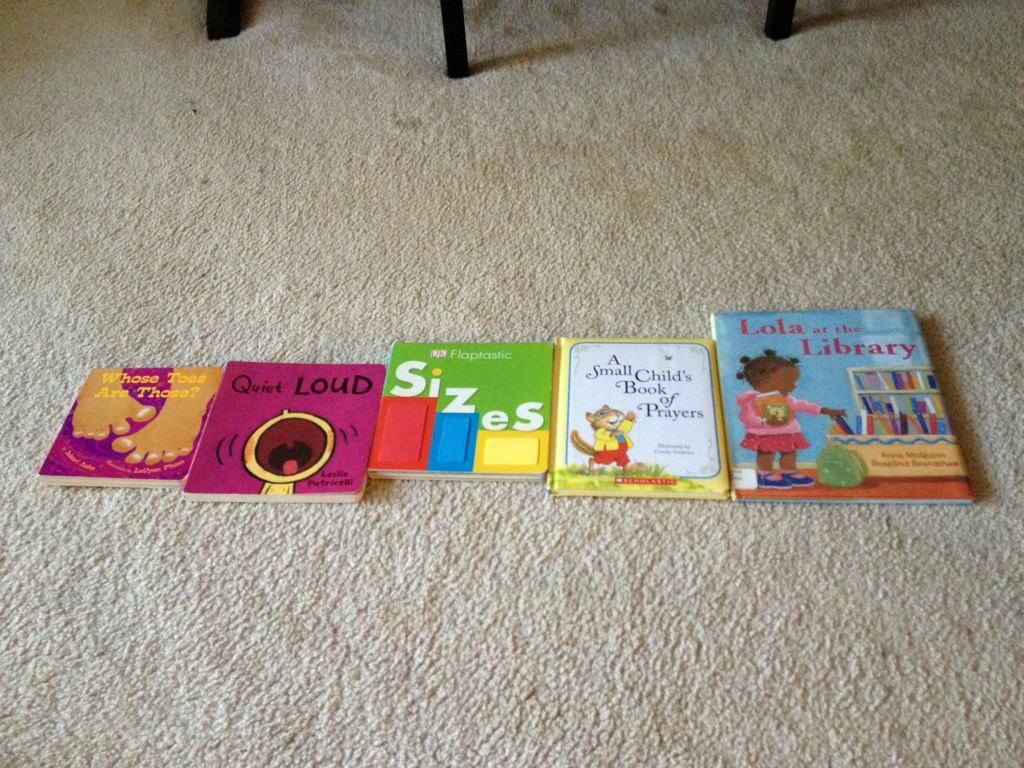
books lined up according to size, during independent play.
But speech, they break to us gently, is a symptom, not the core issue. They cannot determine, through this battery of tiny tests, how much of what we say is being understood. Perhaps she is isolating recognized words, but not grasping entire sentences. Perhaps she doesn’t answer or ask questions because she isn’t sure how to arrange what the words she knows. They tell us her play is too orderly; she is more interested in lining things in neat rows than in fashioning intricate worlds.
Were she hitting developmental milestones, in other words, she would not have just offered the bear a drink. She would’ve told us the color of the juice or charged him a million dollars for the privilege of dining in her castle.
It’s manageable, they assure us. The assessment, after all, was to determine how best to address her needs. They say that she is in a good place, at home during the day and surrounded by familiar faces who offer patience and love. They look warmly to her father’s face in my phone when they say this.
And she shows determination. Many of the children they visit run to other rooms when they won’t or can’t engage the women’s activities. Story stands her ground. She is brave.
I am late to the radio station. On air, I do not hear myself. The segment is about how single mothers “make it work.” But this is a topic on which I know too little, especially today.
Back at home, I hold Story close. We all do. I give my heart the rest of the day to adjust to the new light in which I’ve been advised to view my daughter. It is as bright as it’s ever been, as bright as the night she was born.
I crawled into you and set up camp. You were warm, steady as a strong-blooded pulse, and I was shivering. I came because I was sure I could survive. But you wanted me, remember? I did not invade; I was invited.
Soon enough, I learned you were a desert. Everything that grew easily had been gutted. You were no mirage; I touched you, beveled, pocked, and longing. Every space where you hurt hummed under my hands; I saw the blood. Sometimes, I walked away with a spot of it staining a dress. Old blood, crusted yet somehow fresh: oozing from regenerative wounds.
I saw enough — felt enough — when I leased this square inside you, already so overrun with other squatting things. I thought I understood. There were memories and guilts and sadnesses you must nurse and not evict. They are the true lay of your land. And though I did not set out to save you, I still cradled a garden in my palms: every seed I thought you’d need not to die. I still prayed that I’d grow the right balm to properly bandage your gashes.
It was easy to ignore how dry your tongue remained after giving you so many gourds of water. Your kind of thirst is difficult to quench; you wish for a well whose waters bend time. At my best and on the keenest-eyed of voyages, I will never scout you this. But we remained silent on the subject. It seemed enough that, even when your eyes were sallow, listing, they still lit when they locked on my face.
(Didn’t they?)
Sometimes I followed your gaze and saw them: a family, waiting, their laughter carrying across these empty arcs of dust and air. You would rather be with them. Our circle of seeds was inadequate.
You could see what I had yet to: the futility of tilling. But it brought you the briefest of hopes. You have always wanted a garden. Something must’ve appealed to you: the gentleness, perhaps, with which I lifted sand and primly patted it back, my cracking lips dropping promises: someday, we’ll dine. You could see it, once, couldn’t you? A feast of eggplant and lentils, of grapes so pregnant with juice that their skins pulled away from the stems?
I could be so strange, sometimes, so withholding. But I wrote you so many loving missives in the sand. (You read them? The winds will let you hold them?)
Yours is a house of sorrow but your porch was built of cedar. We sat there, somewhat happily, awaiting signs of life.
It has been months since winter. But yesterday was cold. The frost bit our first — our only — emerald tendril.
(Or did it?)
Deserts are impossible places for love, overrun as they are with so many duplicitous images.
But I know that the family is real. Some of them are waiting. I see them, even when it seems I don’t. They are waiting, but they are also watching. Do not rush to them; they want you alive. They need you to drink and revive, to grow green things again.
Tomorrow, I’ll be a guest on NPR’s nationally syndicated radio program, Tell Me More with Michel Martin. I’ve been invited to join author and family therapist Lori Gottlieb to discuss single motherhood for the show’s weekly Parenting broadcast.
Beyond nervous. Beyond excited. I’ll update when a link to the audio becomes available online. You can stream Tell Me More live at WAMU FM from 2 pm to 3 pm EST. Use the NPR station locator to find out where you can catch it on the radio in your area.
That whatever warming light he brings is sourced by more than wisps of filament. That the light will not burst when you’re brooding or silent. That he himself is light and will not darken, upon exposing you. That he will see your shadows, welcome them, find in the silhouettes something singular, invaluable. That you are your genuine selves. That he will wait. That you will. That patience isn’t foreign to you. That whatever needs to heal in him, in you, will mend in its time. That you will yield. That he will. That truth hums on his lips, long and low, a melody never quite too abrasive for ears. That this ache that comes in when he’s honest spurs honesty in you. That you will not lie to spare one another. That you will not become someone uncomfortable. That you will be spared. That the word “appease” has no translation here, in this subtle, dying dialect. That things will change. That he is right: it will not always be this way — whatever way this is. There will be more, not less. That this is not rehearsal. We are not curtained, cordoned. That this is more than a stage. That we have not roused a promising love, just to let it roar and starve and rot. That this distance is imagined. That indifference is imagined. That we’ll find each other walking, in the dark.
It’s been a crazy half-month. Last week, my blog entry, “How the 3/5ths Live” was featured on WordPress’s Freshly Pressed page, drawing more traffic and comments to this site over a four-day period than it’s seen in the five years it’s been around. If you’re a new blog subscriber via Freshly Pressed, welcome! I’m glad you’re here.
Fair warning: I’ll be moderating my comments rather closely from here on out. I appreciate and welcome all respectful and productive feedback. But I’m doggedly anti-troll.
After this site saw that sudden surge in activity, I was invited to write a piece on unmarried motherhood for The Atlantic. I know. Pretty amazing, yes? Still pinching myself over that. In addition to being a creative writer and adjunct English professor, I’m also the founder of Beyond Baby Mamas, an online support and advocacy community for single parents of color. If you know anyone who could benefit from joining our fledgling group, send them to our Facebook page, our Tumblr, our Twitter, and our website.
The Atlantic piece has now led to what’s going to happen tomorrow (March 27) morning: I’ll be joining a discussion on unmarried motherhood and why talking to unmarried mothers is a critical part of interrogating stats on single parenthood. The discussion takes place on The Takeaway, a co-production of WNYC Radio and Public Radio International, syndicated nationally. If you’d like to listen live, I’ll be on around 9:45 am. I’ll update this post with an embedded audio clip, should one become available.
If you came to this blog for lyrical, moving writing, fear not. The next post will be a return to form. Periodically, I do update readers on my writerly news, publications, and developments. But this is, first and foremost, a creative nonfiction (and fiction/poetry) blog. That it will remain.
Whether you keep record of the glorious or the grotesque, beware the lover whose first impression of you is forged through your work. The suitor who falls, head first, for your words — their beauty or strangeness; their raw, vein-opening properties; their subtle choreography across a page — will never truly know you. He may think you part-goddess, a sorcerer, a changeling, confusing your rare talent with an unattainable affection. For him, your heart is only to be apprehended in increments, a collection of short, amorphous fictions. For him, you are slightly more than mortal, a creature to be loved but held aloft.
He is not wrong. You do possess a particular power; all women do. But for the writer in love, words are an amulet of impregnable potency. Carefully composed, your words can bear him up. They can be lowered into pits, dropped like ladders from the sky. They can carry him elsewhere. But they can also be a murder, an acquittal, an asylum.
Maddeningly, what they meant months or weeks or mere hours ago may not be what they mean the next moment.
In this way, it is more possible for the woman-writer to destroy something essential in a suitor than it is for any other construct of woman in existence. It is right for the men we love to treat us gingerly.
If we are idealized, it is, at first, not entirely unwelcome. We intend, however quietly, to be adored. Here is our secret: we do not feel mortal, not always. When we are with the work, in solitude, we are transcendent. And when we emerge, we covet the worlds of our making, disappointed when we look up and find ourselves tethered to a reality we cannot so easily bend. No, we do not expect to die; our words, should they reach the eyes of future generations, will regenerate us.
Writers may be more reclusive — may appear more enigmatic — than actors, but we court a similar importance, perhaps especially in our romances. We may come to our lovers as casks filled with nothing save our insecurities, and expect that they empty us then refill us with affirmation. We may find ourselves unable to fully invest in their conversation or emotion, so preoccupied are we with capturing the moment for later freeing on an empty page. We may pummel them with a deluge of missives and demand that they respond in kind. And if our dealings with them begin to breach that most sacred of spaces — the space within which we create — we will grow to resent them.
It is unsurprising, then, that the layman who falls for a writer often feels he has gotten both more and far less that he’s bargained for.
But woe unto the woman-writer who becomes enamored of one of her own. They will be as two tempests in battle, each on quests to throw the brighter bolt of lightening. Whether hot or cold, they will gasp under the weight of all their words. The lava and the avalanche are equally likely to consume them.
None of this is to say that we should resolve ourselves to solitude. It is simply a reminder. We must never let our power corrupt our ability to care. We must remind ourselves that the bone and the breath, the warm inner skin of a palm, belong to a person and not to one of our paragraphs. If we are to love at all, we must understand our limits. Though our words may grant us second life, it is only this first in which we are able to truly live.
For you, the erstwhile Tender, a good bar serves mead and counsel to common men, and bawdy talk to strangers is but a prelude to battle, a toast to what may be one long, last ride. You, as if by unspoken vow, are a keeper of tallies, of wagers, of secrets, a steadfast sage often mistaken for a mere villager.
For you, Baltimore is but one of many kingdoms, its harbor a passage to freedom, to war. Yet your wanderlust has been waylaid and you’ve felt tethered, as if by some sorcerer’s edict, to home. Though a firstborn son, a namesake, an heir, you do not seem as interested in these familial vestments as you are in the many storied marvels that lay months away from your own hearth, as you are in worlds written into the endless reams of parchment you are able to consume in far less than a fortnight.
You are someone else; you are more, meant for a life beyond the hills of druids, beyond fair Canton’s shore. You’ve an earned nobility, if not a noble’s name, an unused valor, and purposes as yet unmined. You are most at peace among large, intimidating tomes that foretell unspeakable futures as well as untenable pasts. You are warm, even in winters of the soul, when the hearts of lesser men grow coldest. You deserve to slay dragons, to gaze on citadels of light, to stare into the eyes of sirens without succumbing.
Though I suspect I am able, I’ve no desire to turn you to stone.
When I met you, you were full of tales, of lives interrupted, of grounds both gained and lost, and you looked at me as though I were a great ship’s bow, a star pointed eastward, a vast sea itself. Would that I possessed the power to knight you. I would see you kneel this very night. I would hear your solemn oath.
But none knight men like you, save God and Self. You are your own, and everyone you serve is better for it.



 stacia l. brown