Patriarchy wrings young women dry. It tells girls who were raised in households where men were not present that their mother’s ability to thrive in a man’s absence was not a testament to her strength but evidence of his rejection. When a mother internalizes this, her daughters are raised under a specter of spurning. Every action and word they witness is instructive: this is how to act when you are a woman and mother on your own: decisive, assertive, impatient, frustrated and curt, entirely confident and selectively cooperative. This is how to own yourself: be unapologetic; accept that it may mean remaining alone.
But a daughter raised this way may not immediately ascertain the appeal. She may be lured instead by the promise of men’s presence, by the challenge attendant to compelling them to stay. And she may act in all ways opposite her mother’s example to curry their favor.Learn to cook, she might note, not what you love but what he will eat. Learn to let a last male word — even (and perhaps especially) a foolish one — linger in the air. If it is foul, pretend not to notice its stench. Allow him its echo. The last word is a preservation of dignity. Women who shout down humiliate.
(But what of our dignity? What of our own humiliation?)
* * *
I was ten when the only man who ever lived with us moved in. He told me, early and often — whenever I wanted to be heard, whenever I seemed to be more than an ornamental fixture of a marriage he barely wanted — that I was disrespectful or ungrateful for his guidance, provision, and presence. If I said: you are wrong; if I said: I’ve not done what you’re accusing me of; if I said: I am not who you’ve convinced yourself I am, he would take these words to my mother. If I brought the words to my mother first, he accused us of conspiring against him: peasants attempting to overthrow a king.
In marriage, my mother was bossed, her husband a man not given to ceding the final say. Over time, she learned to be meek. If peacekeeping meant to defer — or, as our churches taught wives, to submit — she would. But she had to contort herself to do so, had to twist like wet laundry to be left out in the wind and pretend that being limply pinned, absorbing her husband’s hot air, was a welcome aspiration.And sometimes when we were alone, in the quiet of a house for which he paid, she would tell me to throw the fight. Accept the charge. Nod at the accusation. You know who you are. It does not matter what he calls you. It’s his house. Let him win.
Bossy. Boss. Bossed. None held much appeal. None were winnable.
I was not raised in the manner of girls whose anthems and aspirations instruct them to run things. I would not know where to begin, if I were told I should govern myself as though the world were a corporation and I, its CEO.
I was raised to know who I am but to keep quiet about it.
* * *
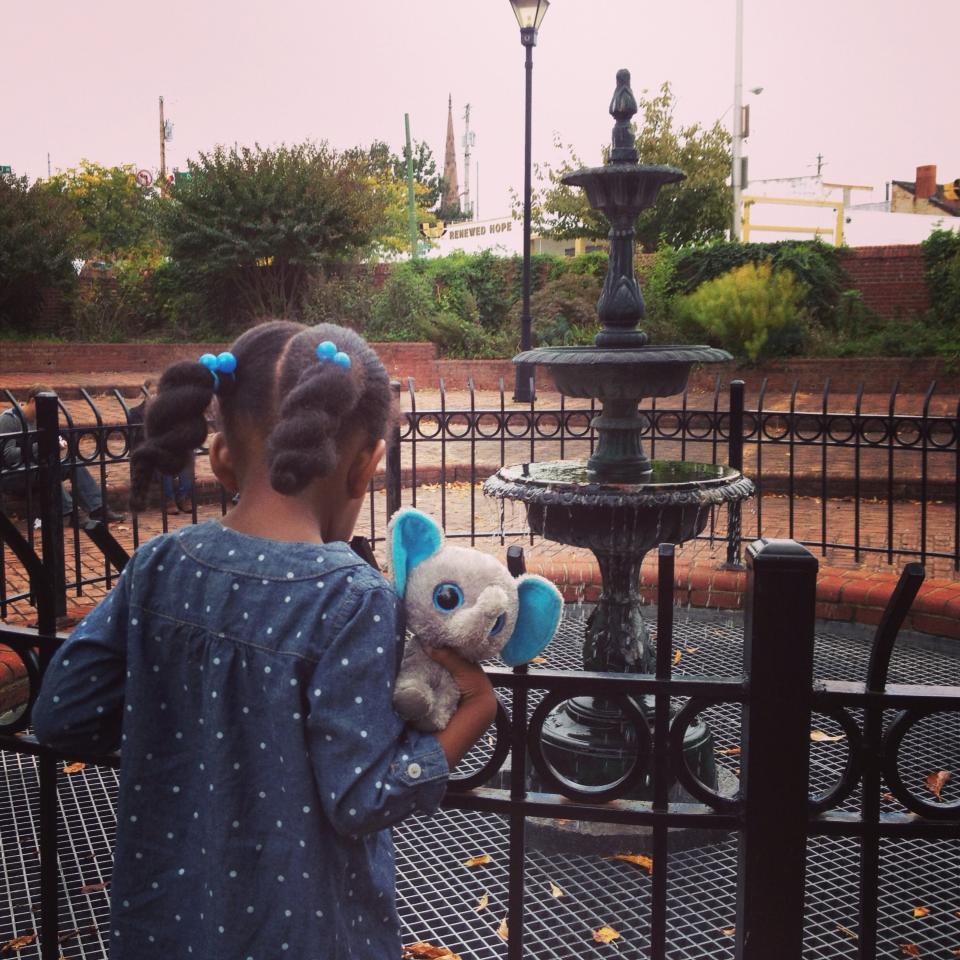
My daughter is months away from four. Every day for the past two years, I have watched her struggle to coax words up from her consciousness — where they seem to be quite clear to her — and out through her mouth, where they often sound garbled to the naked ear. Sometimes, she wails in frustration. Sometimes, she barrels through, happily chattering as though she is fully understood. And sometimes her expression clouds because she knows, looking into the face of the listener, that she is not.
I would never have learned the importance of raising my voice if I had not watched her wrestle so with hers. Her language is swimming upstream, but she calls out over the current. I will be heard, is what I always hear, whether I understand the words or not.
And I would not have understood being assertive if it had not become so essential to advocate for her. Regularly, I weave in and out of meetings, in and out of conversations, where her development, her hearing, and her cognition are assessed and questioned. It becomes ever clearer that managing someone who cannot manage herself requires an absence of ego, an open ear, a willingness to give oneself over to the study of what best serves her needs and her interests. This kind of leadership hinges not on being acknowledged as a boss but as a confidante, not as a superior intellect but as a constant student. We do not become assertive by telling others what to do; we do it by informing them of what we will and will not abide.I am an opter out of many discussions. Whether to embrace or repudiate the term “bossy” is one of them. But I know well the damage that is done when young women and girls are not taught to speak on their own behalf. I know what fighting to own oneself looks like and how terrifying it is to watch a woman go slack under the guise of submission. I have contorted myself for men who’ve seen no need to do the same. And I’ve worked for and with difficult, yet enviably self-possessed, folks of many genders.
It is always the better lot to own yourself, to carry your voice across the current, to insist that you should and will be heard. And it is often the better lot to be gentle — not only with others, but also with yourself. Label this however you will; it is an ideal way to live.
Let every man and woman who wants power pursue it, but not at your expense. Power isn’t the ability to make others bend to your will; it is possessing sole guardianship of your will. If you would be “bossy” about anything, let it be about how you will be addressed and defined. Let it be about who cannot enter your space with the intent to tamp you down. Let it be in the stead of those who have gone limp or shrugged off their wills and thrown them at the feet of someone they love. Let it be for those who have been treated as though they are incapable of governing themselves at all.
Some of us are best off calling ourselves unbossed. Like Congresswoman Shirley Chisholm, we want history to remember us, not for the professional goals we accomplished or for ascending through ranks often dominated by men, but for the larger feat of holding onto ourselves in the process.
This is a story of an elegance carefully cultivated. This is no sudden ascendancy to delicate silks and bold brocades, no tale of a girl plucked from obscurity or hardship, conferred the brass ring of Tinseltown by princely powers-that-be. It is, instead, a story of privilege, of justice. It is what happens when a Kenyan senator entrusts his daughter’s post-secondary education to The Yale School of Drama, rather than insisting she study medicine or law or finance. And these — the highest accolades in the field — are what’s expected when such a daughter is daring enough to pursue a life in pictures, within a family of professors, physicians, and politicians.
This is not a reality as well known to American black girls with silver screen ambitions. We watch our stateside actresses languish in Hollywood for decades, delivering pounds of flesh just for bit parts: girlfriends in black films and girlfriends in white films and staid, put-upon wives in comedies, action films, biopics. And yes, even now, the occasional brave domestic, even now, the harrowingly tortured slave. We see them shed their apple-cheeked innocence all too quickly, becoming more vocal and more cynical about the dearth of complex and meaty work for them to do as they age.
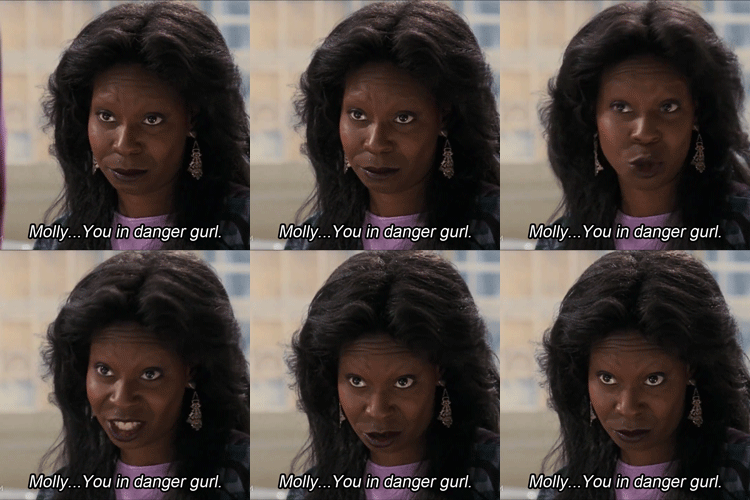
Our ingenues rarely win Oscars. It is our seasoned comediennes, sassing their way through lines like, “Molly, you in danger, girl!” or throwing frying pans at their pregnant daughters, who take home the gold. It is the reality star who belts a gut-wrenching beggarly torch song to a man already walking away or the naked grieving mother sexing the guard who executed her husband, the round, battered, quick-witted maid who bakes her own excrement into pies. They are the ones who win. And we are proud of their achievements. We take everything we get, and we are glad for, if critical of, it.
We know how hard those actresses had to work to get it, know how many low-budget straight-to-DVD flicks they made to keep themselves visible, how many blond wigs and gold teeth and fishnets they had to don and exactly how much of their bodies they had to bare — just for the opportunity to be seen. We suffered through Whoopi encouraging her ex to appear in blackface. We accept not just the existence, but the five-year run of The Parkers. And we swallow the painful realization that though many a role easily procured by a Paltrow, a Portman, or a Witherspoon could be played, if not better, certainly just as well, by an actress of color, the film would not likely be attended by as large an audience.
Because this our sisters’ lot in all of the American workforce. We are offered little, we earn less, we hustle harder and stress more — all in response to the idea that our appearance and ideas and work are not as marketable as a white colleague’s would be. Why should Hollywood be different?
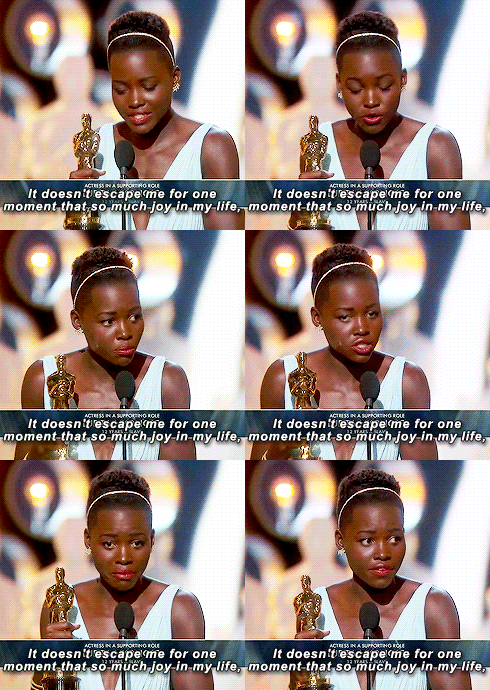
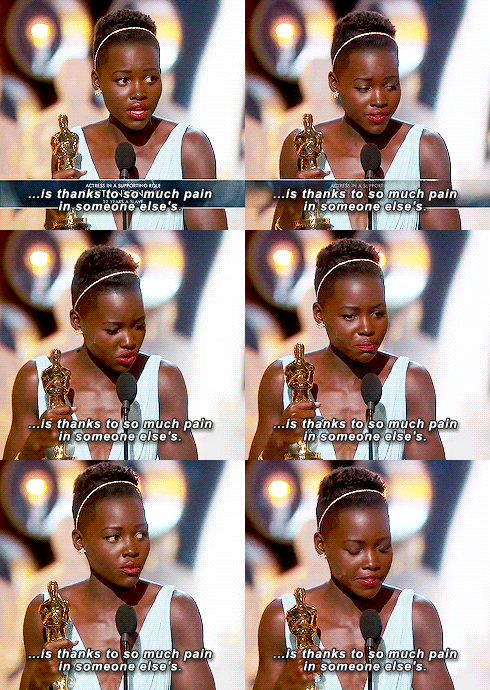
We are gathering our awe and placing it like so much frankincense and myrrh at the feet of Lupita in direct response to this resignation. This awards season she has become the boilerplate of every blackgirl dream deferred, and it is understandable. Her skin, a brown so rich and deep it seems to welcome the seeding of our hopes and the promise of harvest, is politicized (and romanticized) because such things are inevitable in any country where skin color can ignite or exempt citizens of resentment or responsibility. Nyong’o herself speaks to the significance of women who look like her ascending in high-visibility markets. She cites Alek Wek and any number of American black actresses as her own self-image inspirations. And she is similarly self-aware of what it means to be a literal projection of an audience’s desires, history, and needs.
But the story of Nyong’o’s near-instant entree to the A-list is uniquely her own. She stars in an elegant, brutal British film about American slavery, deeply connecting with part of the diasporic experience that is foreign to her family in ways it is not to the American black’s. And she graciously accepts a well-deserved Oscar for that portrayal without having to carry the full weight of the awards’ contentious racial history.
If she hears any naysaying speculation, any claims that she “only” got the Oscar for playing a slave or that the win isn’t one the black community can fully claim because she “isn’t ‘black’ enough,” the criticism will not dampen the moment, will not force her to interrogate her joy to the degree that it would for an American black actress.
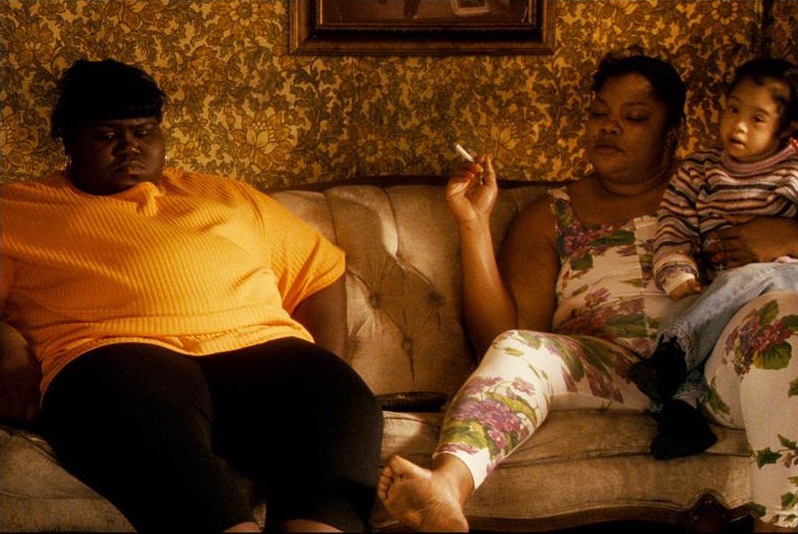
She is not saddled with centuries of diminishing returns. Accordingly, Lupita is a carefree black girl par excellence — and we have yet to see what the career of a black actress this successful with just one feature-length role under her belt, and this comparatively unburdened by Hollywood’s racist legacy, looks like. (Consider other recent black American actress nominees with one role their belts — Quevenzhane Wallis and Gabourey Sidibe — and how their reception in Hollywood and media compares to Lupita Nyong’o’s. Neither swanned through her awards season unscathed by racist, appearance-policing coverage — and Sidibe is still the subject of think pieces that actually use their headlines to implore that the public treat her with more respect.)
It is this lack of similar encumbrance — perhaps above all else — that excites me so about Nyong’o. We have yet to see what happens when a privileged black woman begins her acting career with Ivy League theatre pedigree, unchallenged fashion icon status, and an Oscar for her very first role.
It would be easiest to succumb to the skepticism I’ve been keeping at bay. I know America; it’s my homeland. It is not Nyong’o’s. I’d imagine — and I could well be wrong — that she is coming into Hollywood with the un-self-conscious approach to race that Chimamanda Ngozi Adichie’s Americanah heroine Ifemelu (and indeed, Adichie herself) have brought with them to this country. Adichie was famously quoted last year as saying that American blackness did not initially occur to or appeal to her:
In Nigeria I didn’t think of myself as black. I didn’t need to. And I still don’t when I’m in Nigeria. Race doesn’t occur to me. Many other things occur to me. But in the United States, yes…. Also, race is something that one has to learn. I had to learn what it meant to be black…. If you’re coming from Nigeria, you have no idea what’s going on. When I came to the United States, I hadn’t stayed very long, but I already knew that to be “black” was not a good thing in America, and so I didn’t want to be “black.”
While I don’t get the impression that Nyong’o, having spent the last two years of her life immersing herself in study and portrayal of the American slave experience, would hold the same perception of American blackness as Adichie initially did, it is safe to say she can still hold herself aloft from it. For her, blackness, in a context of white American oppression, is a role. It is not intrinsic to her identity. She will play plenty of other roles, but she will not feel “relegated” to stereotypical portrayals in quite the way that American black actresses do.
I already know what Hollywood will try to make her. I know the gradations of blackness they will implore her to learn. But I do not know how she will resist. I do not know what she herself will teach. But she is entering the field with just enough privilege and confidence to inspire my hope that she will do just that: instruct rather than simply accept — and learn from black actresses (rather than white directors) how best to navigate this space.
Today marks the beginning of the third month of the year, and I must admit I’m feeling a bit untethered. After years of cultivating a very specific voice for this blog, I’m having a harder time conjuring it these days — and I’ve been allowing that to stop me from updating as much as I’d like. Aside from my last piece, which was the most viewed post in the history of this blog and which was picked up at the American Prospect, I’ve only updated one other time this year.
Freelance writing also seems to be slower at this point in 2014 than it was by this time last year.
Even so, here’s what I’ve published since 2014:
A piece on a Melissa Harris-Perry Show faux-scandal that already seems like it happened a lifetime ago.
Something about how white the Golden Globes are and how infuriating that was this year.
Musings on a mall shooting in Columbia, Maryland at the mall where I most often take my daughter.
And this piece, written in the wake of Philip Seymour Hoffman’s death, which I wound up really being proud of, even though I had one of the details wrong.
I also wrote this about mothering and teaching mothers in a college setting.
I’ve read two novels, too. Roxane Gay’s An Untamed State, not to be released until May of this year, and Gina Frangello’s A Life in Men. Here are my impressions/reviews of them on Goodreads. And did y’all know I also have a Tumblr, where I occasionally do some creative microblogging?
Here are a few pieces I’m only highlighting here because they’d be hard to find there, between my copious reblogs of Chiwetel Ejiofor photos:
Because 2013 was an amazing, prolific, incomparable year, I’ve been putting a good deal of pressure on myself to keep pace or outperform. But as the first quarter of the year begins to draw to a close, I’m just going to keep steadily at work. If you’re like me — prone to anxiety and hard on yourself — I’d encourage you to join me and do the same.
I was hoping for something immediate; we’d put them in and every word she uttered would be comprehensible because she could hear the highs, the lows, the hisses of them, could distinguish the curling in of the lips around M’s and the baring of teeth for the N’s. And maybe the selfsame night, we would curve our bodies together like the twin-bed-sharing contortionists we so often become and have, for the very first time, an unconfused conversation.
You rush her along, her father insisted two nights before our audiology appointment. She’s only three. She’s a baby.
He is right; in my mind, I am rushing it all along — not just our daughter’s development, but ours, as parents, as co-parents, as individuals able to contentedly compromise. We still do not know how difficult all of this is for the other. Our feelings are passing ships. Afloat, alone, at the ends of our days, we are too busy nursing our private wounds to be beacons for one another.
The hearing aids are inconspicuous. The amplifiers, a deep indigo, tuck neatly behind her ears. The molds are translucent, two shades lighter than her skin; they curl around the cartilage and settle just inside the ear canals. Kim, the audiologist, urges us both to take turns pressing them in and demonstrates how to remove the batteries.
Both exercises take me two tries; her father does them by rote. Today, I am too ginger, a bit disengaged. Today, he is the one sitting with her in his lap, listening as though he lives with us.
This is his first trip to the audiologist’s office. It is my fourth. I am alone at the meetings with her hearing instructors, alone at her IEP meetings. He tells me, all the time, that I am not in fact alone; that he is also here: worrying, scheduling, purchasing, negotiating, budgeting.
But his here is too often metaphysical. He is here, but he resides across the country. He is here, but not in a way that allows me to remain asleep when our daughter wakes at 4 a.m. or to write when she needs a bath. He is here, but he cannot hear her when she asks for him, cannot discipline her when my patience is papery, brittle. He is here while ever urging me to uproot and move myself and our daughter there.
It is true that I rush. I am eager for that other shore, where this will be well resolved, but I do not wish to abandon my ship to reach it. Neither does he. These ships are tall, are sprawling. We’ve built them, for better or worse, apart. Our ships are all we have.
The batteries last just 7-10 days. Their strength can be determined in one of two ways:
1. Hold the hearing aid in the palm of a hand. Open, then close the fingers. Listen. If there is sound, not unlike a microphone’s feedback, the batteries are working.
2. Affix one end of an external tube to the part of the earmold that fits into her ear canal; hold the other end to my own ear. Say something. Listen. If I am louder, clearer, more distinct: the batteries are working.
She came home with the aids in her ears, and before long, my mother was teary. She had not taken discussions of buying them well, insisting that they were unnecessary, resolute about other speech and language methods we should try before conscripting her to what she felt was an ill and too-early fate. She just needs time, she would press. She just needs time.
But she was with me when the tests were run. We sat thigh to thigh while the baby was sedated, watched and waited in silence while the probes in her ears and on her forehead produced squiggles and ticks and graphs. We both heard the assessment, the recommendation: though this isn’t the type of hearing loss that will progress, it is also not the type that goes away.
This day was always coming. She just felt rushed along.
I, on the other hand, keep feeling like we’re lagging behind. Teachers have been asking for months when we would get these tiny devices. Her pediatrician has called me, questioning, pressing. Her deaf and hearing impaired instructors have called me in for meetings, have played sound files that simulate what noise sounds like in our ears compared to in hers. Everyone else with a stake in our girl has insisted: the sooner, the better.
When everyone wants to know when, it’s the mothers who are markers of time.
These decisions should ultimately be ours, her father says. Promise we’ll be the last word in making choices for our daughter. He is asking us to be noise-cancelers for each other.
We are, is what I tell him. But what’s truer is that, for now, these decisions are mine. I act as my own filter of what voices are welcomed in or canceled out. So often, I am hearing them alone. And explanations are expected, not of us, but of me. He is the disembodied voice, enforcing via phone; I am the one who walks in through the door. Here.
It has never made much sense to me why he is not. But I’ve grown quite adept at pretending, at nodding my head as though it’s all coming in clearly.
She can take them out with one fluid movement. Mama, she says, extending them both in the cease of her hand. Ears. Maybe she thinks they’re an extra set, ears for their own sake, lonely for a body to befriend. Maybe when she hands them to me she is saying: these friends are beginning to bore me.
The goal is to get her to wear them at all times except during baths, naps, and bedtime. For now, she is primarily wearing them to school and when we are alone at home. A weariness befalls the house when she wears them with my mother and grandmother here. They do not like to handle them; they sneak skeptical glances. And in the hidden space where I am squirreling away private anxieties, their unease makes me question myself in ways that I cannot let on.
We are all being tested like her batteries. Opening, closing ourselves: waiting for feedback. I have no problem listening, but it’s my voice that needs to be amplified. If I am louder, clearer, more distinct, my daughter will hear what she needs.
Before, I imagined immediacy: her face lighting up, clear sentences coursing through her lips in streams. But now that they’re finally here, I can’t really tell what difference the hearing aids are making in her experience of sound. She never resists them. From the very first day, she has welcomed them — at least for awhile — without any protest at all. Once or twice, with them in, I have heard her correcting her diction. It’s difficult not to make more of that than I should. I am impatient for witty repartee, for knock-knock jokes and endless questions, for clear, concise signals and measures that we’re truly communicating.
But this is a shifting that’s subtle. It cannot be rushed. Slowly, we are all being called to self-correct and all hoping, over time, that we will hear with more sensitive ears.
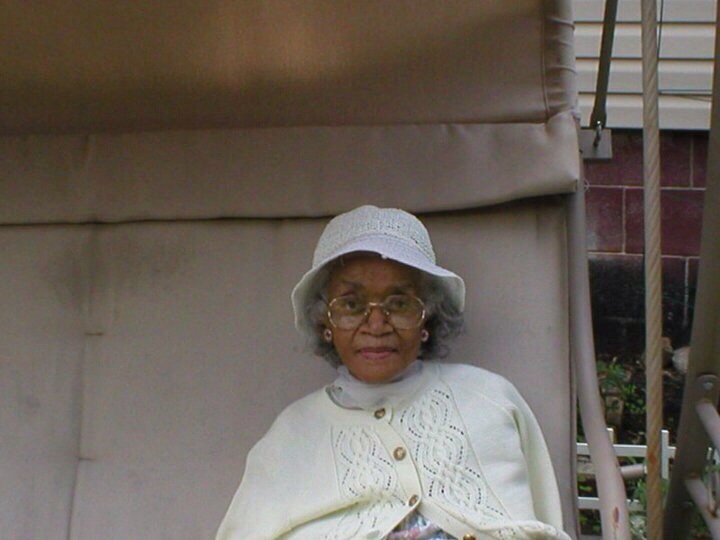
Verlia “Verlie” Brown in the last years of her life.
By the time Grandma Verlie turned 90, she was skin over softened bone. Thick raised veins routed through her hands like cables. The moles on her face, marking time with their slow, steady growth, were both reddish and brown. Her back held a seahorsish spine that has spent years curling, calcifying to carry 10 children’s burdens. By 90 she had heard too much, seen things that made younger people shudder, lost all manner of loves. She was girding herself to leave; living gets tiresome. At 20, I’d matured enough to pay some attention.
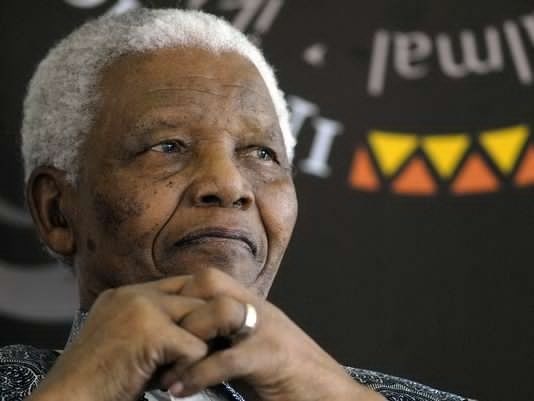
We would have her for five more years. Like Madiba, she would die at 95 and we would not quite know what to do with ourselves.
At cookouts, at Christmas, at other people’s funerals, my massive family would warn itself that she wouldn’t be with us forever. Hadn’t her husband, my great-grandfather, preceded her in death by a decade? And hadn’t the loss of him left a hungry, pulling hole where the heart of our family had been? He’d only lived to be 87. He was large and lumbering and we’d been losing him incrementally for years: four fingers to a machine in the Goodyear Tire factory that once employed him; countless hours in commutes to and from Jackson and Adrian as an itinerant minister; artery after artery as he ate meats and breads brushed with lard; hints here and there of a mild dementia.
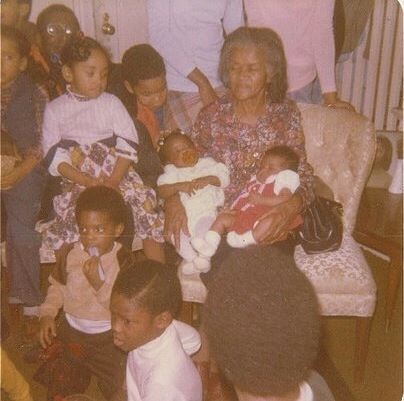
Grandpa (left, background) and Grandma in Dec. 1979
This was not so with his wife. We had no danger of losing Grandma Verlie residually. She was unquestionably present, especially after Grandpa’s passing, leaning in to better catch the details of a whispered conflict between mother and daughter, listening to our secrets so intently, so silently, we wondered if she heard them at all, and until she turned 90, cooking three full meals a day with such vigor and care you could taste the pains she’d taken to evenly coat the chicken, to fold the biscuit dough. You could taste every year of her life, years she had offered at who knew what cost, years we had all eaten up.
She died in the only home where I’d ever seen her live, the hospital bed set up in her room flanked on every side with family. I was not there, but I knew before we got the call.
Something shifts in the world when the very old depart it. It doesn’t seem to matter much who they were; it is their peculiar property of hardiness, their survival of the same histories that claimed their spouses, their siblings, friends, rivals and, in the most tragic cases, their children, that makes their passage into eternity remarkable.
I have to believe that a soul expands the longer it remains in the body. It does not change shape but gains density: trauma upon trauma, joy upon joy, sorrow upon sorrow. We souls begin weightless inside our infant shells — and then we live. The eldest souls among us live till they’re nearly leaden, so that when they unanchor from Earth, those nearest them can feel it.
1918-2013
We did not need to be close to Madiba to feel gravity recalibrate when he died, did not have to be his grandchildren or even his countrymen to feel disoriented in his absence. His was a soul that afforded us sure footing. Such was its steadiness. Upon exit, it extracted so much diplomacy, so broad a capacity to forgive, such willingness to be flawed and revered and opposed, that in the days following Madiba’s death we feel inklings of doubt with each step. Will the ground still bear us up? Is it still as safe a place to stand?
Grandma has been gone for nine years. Our secrets are in less secure hands now. We turn in toward our immediate families, each one its own enclave. We struggle to remember at which addresses our most distant relations can be reached. There is too little land left: no longer can we call a single house “the family home.” Too many of our children have never met.
This is the aftershock.
Our generation has not been raised to succeed this caliber of elder, whose scars traced back to eras long before the freedoms we’ve come not only to know but to abuse. We have not needed their mettle; our souls have not endured what made theirs so heavy. In the absence of their anchoring, we feel tremors.
Only great hubris would make anyone rush toward the hole Madiba has left in his homeland. Dare come too close to where his spirit uprooted itself and took wing; there will be nothing to do but fall. Best stand aloft and take the adjacent earth in your hand. Roll it between finger and thumb. You may find, as my own family often has, the tiny, viable seeds shaken free and left scattered behind.
1. Stop expecting. Fields of expectation yield harvests of heartache. 2. Curb your craving. This is fairly easy: for every pang in the hollow of the chest, tighten the cocoon you’ve made of a favored blanket; for every pinch at the lips where his kisses once lingered, taste a comfort food — or healthier: belt a loud, offkey song. 3. Stalk. (And this is a critical, oft-concealed step.) Find out how quickly he’s moving on and how. This will have no bearing on your own pace; it just satisfies a maddening curiosity. Make peace with the fact that she’s pretty (and witty and brilliant. He has good taste, after all; he chose you). Do not call; preserve the fourth wall. But allow yourself your petty voyeurism. It will pass when you’ve seen enough (but first — and perhaps longest, it will sting). 4. Remind yourself that rescinding this romance means an end of self-censoring, a recalibration of filters: let more in, let more out. You will not feel so accountable; you will feel much less beholden. 5. Fully realize the self rejection teaches you you can be: steely, unapologetic, affirming. Combative, if necessary. 6. Say aloud and often you are better off friends, not just because it’s true, but because there should be walls, low and easy to clear, but resolutely erected: piled, pebbled markers on an otherwise boundless affection; a redistricting of wide-open spaces you once claimed as your territory: Time, Enthusiasm, Mouth, Conversation. Accept that it is all shared domain. Accept that there are moments when he is not open to the public. Understand that you are now the public. Mercifully, this cuts both ways: you are also your own again. These days, you are greeting yourself in mirrors as you would a long-lost friend. 7. Resist blame, especially if you’re prone to blaming yourself. It doesn’t work this way. There is no sense in believing you’re broken. You will approach every new suitor with inordinate deference, with a palpable, discomfiting desire to be fixed. 8. Admire him and raise a glass. You don’t know how he does it. 9. If you ever see each other again, be mindful of how you hold yourself. Your every appendage speaks a language, but you are no longer on safe terrain for the utterance of old dialects. When you recall this, when you remember all the sentiments left unsaid, you may find that the need to touch him overwhelms. Dead languages are too beautiful not to be whispered. They were meant to be murmured in understanding ears, meant to be conveyed with a too-long embrace. If this is your case, wrap your arms around your breasts; press your fingers into your back. Become your own strait jacket. 10. You are not out of love at all; you are in the eye of it, watching it whip around, carting off heavy things, antiquities you once held dear. Your meager walls, your feeble resolve: collateral damage. But this is the clarion purview. Be your absolute stillest. Feel and look and listen. Soon it will crash in; it will carry you off. This love that once felt close as breath will fling you far way.
It doesn’t feel as permanent as it should. I still linger at the window; I am still expectant (though of what, I do not know. Relief? Permission?). I’ve barely shaken the sense that someone left her here, some unduly trusting soul, trying to teach me something. On occasion, I anticipate that this someone will reemerge to reclaim her. The prospect doesn’t sadden me. We have never been apart long enough for me to miss her; in her absence, I feel raw obligation to return. And I do. I rush.
It is unromantic.
When this someone comes, to determine if her trust has been ill-placed, an inspection will occur, making clear just how many of my duties I perform not with particular joy but by rote. I mother because I must, not because I am given to throes of euphoria while doing so. This, I suppose, is common. But there is something else, equally obvious: I had been waiting.
I am glad that someone has come.
* * *
You need to make her be quiet. The neighbors downstairs will hear her jumping and laughing at this hour, and they’ll call DHS. DHS loves to take black children.
* * *
It has been 40 months. No one has come. It is possible, now, that no one will.
I fill the hours with embraces and photographs, kitchen karaoke and dining room dance parties. Frequent I love you’s. So many kisses. The aphorisms hold: being present, relishing the moment, slowing, rather than marking time — it all helps. But inside, a second skin is twisting against rope. Tightly bound, it is burning.
* * *
They are going to tell you medicate her, if you can’t learn to make her keep still.
* * *
Motherhood is an overlay, sheer and clinging. It obfuscates appearance, makes pre-child passions opaque, but it does not alter what lies beneath. What I cherish about my daughter is what I would’ve cherished, had I never become her mother: her boldness; her mercurial heights and depths; the scent of her freshly bathed skin; my nose in her parted hair.
I am still me underneath.
But motherhood cannot be peeled away. It wraps around, becomes a top-lying dermis and, over time, we are meant to forget its artifice. At times, the urge to lift it away from the skin begins to pressurize. There is too little air; there are too few opportunities for new breath.
Here is the truth that helps, that slices through this whaleskin and lets in a slip of light: children are not so life-changing. They are like many other things and persons adults acquire and decide they cannot live well without. Their needs are not so different: tenderness and tending. They are complicated bliss. They are blessing and barnacle.
But they are not all we are.
* * *
Maybe you, and your missed days of prenatal vitamin intake, lie at the root of this behavior, this delay. Maybe you need to be reminded, during your every resting, writing moment, of what you need to do.
* * *
It is best to pretend that I do not need silence, that nothing essential is eroding inside me without it. I smile in pinched ways that I hope my child and others understand. I am here. I find this enjoyable. No, there is nothing behind my eyes that is stricken with panic and wanting to run. If you see this, you are imagining it.
The first two parts are not lies. I am here. I do find this enjoyable. But I am also acting. This is a Method performance: I am always in character, always awaiting the time when it will be apropos to step out.
There are reasons: my only-childhood and its resulting inexperience with children; my summer transience, three months of each year spent hundreds of miles apart from home; the far-reaching tentacles of too much free and isolated time. And I am also too accustomed to things ending, especially the things someone I love has insisted never would.
* * *
You need to learn to do more. This — working, bathing, clothing, preparing foods, feeding, reading, entertaining, coming straight home, rarely asking for non-work time to yourself — is not enough.
* * *
A lifetime spent holding a part of yourself in reserve does not resolve with the birth of a child. We mothers are still entitled to unknowable parts, if we want them. We protect them by snatching time. Demanding it. Allowing ourselves to love someone other than our children — with ardor, not apology. Reading books that are not written on boards or filled with crude drawings of talking cows. Letting something extracurricular lapse. Listening to ourselves — and making sure that what we are saying isn’t always about mothering. Everyone is talking to us about being a mother; the irony is: we only get great at it by holding onto what we loved about ourselves before becoming one.
Mothering isn’t selfless. Quite the opposite.
* * *
I did everything myself, so no one had the right to criticize my parenting.
* * *
If you are an introvert, you will be reluctant to go out and away; you are happiest at home. But what you need now is counter-intuitive. Instinct says to envelop the child, make her as essential to your happiness as being alone has always been. This is a flawed approach. If you must be incrementally alone to feel whole, then you must find ways to be alone.
It does not matter if you will be harshly criticized; that is all the more reason to leave. Aloneness allows you to quiet even the cruelest critics. In silence, you must take hold of yourself, unbind the ropes and tend to the burning skin, the ancient skin, that which was with you before you were born. You cannot let it fester; it will bleed into your mothering. Something will always be pulling apart.
Mother, you must protect yourself. It was you that you watched for at the window. You are the only Cavalry coming.
My friend, Aulelei, sent this screenshot after watching live yesterday. Thanks to everyone who took snapshots and DVR’d. I was more touched and humbled by this than I can adequately express.
There are few greater feelings in all the world than being certain that someone is happy for you. Because I know well what that feels like, I try to impart that feeling to others as often as I can. Fortunately for me, I know a lot of people who are near-constantly celebrating something wonderful: a publication, a new gig, a marriage. And in expressing unabashed joy for them, I feel joy myself. Ann Friedman and Aminatou Sow call this ShineTheory, and it’s awesome.
To be real, though — and I talk to my friend Joshunda about this fairly often — sometimes being happy for others is concurrent with working through more complicated feels. She and I don’t pretend we don’t experience twinges, pangs, and on occasion, even full tides of jealousy.
Sometimes, you’ll see someone’s sudden great news in a social media feed and something plummets. It’s a hasty, involuntary reaction and, if you’re not careful, it can take root, bearing shriveled, bitter fruit.
Everyone handles jealousy differently. I’ve gotten fairly practiced at it (Like I said: I know some amazing people). I’ve a formula that’s become almost fail-proof: suppress, interrogate, eradicate. That’s another post for another day.
I’ve taken this long digression to say: you can’t fully enjoy a success if you haven’t developed healthy responses to other people’s success. If you haven’t done that work, your every achievement is comparative. You’re stuck in a miserable loop of: This is good, but it’s not as good as X’s. I’m thrilled but it would be even better if it was more like Y’s. I feel like I’m getting somewhere but not as quickly as Z.
This is me being as real as I can. It doesn’t make sense to pretend that I don’t wish for experiences similar to the ones that people I love and admire have had. It doesn’t do any good to be a writer of autobiographical content and edit out the baser, uglier parts of myself.
Ultimately, what’s important — at the moment of a friend’s highest achievement or deepest bliss — is that she understands your happiness for her, not your internal conflict. That’s something for you to work through privately and, while you do, your friend shouldn’t have to wait for you to feel ready to celebrate.
I don’t know if this is common or if it’s just me. I’ve talked to people who insist that they’re always happy for others in uncomplicated ways; that they never want what anyone else has; that they have mastery over envy or covetousness; that what God has for them, it is for them (and they’re cool with not getting anything they’ve wanted — and equally cool with watching someone else attain and enjoy that thing — because they’re secure in that affirmation). Let me tell you: I find that to be amazing. I am jealous of that.
Yesterday, I had a big moment. I’ve had a lot of big moments this year. I’m learning a lot about those, too, and about how fleeting they are. I’m learning that it’s important to absorb the success on the day of, because in the days that follow, the world moves quickly on. You will either have other big moments or you won’t; but once one has passed, it’s beyond others’ memory. You cannot pitch a tent there. The caravan has carried on.
This makes the celebration all the more significant. The people who decide to join it — and it’s very much a decision — are to be cherished. You do not know what, if anything, they’ve had to work through to be so present and happy for you.
As someone who routinely downplays big moments, so as not to feel like I’m “bragging,” it means a lot to be lauded without reservation. We all need that, but we’re told we should behave as though we don’t.
I’m rambling. The point is: I really felt loved yesterday. I feel loved every day. But yesterday, when I found out I’d be making a television appearance for the first time, and I tweeted about it and posted a status on Facebook, I felt especially loved. Announcing good news has always seemed like a calculated risk for me. You hope it will be received in the non-braggadocious way you intended. But it may not be. You hope it’ll be greeted with the same confetti-swirling, pom-pom-shaking ebullience you try to give to others. But there are no guarantees.
Yesterday’s risk paid off. You were all awesome. There was no tension, no complaint, no side-eyes, no backhanded compliments, no measured or grudging kudos. Everyone I love and everyone I celebrate loved and celebrated me — and that’s exponentially more exciting than being on TV.
That was my day. Today or tomorrow will be yours. And trust: I’ll be losing my voice in the stadium, cheering for you.
If you missed News Nation with Tamron Hall and want to watch the segment on which I appeared, it’s here. If you want to read the essay that got me on air, it’s here. If you need to know more about Avonte Oquendo’s disappearance, read Amy Davidson’s piece in The New Yorker. And if you want to know how you can support the parents of children with autism, visit Autism Speaks.
She is constantly telling me things, feeding a long invisible thread between us with beads of context completely lost, despite the fact that I am holding tight to the other end. It has begun to matter, the heaviness of the line, the ornate string of incomprehensible chatter. She looks with a narrower eye now, an intensity that’s coming with age: listen closer, this is important, decode it.
She is right; her lexicon is broadening. The words come out unclear, but she resolutely knows them. I should know them, too.
We are reading a board book version of Anna Karenina lately. Each time we visit it, she can identify more of what the writer asks: Where is the cloak? Can you also find the clasp? Where is the uniform? Can you also find the feather? Where is the parasol?
Feather, she’ll say in her gauzy way, like the words have all been thickly wrapped and bandaged. I am learning, too, to unravel packages of pronunciation, to preserve the sounds. Each new word is a figurine, a gift, set on a glass shelf of memory. She will say it again someday soon, and I will lift it out. I’ll admire, if not quite understand, what she means.
This is the girl at three, at school. It’s sudden, the shift in both temperament and awareness, like a lever pulled. Something inside her has opened. Something has opened inside us all. It is jarring, too, like the day after a parent marries and your house, once so still and known, fills with loud and foreign faces purporting themselves as family.
When she comes home, her classmates’ phantom muddied footprints tromp in with her. Those blank, timid, scowling, or curious faces I glimpse only at gymnasium drop-offs and pick-ups never seem far from her mind. She has tracked in a little world, wholly unknown to me: tempestuous, vibrant, sickly, and boisterous. I do not know which, if any classmate, she prefers, do not know what they do together on any given day. It’s her secret. (But is it witting or the work of all the words being held hostage?)
Two months into the school year, I am still matching quiet eyes and scruffy hair and backpacks to names on a parent-child dismissal sheet, still relying entirely on circled emoticons in a daily progress notebook to find out about how she felt about her day. The limits of language can make private investigators of us all.
This is what I tell the women ’round the conference room table, pens poised over clipboards, eyes and ears expectant. Her teacher is here, her speech therapist, and others whose titles I’ve already forgotten. They agree that they’ve seen great progress, that she is making more decipherable statements, that she learns well through rhythm and song.
“There’s one in particular she loves,” her teacher beams. “Whenever we sing it, her face just lights up.”
I nod knowingly. “I have a funny story about that.”
They lean forward in anticipation.
But the anecdote won’t contain what the moment held. I tell it anyway.
A few weeks into preschool, my daughter began singing a song — one it was clear she’d memorized, the first ever that I couldn’t decipher at all. It was the kind of thing for which I couldn’t have prepared. Music is our Morse code, our clarity, a call for which we always have an understood response.
I was surprised by my own helplessness, by how crestfallen we both were. She was already learning something I couldn’t quickly come to know.
“Yum, yum! Pee yew!” she’d chirp brightly over breakfast, from the backseat, in the bathtub. She’d rub her tummy or hold her nose; she’d wave her arms.
I felt so thoroughly locked out, shrugging in apology: “I don’t know it,” and she’d frown or stomp and a chasm would widen between us.
Here is the thing about toddler language-impairment; it opens an eyelet into which parents can peer at the long stretch of adolescence, where all roads converge at the epicenter of I don’t know.
“So I Googled it,” I tell the women at the table. “And I found the lyrics and a YouTube video. I’ve learned it, and we sing it all the time.”
The women are pleased. I have given them a succinct and satisfying ending. They lean back and laugh. One says she’s familiar with the tune herself and will have to seek it out. My daughter’s teacher invites her to drop in on her class.
What they do not hear — what I do not tell them — is that the moment I saw her face light up when I played the song and immediately began to learn it is one of my most triumphal experiences as a mother.
I do not tell them this was the moment I learned that the needs mothers meet are rarely as basic as they seem and how rare it is to feel like I’ve completely succeeded at meeting one. I do not tell her how motherhood occasionally feels, even on its easier days, like something else to survive.
It doesn’t matter. They don’t need to know it. And the truth is: I am pleased, too. How often are we forced to pay such close attention? How many of us can say we have learned, on some minuscule scale, to read a mind?
What they do not tell you is that the air at the top is all but unbreathable; this is why, when you get there, you are most likely alone. Neither intimidated by the height nor so awed by the view that you believe yourself unworthy of it, you are a coil of stamina, your body, with its raised and rounded scars, a rosary of wounds. Sometimes, you can feel the fingers of God grazing each one like a sanguine bead. He knows what still hurts. Faith is the height of reason here; there is no one left to contest you. At the top, where even breath is begrudging, it is clear how little mankind controls.
You understand that you are not just blessed but also someone who will always be earning her air. This is your rightful place; soon you’ll stop apologizing for it. Success is not what sets you a-tremble. Planting the conquering flag does not frighten you. No, you are apprehensive of the attention its waving will attract.
Leaving your writing in the crevices of caves, in the craters of wailing walls, is one thing. It is simple to be entirely honest with only the ether as audience. On the side of a mountain there is anonymity; to remain unknown is to be left to oneself. This is tempting, but it does not gratify.
Still, what will you do about these new encampments, these people who are looking up from the bases of boulders and watching to see how conquerors comport themselves? What of the voyeurs and the vultures? Now, someone will always be circling.
Accept the evidence that you’d always prepared yourself to be here today. You pined for it, placing so many pieces of yourself in corners and creeks so that someday, enough of them were bound to be found. Piece together the leafs and there is the book you have always been destined to write, collect the watery daguerrotypes embedded in ditches and there is your photonarrative. There was enough of you here for a retrospective, even if the climb killed you, there may have been some posthumous acclaim.
You pretended to others it wouldn’t matter; climbing is its own recompense, the work its own reward. But this was a mere insulation. You’ve always wanted to be known. Recognition holds the same rush as rappelling and readership is the same as a rope: you cannot reach the top without it.
Your fear is to be poorly received, to become known not for the beautiful boom of your voice from the top of a great height, but for the tinny emptiness it may echo when it reaches the ground.
In the past, you have protected yourself from chilly reception by behaving as though you shouldn’t be where you are at all, that your presence at one pinnacle or the next is all but miraculous, that talent is a mere sleight of hand.
You understand, now that you can see the true distance of a descent, how unwise it is to pretend your own unworthiness for so long. You will convince yourself of it, and even now, from time to time, you are still beguiled by the idea of flinging yourself down.
From this height, you can see other far off climbers, standing atop higher peaks, dancing, so deep-breathed and darling, their beckoning calls a kind of dare to those still below.
There is room for us all, they are calling. But we never really know if this is true. We do not know who will tug at our harnesses and tethers, endangering us to leverage themselves. We remain unsure who comes not to build but to topple. It can make you uneasy, being watched and clambered toward, a bastion to expectation. You do not have your own advice to offer down the mountain — not really — but you give some anyway, as often as you’re asked, and you hope it works. You hope you work. With every rising sun, you tamp down your deprecation and reacclimate yourself to this air.

 I am an opter out of many discussions. Whether to embrace or repudiate the term “bossy” is one of them. But I know well the damage that is done when young women and girls are not taught to speak on their own behalf. I know what fighting to own oneself looks like and how terrifying it is to watch a woman go slack under the guise of submission. I have contorted myself for men who’ve seen no need to do the same. And I’ve worked for and with difficult, yet enviably self-possessed, folks of many genders.



 stacia l. brown

-large-picture.jpg)