Motes and Beams.

And why beholdest thou the mote that is in thy brother’s eye, but considerest not the beam that is in thine own eye? — Matthew 7:3

Last night, a woman cradled her abdomen and revealed the life growing there, as vibrant and as certain as the crimson of her Lanvin gown. You are too young to know her, but she is an icon for my generation, in much the same way that the triumvirate of divas–Aretha, Diana, and Tina*–are for your grandmother’s. Her husband is similarly eminent and, as they took to yet another of what, for them, must be an endless strait of red carpets, the radiant woman basked in the rarefied air that only exists under an arc of flashbulbs.

It was a seminal moment, not at all spontaneous but with just the right amount of coyness, delight, and pride. Responses were immediate–and as polar as they were predictable. Opinions were divided along moral lines. The couple was applauded for being married before deciding to procreate: “They did it the way God intended.” and “They did it the ‘right way.'” Many offered up their hope that this would “start a trend” in the black community, of valuing marriage (as though the reason black women and men remain unwed is because they thumb their nose at nuptials). By extension, unmarried mothers were inundated with presumptuous gloating: “This is what you should’ve done.” and “Never have a child with a man who doesn’t even offer to marry you.” and “You’ll never have this moment.”

But even the couple, so lauded for their pristine ordering of life events, did not escape the critical gaze of their public. They were blasted for releasing their news in as public a way as possible; some detractors went as far as suggesting the news was meant to boost their respective album sales. Others still wanted it known that they would not be engaging in any excited, celebratory antics “over a couple they didn’t know” and wondered aloud if they were the only ones who “didn’t care” about this announcement.

Darling, there is something I should tell you.

Every decision carries with it a value judgment; every action is first magnified then dissected. This is true of the famed and the civilian, of the leader as well as the follower. There is always someone watching, always someone desperate to compare, and to come away from that comparison looking superior. As much as I will teach you that the language of “better than” is dangerous, this language is unavoidable.

There is no sense in defending yourself against people who are certain they are better than you are. That is the worst kind of futility; it not only leaves you spent, but also unnerved and inadequate. But it is no better to seek solace in your own “better” circumstances. This renders you dispassionate and smug in ways that never fail to mortify you during life’s inevitable reversals of fortune. These are slopes that descend into hells; it would behoove you not to slide down them.

I spent much of your first year of life, and the nine months before your birth building an immunity to Better Than. I am still susceptible to the lesser of its side effects, but there are some nerves I have protected from its paralysis. There are some criticisms that I will just not allow to bring me low.

I am a third generation single mother. In high school, I was lauded for escaping teen pregnancy. In college, the voices grew louder, the compliments more flowery. By grad school, I’d “escaped a generational curse” and “broken a cycle.” I was half of an “upstanding couple”–a fine Christian man and a wholesome, Proverbs 31 woman; it was only a matter of time before we married, before someone suggested that we become youth leaders, before we were asked to educate others on purity. I didn’t protest; that wouldn’t have done much good. There was no baby then, to confirm what we weren’t. But I didn’t chime in, singing solo in a chorus of my own praises, either. I knew who your father and I were to each other, and it wasn’t husband and wife. And there were few days we would’ve described ourselves as “wholesome.”

You will find that people love their narratives. They need for your life to have meaning; it must provide them a teachable moment, whether cautionary or aspirational.

But you will never be who they think you are. The more you allow their expectations to dictate to you what you should be, the more unfamiliar you’ll become with your own reflection in a mirror. You must know, even as a grade school girl—and perhaps particularly then, as children can be cruel—that you are not pitiable because your parents are not married. You shouldn’t feel excess pressure to excel because “the odds are against you,” nor does my marital status require you to defend me or yourself against the assumptions of your peers. But it also does not give you license to exalt yourself over other children whose circumstances are different than your own. You will find soon enough that all homes, whether married or single-parent, are not created equal. There is no greater example of this than this red carpet couple whose little one will be swaddled in cashmere receiving blankets, with diamond pins fastening its handwoven diapers.

We are ourselves. That is all that we are, and that is enough.

There will be days—like this one—where I will feel like I am everything others assume I am: jilted, irresponsible, and unworthy of a man’s unerring commitment. And then I will remember that I am the woman who writes to you. I am wise and intuitive; artful and accomplished; nurturing and nourishing; strong enough to tear apart and reassemble myself for you; and beautiful in ways the naked eye cannot observe—particularly if its gaze is obstructed with beams.

Make Haste.

I am often afraid, though Your word says, “Fear not.” I have been told that my fear offends You, that my anxiety is a rebellion You cannot abide. I am told that I am not to rely on this brain You’ve given me, so limited in its purview, so primitive in its ability to decipher; but instead, I should relinquish the boundaries of my own intellect and allow Your presence to invade that which my instinct tells me to protect and to closely guard.

I do not know, I do not know, I do not know what I know.

So, come. The kingdom I’ve erected is crumbling. I am willing to let You reign. I will quit the deteriorating palace and take residence in a hut at the foot of the hill, until You re-establish all that my hand has failed.

This does not mean I will be an unquestioning subject. It will be difficult to see all my work dismantled: the education I fought so hard to attain, through debt and jobs worked well after midnight, to finance what exorbitant loans could not; the home I scraped up just enough to rent, by teaching twice as many courses as a full-time professor, at three different colleges, while sleeping on the sofa of relatives; the car I waited 13 years to own, 13 years to be able to drive, after droves of attempts at earning a license.

These will not be easy losses. And though I know that I only attained these things because You allowed me to, I still do not want to let them go.

It is terrifying to trust. And it is terrifying to plead into the silence of a dark room for deliverance from a disaster of my own making. I do not like the idea of needing things I cannot supply for myself. Basic things: food and shelter and transportation. It is too cliche a fate, to be pressed into trust by the vices of under-employment and poverty.

But if such pressing is what is required, I submit myself to the stocks.

We have been here before. And I know that we are here again because I did not learn how to trust You implicitly the first time. We are here because there is a point You need to make. We will come here again, and again, if need be; we will return to this isle as often as it takes me to accept that I am not You.

On this isle, there is a scripture in the sand, just beyond the reach of a rising tide. It is the first I ever learned, the one I hoped I’d never truly need, though I recall and recite it for even the lightest afflictions. It is the one I’ve never needed quite as much as I need it today:

Make haste, O God, to deliver me. Make haste to help me, O Lord.

I learned it when I was eight, and somehow it still carries me. It is the raft and the oar, when I am tossed from the oceanliner into the sea. I say it when reason betrays me and the sky closes under Your eyelid and the water of an unrelenting rain is all that is keeping me alive.

Hurry, it says. And wash me back to the shore of choice. I will choose differently, this time. I vow I will choose only You.

Twelve Makes One, Part 1.

183999_10150257329053527_1320848_n

Story became a one-year-old on August 1. I wanted to commemorate the occasion by writing a series of micro-essays, one for each month she’s been with me. Like the memoir I’m writing about the months she spent within me, this work will become part of a literary keepsake box I’ll spend her whole childhood constructing. 

Here are the first four short essays. Two additional increments are forthcoming.

1.

We are meant for more. I say this as the space around us closes, as the flat, raw-fibered carpet roughens your knees and I have no unoccupied corner, let alone a room of my own in which to write for you. I confess this, declare it with certainty, even as I enter a fourth unemployed month and await either a two-course fall assignment from the college that employed me last semester or a phone call from the netherworld of the human resources offices harboring my online applications. I say it as I type this into a Blackberry with a grossly past due balance. I say it, as I spend money we no longer have on a birthday party that celebrates our first of many years together. I say it as I scale back on amenities you deeply enjoy, like the basic cable that airs your favorite children’s shows.

This is temporary. This smallish life will swell. These minor woes will recede.

I know this, because I have been here before. Years ago, I wrote the glyphs on the walls your tiny fingers now trail. Let us trace them together and remember that where we have been is rarely where we remain.

2.

Mince your plans. Make them no longer than fingertips. Saute them in an extract distilled from the last of your money. Brown until unrecognizable as the fruits of your former labor. Fold in layoffs. Sprinkle a pinch of social services. Account for the unexpected loss of said services.

Possessions will evaporate. Pride will caramelize.

For best results, taste frequently to avoid bitterness. Braise each thought until there are no reddish traces of negativity at their centers. Mix two parts tri-color frustration—professional, financial, romantic—with one part frothy imagination.

Brine the ingredients with tears. Sweeten them with laughter. There will always be a hint of tartness. There is no avoiding that. But there is also a balancing sweetness.

Slice away shame and inhibition. Leave only the cores of your values. Do not toss in hard, small breasts of lust; let lust plump and ripen into love before use.

If you have no love on hand, you must discard your prep work and postpone the completion of this recipe.

With aged love, pour the mixture into a pressure-cooker. Seal it off from the well-meaning hands of other chefs. Simmer stress. Slow-cook everything until only a humble porridge of gratitude remains.

3.

You do not strike me as a girl who will be easily manipulated. At age one, you laugh at the words “no” or “stop” and run against the wind that carries your name, rather than toward me, as I speak it. You buck convention. I am almost afraid of what that could mean if I fail at my job as a mother; black women who do not respect authority have not fared well, historically, and yet authority has not meted out kindness to the black woman. So you must always be attentive to the steps of the delicate dance I have begun choreographing for you: do as you’re told, but only by those who fiercely love you—and even then, do not make your obedience so absolute that it becomes a foregone conclusion. It is okay to question why, but know when to take, “Because I said so,” as an answer. Weigh all advice against the motive, even mine. If I ever tell you not to fly toward an apex you know you’re meant to reach, gently defy me. Never step toward danger because you’ll feel ostracized if you don’t. Always listen, if only for lies and loopholes. Scotchguard your psyche against schoolgirls who mean you harm. Their antagonism is rooted in pain, and their pain is not your responsibility.

The life of a young girl is a recital, to be structured and practiced and governed, so that when she is a woman alone in the world she knows how to dance her way through it.

4.

Your father calls me in traffic, on his way to the sets of movies and television shows, and we talk about you. We talk about how to afford you, as we’re certain you’ll have exquisite, expensive taste. We talk about, but never compete over, how much we love you. I describe you to him, calling on the best of my creative abilities, but I still cannot quite do you justice. You are what I named you: a breathing narrative, an ever-transforming Story. You evolve hourly; there is no way I can paint a picture vivid enough to capture the excitement in your smile when you wake up in the morning, clapping and cheering, or the way you approach finger foods with a surgeon’s precision. I see in you a fraction of what you’ll become and I am only afforded that fraction because of our daily togetherness. I do not envy your father his absence; I know he laments it. He tells me so. The rest of what he must feel is his own story to tell. I will not appropriate it, the way some of my writing has done in the past.will no longer presume to know the depth of his capacity for love. Remember this; it is the most significant of the many lessons I learned from your father: a man’s measure of love for you is not necessarily his measure of love. A man’s measure of love for his child is the true gauge to which you can set the needle of his moral compass.

The Evolution of Self-Image.

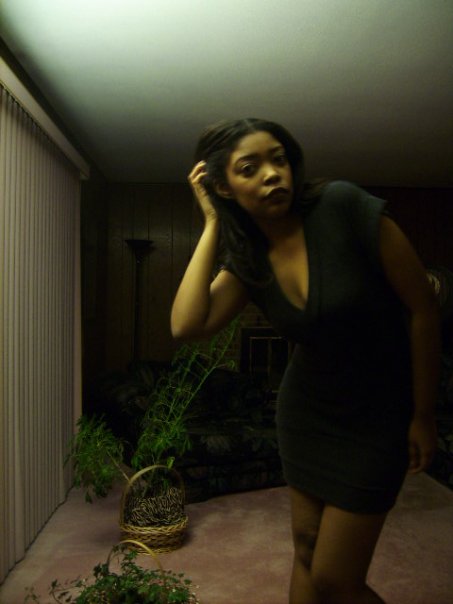
This is what I looked like, before I had a baby:

first i was like...

And that was my hair:

I’m gonna say this, even though I’m fully aware of how arrogant it’ll sound: God, I was pretty. (I don’t use God there as a taking-in-vain. I mean it conversationally, as in: “Why didn’t You tell me?” In retrospect, God did tell me. He gave me friends, and He gave me family–and a lot of them tried to inform me that I was beautiful. It is my own fault that I didn’t believe them.)

I’ve said here before that I started taking pictures of myself in grad school. I got my first digital camera as a birthday gift, during my second year there. Fortunately, that was the year I had a room of my own, with a door I could close and even lock, as opposed to the dragging overlong curtain I had to hang with a suspension rod over the open-space cubby hole I lived in my first year.

There is nothing like privacy, when the time comes to confront your attitudes about yourself. I always suspected that I wasn’t who I believed I was, that I was better. But in what ways? I started taking the pictures, in part to test this theory. How would I have to project myself, in order to begin to see myself differently? And what, exactly, did I want to project? How much did the way I viewed myself differ from the way I was viewed by others? How much should I care about how others viewed me?

After classes, I’d close that bedroom door and I’d get either literally or figuratively naked. I’d give myself to the shutter, letting it capture whatever it would: a dark and splotchy blemish, a pucker of cellulite, the baby tooth that never fell out or the extra, 33rd tooth rooted a quarter-inch above the rest of my gum line. Bushy eyebrows, underarms two days short of a shave, thunder thighs, and all.

Eventually, I began to understand myself. I’d look at a batch of 80 self-portraits and find maybe five at a time that I was happy with. Then, I’d stare at the five and evaluate what I favored about myself. I enjoyed the length of my limbs, how the bend of an arm at a certain angle made me look contemplative or how the seemingly offhanded extension of a leg in a certain direction made me appear fanciful and carefree. I got that my teeth appeared straighter when I smiled with my leftmost face. And my eyes were, in fact, capable of more than a deer-in-headlights ogle.

I could be open or mysterious, earnest or duplicitous, seductive or chaste, intellectual or downright primitive. All it required was forethought and action.

It was around then that I began to invest more in my daily appearance, I suppose. For one, I was becoming a teacher of teenagers and few groups are more thorough assessors of looks than people who are fresh out of high school. But apart from my desire to appear competent to them, as a new professor, I wanted my outer appearance to reflect my gradually improving opinion of myself.

In order to understand what a feat this was, you’d have to know how impassive I was before. When my hair was long and I rarely had to think about it, I never styled it. For years, I didn’t even roll it at night or comb it every day. I let it hang limp and curled it only when I was heading someplace where I imagined my appearance would be scrutinized. Even when I learned to care for my hair–to roll it at night and to wrap it in satin to protect against dry cotton pillowcases or to cover it when I was out in the rain–I continued to take it for granted. It had always been there, and I figured it always would be, unless I chose otherwise.

And then there was body image. I thought I was fat. Not always, but sometimes. I knew I weighed about twenty pounds more than the ideal for my height. But I looked like ^that^. So some days, I felt thin and svelte and healthy. Other times, I felt lumpy and hippy and plump. I rarely ate healthfully. One big unhealthy meal, followed by hours of air. Or several small floury snacks and no real meals at all. I even followed that pattern, pregnant, some of the time.

It is perhaps because of my sketchy nutritional practices (in addition to the “partner-less pregnancy” stress) that my hair started falling out in handfuls three months after I gave birth. I was afraid to comb it, it was so delicate. Even though I Googled it and found several sites reassuring me that no matter how much hair I lost, I wouldn’t lose it all, I remained unconvinced.

Meanwhile, if I occasionally thought I was fat before, when my stomach was taut and my hip bones were visible, I was certain of it, post-partum. So much for even pretending through standing at just the right angle to have a flat stomach. The looseness of the skin that’d just stretched to its limits in order to house my baby was unmistakably hanging over jeans and protruding under shirts and dresses.

For a while, the work I’d done on improving the way that I felt about myself seemed to be unraveling.

I was back to inaction and believing that whatever attractiveness I’d cultivated before had been forfeited through the doughy business of passing a person through my body.

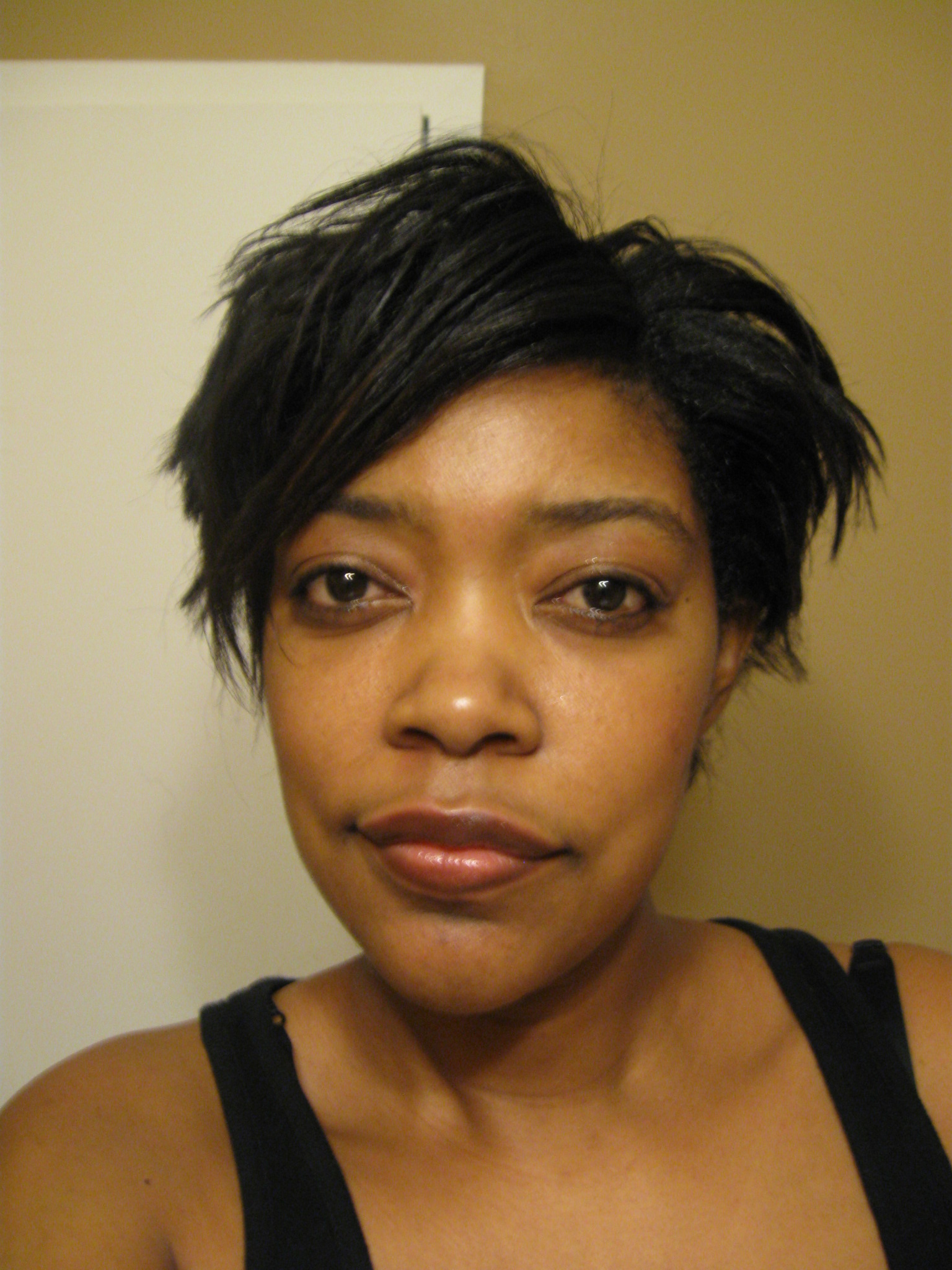
Then, my hair was translucent. What once was a thick curtain of dark tresses was now a stringy set of sheers. Once I got over the shock of seeing handfuls of hair in my hands, I marched into the Douglas J Aveda cosmetology school five minutes from my apartment and I got it cut:

then i was like...

I knew when I saw the pictures I’d taken that day that I was no longer the person I’d grown comfortable with. My body had begun to reflect the inner transformation motherhood necessitates.

In short: I wasn’t… pretty anymore. No matter how I twisted myself to pose, the skin under my eyes formed crescents of sleeplessness and the curves I’d grown to love weren’t anywhere near where I thought I’d left them.

But it didn’t matter anymore. While my appearance is still important, I’m really too consumed with being a less self-conscious person—that is to say: too busy actually becoming what I only pretended to be in pictures, before—to obsess over prettiness lost.

And that, friends, was the goal all along. So I gotta tell you: now?

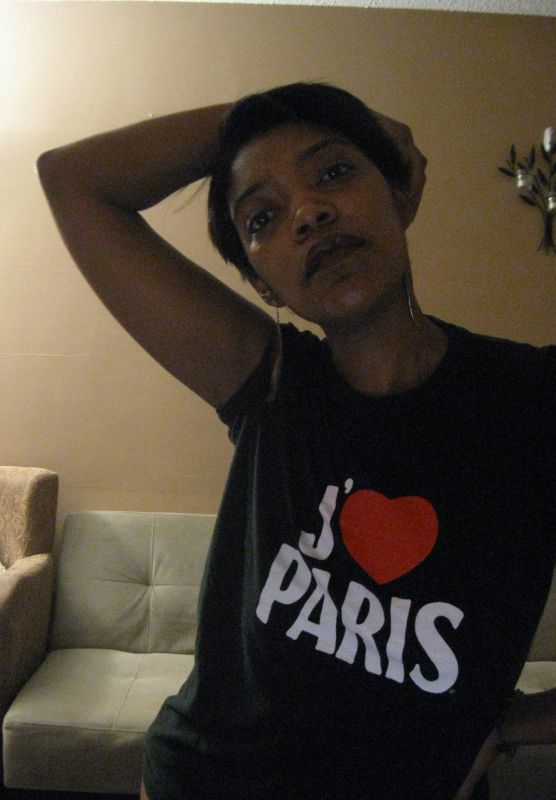
Now, I feel quite beautiful:

and now i'm like...

Oh, I still take the pictures. But not for the same compulsive self-assessment purposes. Now, it’s just… fun. Imagine that. Before, self-image was a minefield to tiptoe through. Now it’s a hopscotch board. Or, you know. Twister.

what.

What It Means To War.

(For the four Afghan women training in America to become the first women pilots for the Afghanistan Air Force)

Women war differently. We do not disease the children. We do not take the pregnant as prisoners. We do not infest blankets with bacteria before extending them to shivering indigenous citizens, as we prepare to steal their land. Our theft is of hearts, not hearths. We do not lop the hands that feed us, nor do we leave our rifle casings where the babies will mistake them for candy. We do not rape the journalists. Our wars are waged with wisdom. We are not recklessly retaliatory.

We wait.

I mean this, daughter, as double entendre. That is to say: we serve, with our tavern skirts sheathing our daggers, and we sit, with impatient expectation, until the men are weary enough, under the caress of our arrow-launching fingers, to yield.

We gather their secrets. We accept their slow and eventual admission to their boys’ clubs, their ballot boxes, their military. We tell them we love them, when they come to us convinced they have lost their right to anyone’s affection. They are right, but we are not lying: we love them.

This, by far, is our greatest ammunition. We understand, in ways that they don’t, that war–the way they wage it–is quick to dehumanize. We understand that when we cease to see their faces, their fear, their defiance, their patriotism, their own tenuous ability to love, we forfeit those very traits in ourselves.

Our war is not against the courage of our opponents’ convictions. It is against becoming shells.

You will never become the husk of the self you shed, if you remember how deeply and powerfully you can love.

Rodrick Dantzler is dead.

Rodrick Shonte Danzler is dead. And so is his 12-year-old daughter and the six other people he killed Thursday.

I didn’t become aware of the massacre or begin to watch the live footage until his five-hour hostage standoff was well underway. Apparently, Dantzler’s killing rampage began in the afternoon and alternated between two Grand Rapids communities, both to which I have strong connections. He shot several victims near the intersection of Fulton and Division, which is three parallel blocks away from my apartment, and the others were slain on Plainfield Avenue, near where I lived with my aunt and uncle for the first two years of my stay here. Their street, which is a serene suburban strip, just off Plainfield was sealed off last night, to ensure that Dantzler could not escape the home where he’d holed up with what was first believed to be two, but wound up as three hostages, when the last was discovered hiding in another room.

This all hit, quite literally, close to home.

I’m no stranger to mass murder and serial killing and gunmen turning their weapons on themselves to end it all. I’m from Baltimore.

Even before Dantzler decided to end his life, I predicted he would. Even before an anonymous extended family member told Wood TV 8 that Dantzler suffered from mental illnesses for which he was not taking medication, I guessed it. That Dantzler knew his victims was also something I thought likely.

But it’s his relationships to those victims that is so unsettling. Two of the women murdered were Dantzler’s ex-girlfriends (another who was shot and injured was a third ex); almost everyone else slain was related to those women. In addition to his adolescent daughter, he also killed the 10-year-old niece of one of those exes.

Investigation has revealed that Dantzler’s long rap sheet is littered with charges of violence and threats against women and relatives. He even allegedly assaulted a pregnant girlfriend in an attempt to kill the unborn child.

Grand Rapids Chief of Police Kevin Belk insists, “It makes no sense to try to rationalize it, what the motives were. You just cannot come up with a logical reason why someone takes seven people’s lives.”

He’s right, of course, but it doesn’t stop me from wanting, if not an explanation of motive, a meaning or–to use a term that makes me cringe–a teachable moment.

It’s been difficult, and it’s still early yet. I’m at a bit of a loss.

This was a man who first became a felon close to twenty years ago. His own mother sought a restraining order against him in the early ’90s, after he set fire to her home. She was one of four women who sought restraining orders against him during that decade.

He was 34. And though neighbors at his current residence described him as friendly, mild-mannered, and “normal,” he woke up yesterday morning with a .40-caliber handgun and “plenty of ammunition,” with the intent to end the lives of his exes and his daughter.

The photograph of Danzler that most often flashed across my television screen Thursday night showed a man rather indistinguishable as crazy. His hair is freshly cut, and his clothing, what little is seen of it, seems average. The eyes usually tell the tale. They are wild or darting or dilated. Danzler’s may be a bit dull, as though he’s been drinking, but they don’t show the worry or fear or anxiety or even rage you’d expect to find in the face of a man who premeditates the murder of seven people.

This was among the most notable of details, for me. Sanity, or its lack, is not easily determined by the naked eye or, at least for these women, by early interaction.

I found my mind wandering through the ruins, wondering what the victims must’ve been thinking.

A part of me already knew–the part that is attracted to eccentrics and “Iceberg Men,” as I like to call them. Iceberg Men are never quite knowable. You get the ten or twenty percent that sits above the water’s surface, but you’re also ever running afoul of the jagged, arctic ridges underneath. You are privy to the beauteous transparent peak, but not the denser, cloudier behemoth waiting below.

At the beginning of one of my relationships, my boyfriend showed me two of his earliest films: the first, for which he won a college scholarship, was about a man sent to prison for killing his unfaithful girlfriend. He starred as the inmate. The second film he showed me was about a man who mistook Philadelphia’s Center City for the rice paddies of Vietnam and began hallucinating himself knifing passersby, like he’d done as a soldier. He starred as the PTSD victim.

I gave him a pretty long side-eye, after those screenings. But eventually, I chalked it up to the eccentricities attendant to artists. I love creatives. We exorcise the baser urges of our ids on paper, celluloid, stages, or dance floors, and when we’re fortunate, those urges are contained to our media. Imagine if he were a horror auteur, I told myself. Imagine if you were dating a Black Stephen King. That, I decided, would’ve been markedly creepier.

Still, I Googled him. I listened when he offered views on gun ownership and channeling anger and the importance of self-defense. I observed how his relatives and friends responded to him. And after that vetting period, I relaxed.

He was a hybrid: eccentric Iceberg. But I was never in harm’s way with him.

I have to wonder if any of Dantzler’s exes similarly vetted Dantzler. I wonder what negotiations their hearts held with their common sense.

Since even he could appear sensible and “friendly” and “mild-mannered,” did they think that their love for him would transcend his past and mellow his future? And once they realized that wasn’t possible, did they fear that this fateful Thursday would come?

The world has never offered much sanctuary for women. And often, our decisions about who to love have repercussions that extend far beyond any we can imagine. Sometimes, running afoul of our Iceberg’s lower half results in far, far more than the bump on the head for which we’ve prepared.

Rodrick Dantzler is dead. He killed people who’d once loved and trusted him. Intimates. Children.

I don’t know if there’s any sense to be gained from violence this senseless.

God rest their souls. God bless your life–and be wise with what’s left of it.

In Light of the Casey Anthony Verdict.

Story is now 11 months old. She inches her way around the perimeter of our apartment by placing her pudgy palms on knees and toys and furniture, then beams up at me or grins to herself, radiating pride.

She is beginning to communicate intent. When she wants to play or be held, she crawls up, raises to her knees and either pulls up on my pant legs or presses her hands to my shins, looking up expectantly. When she wants to be put to sleep, she lies across my knees.

We share food. I can no longer consume a meal without breaking morsels and passing them to her, like we are sharing the hallowed sacrament. And in my two-seat car, she always rides shotgun, mostly in silence, while we listen to songs from my iPod as though they are reports from a police scanner and we are actors in a buddy cop movie.

I can no longer fathom a life without her. In these long and home-employed summer months, she is omnipresent. I am rarely away from her.

I know what she enjoys, what she can do without, what infuriates her. And in all these ways, she is mine. She belongs to me.

But I do not always feel like her mother.

Fleetingly, in a nanosecond’s passage, I’ll look at her and forget how she grew–pound for pound–in my womb. I forget her delivery room diaspora from the space I’d made sacred and warm for her. And I think, “What a lovely little girl.” As though I’m admiring someone else’s child at a mall or a petting zoo.

It is an unsettling sensation, and as quickly as it rises, it disintegrates. I see her father’s eyes, my lips, her own gapped and scalloped teeth. She touches me or I finger-comb her hair and there is an instant reclamation.

In this manner, I am beginning to understand the complexities of motherhood. It is not as instinctual as we prefer to think. My bond with my daughter has been forged through the repetition of the commonplace; in the ritual of rocking and bathing and feeding, she has become someone I could not move forward without strapping to my back. She has become someone I would willingly relinquish my mind and my freedom to protect or to avenge.

Were I not with her every day of this 11 months, were I to prioritize the pursuit of men or strong drink or of other, errant pleasure, I would be able to conceive of her as someone else’s responsibility. I could leave her–with a parent, a neighbor, an imaginary nanny named Zanny–to pursue my pre-child dreams of a Fulbright or of simply living a life of lonely leisure.

That these are reprehensible ideas rather than palatable ones has more to do with the ritual of presence than the imperative of biology.

I couldn’t follow the Casey Anthony case. I never allow myself to recall to mind the acts of Susan Smith. And I wince whenever Sethe’s “liberation” of Beloved wafts into the foreground of my consciousness.

It is better for me, as the kind of mother I’ve become, not to contemplate the kind of mother I could’ve been, were the chemicals in my brain imbalanced or the condition of my heart compromised.

Instead, at least twice a month, I openly weep, with my daughter in my arms, as we dance across the carpet to a soundtrack of worship songs, and think: there, but for the grace of God, go I.

Constants for the Wanderer: Mali Music.

I hadn’t heard of Mali Music before the Gospel Music Channel started incessantly airing Deitrick Haddon’s debut feature film, Blessed and Cursed, which I LOVE for reasons that could probably fill a whole other post. Another day. But yeah, Mali Music played Deitrick’s cohort who “backslides” because he experiences a betrayal as a member of Deitrick’s choir. He then becomes instrumental in setting Deitrick’s character up, inviting him to a club where he encourages him to get completely smashed, while someone tapes the whole drunken mess and takes it back to the Bishop who employed him as a worship leader.

Mali Music doesn’t have very many lines. His most memorable one is something along the lines of, “I’m sick of church. I’m sick of gospel. I’m sick of Bishop. I’m done.”

While I’ve never been there, I understand.

My mother’s marriage fell apart while she and my stepfather were serving as part of our church leadership staff. At the time, I was writing and performing a lot of Christian spoken word—this was before it was en vogue; it was almost unheard of back then, in 1999 and 2000. Arts ministries are relatively new and while drama and liturgical dance were in full bloom, poetry was just becoming a viable ministry medium.

So our family was high profile at our local assembly. My parents were well-liked, sought after, even, when congregants had problems they wanted discussed with discretion, compassion, and respect. And I was kind of this retreating enigma–as soon as church dismissed, I tended to duck out to the car and hide while my parents spent an hour or more post-church-socializing–until I was behind a microphone on the pulpit, rapid-fire reciting admonitions and observations about the crumbling state of the church. (It was your typical fare: get right, we’re too judgmental, be who God made you, don’t conform… but it was delivered so quickly no one caught that it was kind of critical.)

I got a lot of, “When you gon’ write me a poem?” and a lot of requests for performances–at weddings, children’s birthday parties, and funerals. I even did a housewarming once. I felt defined by what people called My Gift, as though I wasn’t much more to anyone than a performer–and a niche one at that, only marketed to church groups and youth conferences.

So I stopped.

My parents left our church. A year or so later, they broke up altogether. I felt like I couldn’t discuss that with anyone at church—it would’ve been a betrayal to my parents, who were still held in high regard by the congregants—but it was a really difficult time for me. Their whole 11-year marriage had been a difficult time for me. And though I enjoyed church–the hallowed way I felt upon entering, the utterly cleansed way I felt walking out, the warm embraces of people who didn’t know my secrets and didn’t need to, to be warm and welcoming–I was always quietly recoiling from it.

I didn’t belong. Anyone who attended church with me, at any point in my life, would disagree. I was a model church member. I dutifully turned to scriptures, took copious notes, highlighted key verses. I raised my hand to answer biblical questions in youth group. I performed at church block parties and washed cars to raise money for the building fund. I passed out bag lunches and Chick tracts to the community. I told strangers that Jesus loved them. I made my all my decisions, particularly those related to private and public conduct, with the very earnest belief that I was being constantly surveilled—by Christ, a nearby congregant, or both.

And these things did give me great joy. I loved everyone I prayed and worked and believed alongside.

But I never felt like I was one of them. My mind was always somewhere else, concocting stories. Writing about “secular things.” I didn’t have much interest in only being a Christian poet or a Christian novelist or a Christian anything. I tried it, making sure that all my stories had a wayward, tortured soul who had a conversion experience by narrative’s end and all my poems referenced scriptures and the Savior. But that felt false somehow–or if not false, then certainly forced. I wanted to use the gifts and talents God knew I’d have when He created me, in any way I saw fit. I didn’t feel a responsibility to contain them, so that they were only functional within a Youth Sunday or special service context.

I just wanted to be a citizen of the world, a writer, a wanderer. I wanted to be like Jesus: everywhere and ever speaking in parables.

But how do you explain that without sounding like a heretic?

You don’t.

You don’t.

But back to Mali Music. I was struck by his character’s frustration in Blessed and Cursed. It stemmed, as a lot of frustration does, from being misunderstood, from being treated with distrust when your intentions are noble. And his response to that frustration was, like mine, the wrong one.

I don’t know much about this artist yet. Sunday, he appeared on the BET Awards, in one of its Music Matters segments. In a post-awards interview, some artist who performed on Music Matters last year, said of Mali Music, whose name he didn’t remember, “His performance gave me chills.” It was unclear whether or not he knew that Mali Music was a Christian artist; it seemed that he didn’t. But he was moved, repeating that phrase twice: “gave me chills,” in a tone that suggested that he didn’t understand how it had happened.

I was on Twitter when he performed, and my timeline had a similar response: “Googling Mali Music.” and “I didn’t know this cat was gospel. He’s not wack.”

I began to feel about him the way I feel about anyone I encounter these days who has cracked the code, who’s found a way to be like Jesus–a citizen of the world, a philosopher/artist/thinker, a wanderer–everywhere and ever speaking in parables–without being confined or cast out.

I think, “Good for him.” I think, “That could be me.”

This morning, I found a song of his from two years ago: “Foolish.” It’s part of a project I didn’t know existed, called Gumbo Red. And the lyrics convey that resonant frustration, this idea that people have to be who we expect them to be in order to be ministerial or even Christian: seminary graduates, skilled musicians, scripture memorizers. The through-line is that God uses the foolish things of the world to confound the wise, which is a scripture oft-misinterpreted, if you ask me. Sometimes, people just trot this verse out when they want to use an Isley Brothers sample in a gospel song.

But this song seems to get the scripture right–at least as I understand it. Sometimes the role of art in the Great Commission is just to leave someone feeling moved, without expressly stating why you’re able to do it. This seems to be something Mali Music understands.

There’s another piece to this, involving the Holy Hip-Hop Movement that got its start a few years before I started reading poetry at church and how Mali Music definitely seems to exist within the confines context of that movement, even as his work seems to transcend it. But again: different post, different day.

On: Exposition & Excerpts.

I excel at premises and exposition. It’s the plotting and pacing that trip me up. I can have an intimate knowledge of characters–what motivates them, where they live, how their experiences have converged to create the versions of themselves that we meet in my stories. But making them do something, in real-time, is a challenge. If I clear that hurdle, it’s even more difficult to make their doing reach some sort of resolution. Below is an example of the type of work I can trot out with ease. I texted these 1,100 words on my Blackberry Friday and yesterday. They poured right out of me. But now that it’s time to make the characters–the narrator and Uncle Sonny–do something, I’m stuck.

I’m posting this, in part, because it’s the first new fiction I’ve written in months. But also because this is where I post things I want people to encourage me to continue writing. This is where I look for readers to say, “There is something here. Keep going. We want to know what it is.”

*  *  *

“Mississippi ain’t what it was, but it still ain’t shit, if you wanna know the truth about it.”

Uncle Sonny flicked a long-nailed finger across his tongue, removing a flake of loose tobacco. He smoked unfiltereds so relentlessly that sometimes, along with the stink of stale cigs past, you could also smell the death hounds, held at bay, perhaps, by the prayers of great-aunts and Grandma, but gunning for him, all the same.

We spoke often, in my family, of the death hounds, and how, by and large, we’d dodged them. They felled Grandpa with angina back in ’96. He was nearly 90, a Baptist minister who bickered often with his wife and barely knew his sixteen children, least of all Uncle Sonny. He accepted love in the forms of fatback and collards, cornbread softened by buttermilk, and thick cut bacon far more white and red when raw. He gave love in the form of the strap, in hard words for his sons and few words for the daughters, in the sweat soaked through three shirts a day in fields and foundries.

Uncle Sonny’s position here, in the living room of the high-ceilinged rowhouse, with the stained glass in the parlor and the upright piano in the sitting room, was the direct result of Grandpa’s labor. But even as the intended beneficiary of the deed in the event of Grandma’s passing, Uncle Sonny would be hard-pressed to acknowledge that.

“Most of these niggas round here came up from North Carolina…”

I grinned to myself at the musicality of his pronunciation: Cuh-LIE-nuh. He was beautiful, Uncle Sonny, and by far, my favorite uncle. At 70, only his language belied the grimier bits of his past, bits to which I’d only become privy in the last year, when the aunts began raising their hushed tones till they were just loud enough to overhear.

You had to be at least 25 before this happened, in my family. I was 31 and still learning.

“The NAACP buried the N-word a few years ago, Uncle Sonny.”

“Can’t bury nothin’ you ain’t got the power to kill, baby.”

He crushed the burnt remains of a cigarette in an overflowing ashtray made of sterling, then sipped from a mug of coffee he’d made, so bitter it tasted as though it’d been brewed from the grounds of that very tray.

In solidarity, I sipped from the serving he’d given me, presented in a teacup with two sugar cubes on the saucer. Forcing a grin, I resisted the urge to check the recorder I’d started–or thought I’d started–just after we sat. There was a strong chance Uncle Sonny had forgotten it was there. Calling attention to it would be counterproductive.

“Like I was sayin’, most of these niggas here came up from North Carolina. That’s why they always skinnin’ and grinnin’ for these peckerwoods.”

Peckerwoods? It wasn’t the first time I’d heard Uncle Sonny use this particular white-folks-pejorative, but it was one of the few for which I hadn’t researched the etymology. I typed it into a Blackberry memo and set my phone back down on the coffee table.

“What you over there writin’?” It was a question he never ceased to ask with suspicion. Ever since I’d started writing poetry in high school and gave Grandma that pretentious 80th birthday poem with the tiny font and the five-dollar rhyming words, I’d become known as the next writer in the family and, for us, it wasn’t a role of honor.

The last writer in the family, Aunt Edie, had penned a memoir about being the eldest of sixteen, born to ex-slaves from Mississippi. It was compelling work, filled with the brutal accounts of flogging and selling and sit-ins you’d expect of such a piece. It was also, the whole of it, a lie. Grandpa and Grandma were born in 1908 and 1911. Even their parents had been born free, all except Grandpa’s father, perhaps, who bequeathed him his deep brown skin but didn’t stick around to provide him much else. Grandpa couldn’t have told you his father’s middle name, much less whether or not he’d ever been owned.

Before Aunt Edie, there was Cousin Vuretta, who’d penned a very convincing letter to the school principal, accusing Sylvester Dotson, another of our distant cousins, of a rather ghastly assault, after they’d been caught in a consensual indiscretion in the lunch room, after hours. Sly got sent to a home for wayward boys, where he learned the fine arts of hardened crime, and within a few months of his disappearance, Vuretta recanted her story.

Then, there was Elester Pitts, whose writing was limited to love letters, discovered in the various homes he’d broken by pilfering the affections of other men’s wives.

Baltimore may be a major metropolis to some, but for us, it’s a just a big town with a long memory. Grandpa and Grandma moved up here when Uncle Sonny was just seven years old. He was second-born. They’d come up as a family of six—my Ganny was the baby then, soon to be displaced by Uncle Wally. I supposed, since then, we’d developed quite the reputation, “country” as we once were, “hood” as we are now.

I know very little about it. Somehow, I’d been insulated. My mama, Denise, was what the rest of our kin referred to, under their breath, as a Jesus freak. By and large, we were a family of Baptists. Mama was a devout neo-Charismatic, which is as far left of my family’s church experience as James Cleveland is from Jimi Hendrix.

I was already a zygote when she gave her life to the Lord in that open space below the raised pulpit that’s often called the altar.

She hadn’t told anyone about her pregnancy, being eighteen, college-enrolled, and unwed. But she raced home to tell my Ganny and her sisters, engaged in a heated game of bid whist, that she’d gotten saved. Perhaps she thought, naïvely, that it’d soften the blow when, months later, they noticed how big I’d gotten under my mother’s silk blouse.

Aunt Xenobia raised her glass of gin, making the ice cubes tinkle in congratulation.

Aunt Imogene just pursed her lips and cut her eyes, which are generally her sole contributions to any conversation.

Aunt Edie humphed. Ever since she’d been called a liar to her face by every living family member–and, to hear Uncle Sonny tell it, even some dead who’d taken to stalking her dreams–Edie thought it prudent, on most occasions, to keep her mouth shut.

Ganny was the most vocal: “‘Saved,’ huh? You could’ve ‘saved’ the gesture. You already baptized. I made sure of that.”

Mother needlessly gathered the fabric of her sweater around her still-flat stomach and slunk up to her room.

“That gal ain’t got the sense God gave a tick,” Aunt Addie Mae could be heard quipping behind her.

“You need to hush,” Ganny scolded, by obligation, before snickering.

Futile Devices.

It’s been a long, long time
Since I’ve memorized your face
It’s been four hours now
Since I’ve wandered through your place
And when I sleep on your couch
I feel very safe
And when you bring the blankets
I cover up my face

I do
Love you

The futon is broken. A week before you came, I plopped down on it, with our daughter in my arms, and with resignation, a circuit of metal springs slumped under us. If you bend down, you can see the most fed up of the few; it’s jutting near the ground, a smattering of foam entrails circling it.

I apologize for this before you arrive, though I know this is not the most uncomfortable you will have ever been. It is not the most uncomfortable that you will ever be. But I still offer this explanation, with no small amount of chagrin.

I am amazed that I’ve retained, after everything, the habit of treating your every visit like an audition. The role is constantly being rewritten, but my performance is invariable. I am dutiful, accommodating. I anticipate need. If there is any difference at all, it is that I no longer tip my emotional hand. I play every feeling close to the vest.

You assure me that the concave cushioning won’t be a problem; you are too excited to spend time with our ten-month-old. You haven’t seen her since the winter holidays, and though I email photographs near-daily and though you ask to speak to her by phone three times a week, you will be surprised at the unusual length of her legs–on an infant growth chart, her length is in the 90th percentile–and the ease with which she unfolds them when pulling herself up to stand. She was not so autonomous at Christmas, wasn’t looking at us and saying “ma ma” and “da da” with intent. Her hair hadn’t gotten so long that the ends of the plaits in the back grazed her lower neck. You have never experienced the unsettling joy of watching her thoughts progress on her face, each eye its own sprocket, each impish smirk a cog. You have not seen her, with five teeth.

I listen to you speak of her, listen to the softening of your timbre, the smile that creeps into your every utterance of her name. You sound, finally, like a father. In exchange for this yielding, this acquiescence to what has been reality for me since two Novembers past, I am expected to pretend that you have always sounded this way, that there has never been a lapse, a hardness, a turning. But this part of the role I cannot play convincingly. Try as I might, I cannot forget the Twilight Zone in which we dwell, where you are no longer a man possessed—wild-eyed, wounded, pulling away from a situation you’ve convinced yourself is a trap—and are instead kindly, ingratiating, and generous.

For you, this visit is a five-day furlough from your life out West, a time-pocket wherein our child is tangible, rather than an apparition whose absence haunts you. For you, this is an act of proof that you are “trying,” that you are willing.

For me, it is five days.

It is the welcome sharing of weight, both literal–she is now twenty pounds–and figurative. It is a nice respite, this ability to wake you when she rouses herself at 4am and again, for the day, at 6:30 and hand her off to you just long enough to make a bottle, think, brush my teeth, pee. It is nice not having to negotiate these things, to assess whether it’s worth it to leave her in her crib in my room, if the whole time I’m gone, she’ll be racked with dramatic and furious sobs.

I appreciate the sudden parity and the absolute lack of complaint. You are so kind to me now, so readily deferring certain parenting decisions to me, your tongue ever poised to prepare an apology–even if the infraction is minute or imagined. This is an interesting turn. This is a return.

But this is not our lives.

There is something false between us now, something stilted in our interaction, a barely discernible counterfeiting. It is so imperceptible that it often seems imagined.

But I know the things I haven’t said.

I am not okay.

I love you, which no longer computes. I shouldn’t, it would seem, considering. But I do—for there was always this underpinning, beneath either romance or rejection, apart from togetherness or separation, that bound me to you. Something that existed before intimacy and long after it, too foreign a sentiment and to odd an admission to make, aloud. But here it is, after all of it, just lingering.

You are my Laurie. You are more my Laurie than the lover that I made you. We were made for the baring of our deepest secrets, for adventuring in attics and abroad. We used to share journals, writing reams of minutia and epiphanies then mailing them or passing them hand-to-hand in a ceremony of secret exchange. And I wouldn’t seem surprised if, in some fugue state long past, we spit in our palms and pressed them together or sliced crimson slits into index fingers, mingling blood.

You will always be here. We are brothers. And this is why it all backfires.

And I would say I love you
But saying it out loud is hard
So I won’t say it at all
And I won’t stay very long

But you are life I needed all along
I think of you as my brother
Although that sounds dumb

And words are futile devices