Admit that you always wanted lovers, long life, and longish letters secreted in boxes and scented with dead-rose sachets. You were never guileless. No nunnery ever awaited your arrival; you were not holy. And often — yes, often — you did not want to be. You still aren’t, but some days, now, you do desire it. This comes with firsthand knowledge of what it is to be fairly besotted. You will only want to be cleansed when you’ve allowed yourself to be sullied. You are still very afraid, still intimidated by others’ brazenness, still startled somehow by your own. You have not stopped hobbling your inner sprinter.
Admit that, before you were grown, you wanted to straddle chairs and tilt your head while a painter tried to capture something inimitable in you. Now that you have straddled more than chairs, you wonder if there is anything inimitable in you. Are we ever as singular as we think we are?
Admit that you wanted God to turn His head while you made love, because you never really intended to marry, and He knows that you never mean Him harm. You may’ve dreamt of weddings but never of the rugs that would need beating once a month, the bleaching of dingy boxer-briefs, of breast-milk-encrusted bras and a lifetime of servitude. You will not come to view marriage as much different than you do now; you will not tie it in many meaningful ways to the motherhood that precedes it. You always meant to flit about without that kind of accountability. And even when you are your most lonely, even when you are penitent, even when you confess all your sins: you still do.
Admit that you did not want to comport yourself as you did, closing as quickly as a small aperture. You imagined yourself as magnifying glass, translucent, enlarging, but never entirely seen. It would not have been terrible for you to be a watery blur of unconsidered colors. You could have been what happens when pewter commingles magenta, when olive meets cornflower.
I am taking you to task. You haven’t learned. You haven’t learned. And for all your attempts at honesty, you still make yourself duplicitous when you want most to be loved.
Who are you now but the girl that you were, without so much pretending? Who are you now, but someone who lives a bit beneath herself, wants the wrong things, and hopes to raise a less apologetic woman?
I tend to bend toward ambivalence. Romance is a whirl I can withstand; romance does not quite uproot me. It is the man who makes me question why I have come, who leaves the silence draped around us in an open room, who is kind but, in every way that matters, begrudging. He is the leveler.
For him, I will be all three rings of circus: here, the contortionist, pretzeling with anticipation, folding in and unfurling when it doesn’t seem to bore him; here, the fire breather, holding for far too long in my chest whatever ignited my ardor in the first place; here, the tightroper. (I will spare you suspense: I fall.)
Even as the tents collapse, I am cycling, juggling, looking for signs other than exits.
It is curious, how rejection becomes an intoxicant, how similar being slighted can feel to being loved, how easily a shrug can absolve a lover.
Because I am as often a pusher-away as I am the pushed, I understand the value and artifice of open ends. I respect the intentional blur. Like breath wiped from glass, I can see the hint of a message, an illegible trail left by fingers whose nimble urgency once beckoned me near. It is still there, beneath the smear. With love, there can be no clean erasure, and as it wanes, I will always, always cling to the streaks left behind. Are they kitschy nostalgia or coded promise?
Here is where I will linger, on a sidewalk outside the glass. I will come here to hope long after I’ve trained myself not to expect, to continue questioning silently what my pride has stopped me from pressing aloud, to venture sentiments into the silence, bracing for nothing but echoes.
Beyond the smudges, I can see him moving on. There is no greater delusion than believing I can slow or reverse this and no greater hubris than wondering how my every movement may have impacted his choice.
But these are the possibilities that surface so simply in fog. This is where imagination breaks free and runs.
I want to hit the glass, or better, to break it as though this were an emergency. Instead I wipe the pane, collect the smudges somewhere along my sleeve, and accept for fact the sight I’d always second-guessed.
When he spots me, I will mouth: This is how far apart we’ve grown. This may well be as close as we’ve ever been. Let us light upon each other and not look away. We will never be so clear again.
Words in an online space are particles, wafting out to who knows where, being cupped into eager palms or blown out of dismissive ones. When they land, are re-blogged, replanted, you know — long after whatever you wrote ceases to matter to you — that your words are growing in someone else’s heart, that they’ve planted themselves in someone’s memory. It isn’t often, though, that you get an opportunity to meet the people who’ve been tending your discarded gardens.
When I decided, just hours ago, to apply for a scholarship to this year’s Blogging While Brown, a networking and personal development conference to be held in New York on June 21 and 22, I knew this event would provide one of those rare glimpses. Blogging While Brown affords introverts whose social media relationships are as important as her analog ones to break a fourth wall of sorts and clap eyes on the folks whose words she reads and those who read hers.
Erika Nicole Kendall, founder of the uber-popular A Black Girl’s Guide to Weight Loss, talks about her experience with meeting her blogging peers and allies last year. And the meet-and-greet aspect of Blogging While Brown is also an experience Nigerian writer Chimamanda Adichie explores in her latest novel, Americanah, where her heroine, Ifemelu, not only makes networking gains with her already thriving blog but also reconnects with a man she was certain she was meant to love. Adichie understands acutely the importance of writers making in-person connections with one another.
I, on the other hand, have always struggled with it. Two weeks ago, in fact, when I stood in the book signing line to meet Adichie at Washington, DC’s wonderful bookstore, Politics and Prose, I silently proffered my copy of her book when the time came, without even mentioning that I’ve frequently written for one of the very blogs she mentions by name in the book.
Introverts need networking as much as anyone, but it can be far more difficult for us than for most people, to network in spaces that aren’t designed for that purpose. I’ve written a bit about introverts and interaction for Clutch magazine back in 2012. I’ve since founded Beyond Baby Mamas, a new blog used to create a safe space for unmarried mothers of color to share their stories and to receive support and advocacy. Since I’ve grown it as much as I can without facilitating many in-person meetups or events, it’s important that I push myself to grow my online community by strengthening my offline one. Blogging While Brown will help with that and it will allow me to meet many of the black and brown “momoir” pioneers who’ve come before me.
The experience will also help me to grow my personal blog readership — which has seen a significant spike in the past two years. I’m in the process of adapting many of the posts here to book form, a process that has been demystified during BWB panels in previous years:
Of course, if I do win a Day Pass to this year’s BWB, I’ll write about my experience here and at BeyondBabyMamas.com. It’ll be my first step toward applying the techniques I’m sure to learn there to build grow even stronger communities for both sites.
Sing invented songs for every action. Hold toys utensils clothing foodstuff at eye level and label it — every time. She counted to twelve in the morning. Make her draw straight lines — both vertical and horizontal. Make her draw circles. If she resists, place your hand over hers and guide her toward it. She looks deeply into my eyes and says with firm convention things I cannot comprehend. Hand her her clothing; putting on her clothes is a 28-month-old skill. In August, when summer starts its slow, hot last hurrah, she will be three.
Here is yet another yellow carbon; read every line, as it reiterates what they’ve told you. Decide on whether she will go to school in the fall; it may be prudent to place some of the impetus for acquiring these skills on a classroom, a teacher, on interaction with other children. She jokes; she laughs at appropriate moments; she says, “Delicious!” “Mmm, yummy!” “That’s not funny!” She says tons of moderately discernible things, knows the alphabet, identifies letters out of sequence, has the patience to wait for the resolution of a story. Note that this yellow carbon has been careful to credit her for what she does well: uses catch phrases appropriately. Picks up visual cues fairly quickly, is excellent with rhythms. Appreciate that no one who visits your home is condescending; the women seem duly charmed by your daughter. Do not assess their genuineness. Try not to be fearful of her upcoming ear test, though one of the women has mentioned that some of the children she visits have needed their adenoids removed, have — like your daughter — never had ear infections, but may still have standing fluid in their ears making it difficult to hear.
Do not spend every waking moment wondering what is wrong. Make knots in the rope, at each interval where you’ve already been given a solution; use those to climb. She sings hourly; her voice, a modulating lilt, is rarely off key. She plays the piano for over 30 minutes, rarely choosing to hop down from the stool. Imagine her a virtuoso. Imagine her an American Sign Language interpreter for the UN. Imagine her in a concert hall, bringing up a well of sound and pitching it forth with her whole body.
Do not be so quick to cry when your mothering feels micromanaged; no one believes you are bad at it but you. (But would it hurt to hear that you’re good at it from the people who see you do it most?) Do not be ungrateful. Articulate your need to discover more of this on your own; becoming a grandparent — even a live-in one — does not mean re-parenting your own child. Do not take advantage of the other caring eyes and hands; she is yours, and the memory of her daily needs is yours to initiate. Meet them before you must be reminded.
When you are not with her, do not leave so much of yourself at her feet. But also avoid giving the same fathoms of love to those you’re with; the bottomless concern, fierce protectiveness, and doting adoration with which you parent are not owed to anyone else. It will likely be misconstrued. Who could ever understand the rawness of it, save perhaps the single father, save perhaps the man who mourns?
Meet the home visit teacher at the library, to join the special playgroup. It will be good for her, she says, and it will be good for you. You will meet other mothers who are going through this. Do not think the phrase “going through this.” This is not a malady, just a difference.
Go back. Start short and slow. Do not overwhelm her. Forget sentences for now. Forget enunciation. Forget how we treat our children like thoroughbreds. Forget whatever inadequacies you’ve developed as a mother and a daughter and a lover and a friend. And just sit with what is happening. Quiet your raging, voluminous insecurities. Tell God you’re sorry; He will know for what and why. She likes farm songs. Cow is one of her clearest, most confident words. She does animal impressions. Imagine her the next Temple Grandin. She likes sky; she is a budding Mae Jemison. Imagine no one else. She is herself herself herself. Do not compare her. She is herself herself herself. And she is mine.
The last time you were here, you left an open pack of tube socks in the trunk of my car. It’s still there, two weeks later. It will stay there until you return.
I often feel responsible for the things that remain when you leave. There are imprints of you where I do not want them and one beaming emblem of you I could not live well without. I am accustomed to keeping things safe till you reclaim them. I suppose I will continue to; it does not seem to do me much harm.
I can say this without animus now, but it is not always as easy as I lead everyone — including myself — to believe.
2.
Loving anyone other than you had long been an alien concept. Twelve years long, if we’re honest. We were only together for eight (nearly nine) but even when it ended — even during the pregnancy, when I hoped and I prayed that alone or reconciled to you would not be my only options — I did not truly believe I’d fall in love again. I would not let myself, not if this was how I’d feel at love’s departure.
But what could I tell my daughter of love if I could not remember its shiver? How would I hear her fawning first brush with a tremulous hand if my own palms knew only a craven kind of emptiness? How could we parse her first heartbreak if I never let go of mine?
3.
This is the supernova, the white burst, the back-pressed-to-wall, the unending kiss, the lips that won’t leave yours even to whisper, the words you get to roll on your tongue and relish the fact that they were once, just moments before, not your own.
You are holding them now. You are holding him now. And being held and being held and — Father in heaven — being held.
It hardly seems sane, for your arms to know an embrace other than your wriggling toddler’s, to know kisses other than the ones she sees fit to bestow, in boredom, in blessing, at bedtime.
And it isn’t sane, really, or sustainable. It peters as quickly as it popped, a fire in a lidded jar now. And this great, ghastly, heart-pounding, promise-eating love is swallowed up in air, in sky.
4.
Weeks ago, Father John, the eldest priest in our small parish, preached of love.
I wanted him to say something sense-making about women like me, alternately afraid and excessive, who understand love simply as being someone’s priority. I wanted him to tell me how such a low bar could be so difficult for some men to clear.
But I wasn’t entirely listening. I was thinking of all the things and people to whom I’d come second and third and sixth. I was wondering whether or not I was worthy of preference, whether it was fair or childish to expect to be preferred.
“You know that passage, that 1 Corinthians 13 that people like to read at weddings? That’s God’s love. Agape,” he said with a wave of his massive hand. I watched him shake his head, as if all we romantics were a bit misguided.
Father John moved on quickly; for him, this was just an aside.
For me, it was a lifeboat.
Someone else would find this alienating, this idea that we should not use agape love as a matrimonial blueprint because we could not possibly erect it properly and would feel as if we were failing whenever a window shattered. Someone else might scoff at the notion that we shouldn’t strive toward a perfect, selfless care for our fellow man.
But all I could do was think of my own loves: often impatient, sometimes insecure, disinclined to hope or believe all things, occasionally self-seeking, and certainly — if nothing else — susceptible to failure.
I leaned back in my seat, and I sighed relief.
5.
How do we do this? How does anyone do this?
6.
I used to believe I would never be rid of you because you were my predestination. Then I thought I could never be rid of you because of our girl, who looks back and forth between us, whenever we’re together, with calculating eyes.
You make moving on difficult, because you are a kind amnesiac: giving and grinning and hoping to catch us, even as we flutter on, mostly without you. For all your texts, your calls, your checking in, you do not remember — and sometimes do not even accept — what you are not here to witness. You will always believe that I am the keeper of things you happen to leave behind.
I am your safe deposit box. I am your cage.
7.
The other one was elegant, an autodidact, confident in ways I couldn’t imagine, calm in a manner that requires discipline not artifice. He was meant for a family — but he was not meant for mine.
Of all the things that are difficult to accept, this is perhaps the hardest.
He, himself a cage, a keeper of things left behind, always treated me like a bird who’d forgotten the grace of flight.
We who understand what it is to be a series of gilded, bloodied bars want nothing more than to bend them for others. We are the freers, even at our own expense.
8.
I used to be a woman of many compartments. But motherhood makes you an open space. Anyone you love must stand on your floor and face the things and the people you once had an inclination to hide.
There are no fallout shelters. There is no time to assuage hurts, massage egos. No strength for mediating others’ aughts, for carrying burdens larger than those upon which we’d already agreed.
Everyone’s interests must dovetail. Or else, the only door stands open. All are free to exit at will.
Hopefully, prayerfully, tomorrow, I’ll have a new blog entry. Today, I just want to share three recent publications. Most of you may have already seen them, via Twitter shares. But for those who haven’t:
I was not meant to be corseted. What is truly feral should never be made to feel trapped. But beloved, I have spent interminable years binding myself so tightly the skin ’round my ribs was raw and the heart their cage protected thrashed wildly against its constraints. This, I mused, was womanhood: a submission to cords and strictures, a wriggling rawness, an escape artist’s act.
Once an adult, I went into the world with shuffling steps, with halted breath and a scandalous, reveling circuit of hopes scrawled in the tiniest of fonts, in the most clandestine of diaries.
A woman who shuffles takes twice as long to find her footing. She is the late-blooming crocus. She is not taught to run with her breasts unbound through meadows where it makes more sense to be shoeless than shod. When she runs, if she runs, the air itself becomes admonition: Your heels will turn black and no one will think you were raised.
But oh, how painstakingly I was raised, told to lead and not to follow, yet also taught that the house where I lived belonged to a man bound by matrimony not blood, a man who did not know what it meant to love us. Tread lightly, always. It is his house, not ours. But you will always be welcome, my mother would whisper, wherever I live.
We were no Grandma Moses women, not particularly brave, neither freedom-seeking. We could’ve left him, before he left us. But it is the one who is left, and rarely the one who leaves, who gets to be viewed as “respectable.”
At the time — and we were 12 years younger then — we needed edicts, needed pushing, someone’s approval — certainly each other’s, if no one else’s. Even now, we seem locked in a prism, demanding each other’s light. My mother has forgotten the feel of her corset; she has lived in it so long, born that pain that yields traditional beauty for too many years to be rid of it. But she is braver now, stronger, even as she asks: Am I doing this well? Can I do this well? Is wellness still attainable?
Always, always, beneath any question, I hear: do you believe in me more than I believe in myself? (Is this not what daughters are for?)
My own questions cool on my lips. A mother’s belief in her child should be beyond investigation. Bound women owe their mothers silence. Or perhaps we are simply too short of breath to trust our lungs and tongues as couriers.
(But does she believe in me, more than I believe in myself?)
(Should she?)
(Is this not what mothers are for?)
2.
When you were born, your shoulders twisted and you launched yourself free well before I was prepared for a final push. I had been naked for hours by then, under an inadequate and starchy gown. Everything I’d been taught to keep under lock and key for all these years — in order to appear “respectable” — was being pilfered and prodded, tugged taut with needles and stitches. A different kind of corseting, and yet: an untold freedom.
Pregnancy is the great liberator. One looks at a woman’s filling womb and understands just how many things about herself she will not and cannot reveal. Somewhere, perhaps in a room lit with laughter or darkened with apologies, someone has likely known her in ways that you won’t, though he also may never quite know her at all.
If he is not her husband, she is secretly considered — by some — to be salacious. And if she is unapologetic, she’s informed that she deserves to be brought low. Respectable folks then levy what they believe is their greatest of barbs: you have lost your virtue and, if we’re honest, our respect.
But a child shifts a bound woman’s gravity. No longer able to shuffle, she must widen her stance. If that child is to survive her, she cannot remain in bonds. Before long, it becomes quite clear how little the earth will move if she bares her body or soul.
Do you understand what I’m telling you, child? Respectability is a burden, bigger than any one woman should bear. And poor impulse control is not only acting on every desire; it is also believing you must never succumb to any at all. It is subscribing to the belief that the only men worth having are the ones who care too much about how many men you’ve had. It is being deceived about God Himself and how He looks at women who govern themselves as though they do not know when to say when. It is this idea that education and career make you respectable, but only if both yield you enough income never to need the kind of help that requires deep humility.
Poor impulse control is your mother, writing: always confiding to so many strangers and still, still, struggling to look her intimates in the eye. (And even myself in the mirror, child, even my own reflection…) I am not sure I have ever made an unapologetic decision in my life.
And some days, I am stiff, both muscle and mind still uncertain of just how far they are able to stretch without a respectable exoskeleton ever tightening around them.
3.
This is what mothers are for: rawness and rules to be read, to be broken. We are no more meant to be fully understood than our daughters. But here is our upperhand: you — your life, its freedoms, its unmarked skin, its unimprinted ribs — are the parts of ourselves we’ve gnawed loose.
You, walking outside of us, are the evidence: we can both be free of these traps.
The women walked up bearing tote bags, their arms laden with carbon forms and child-things. They are sent to homes in pairs. The wisest among us know enough to feel scrutinized as soon as the women cross our thresholds. We carry ourselves as though we do not know just how much is being observed. One of them wields forms, solicits signatures. The other eyes my little girl and listens, with an ear attuned to difference.
Because she does not know them, she is reticent. They address her by name, and she hears them but does not respond. The women look up at my mother and me, where we sit at opposite ends of a down-filled sofa. “We’ll check her hearing as a precaution.” Since they have stationed themselves crosslegged on our living room floor, Story quickly intuits that they are there for her and they have been invited. She takes it all in: Ziploc bags with colorful wooden and plastic trinkets; a gym-like sack with a small plush Cookie Monster and an Elmo peeking out; a tiny generic bear, seated on our carpet with a tea set in front of him; and of course: the binders, the papers, the clipboards bearing sheets with lines and X’s. The spaces where Mommy scribbles.
While she watches the women, I remember to return her father’s call. It is ten after six in the morning, where he is. He first called at 5:30 am, his time. I was spooning cold cereal into Story’s mouth at record speed, my mind racing toward anything else that needed doing before the women arrived. I had been up since 6, my time, myself, pricked awake by sharp anxieties. “Can I just call you back when they get here?” I snapped, erasing his face from my iPhone screen as soon as he said yes.
He pops up there again now and says hello to the women. Both raise their eyebrows, returning his greeting. I’m reminded how often black fathers are assumed absent or under-involved, how difficult it is for social program workers to hide their initial surprise at a father’s engagement, how quickly they recover.
I have less interest in qualifying things these days. Father “absence” and “presence” will always be relative. It has never served me well to give either much examination. Most days, my mind will go no further than: he does what he can; he does what he can. The truth is: he cares more than I give him credit for. (Of course, this isn’t about credit.)
I prop up the phone so he can see and listen.
“Can you give the bear a drink of water?” one of the women asks.
All three of us — her father, my mother, and I — know that she won’t.
This is, in part, why the women are here. We are no longer sure what is a matter of ability or an act of will.
They have already asked if I’m on public assistance. No, I answered quickly, ashamed at the twinge of pride I felt. I am proud of too many irrelevant things: that Story has no allergies; has never had an ear infection; is too young to remember how many cans of formula I paid for with food stamps (about eight), too young to notice how foolish I’ve been to forgo WIC. And if I’m honest with myself, I am even proud that her father has cleared a morning to watch this assessment unfold on FaceTime. None of this means much, in light of why the women are here. But it’s what I have.
One of them has explained that the program is no cost to us, either way, but that if I were on assistance, the County could recoup some of its operation costs from the state. I wonder what mothers’ already thin resources are being further stretched to make this home visit possible. (Is anyone ever getting all that they need?)
“Give the bear a drink,” the child development therapist urges again. Story sits by the bear, looks at his empty place setting, keeps her dainty hands in her lap.
The women whisk her off to another exercise. The speech pathologist raises a three-ring binder, showing her a page. “Where’s the ball?” They have just played with a ball, hard and hollow, formed of translucent green plastic. It does not look like the ball in the picture. She does not point, even as her eyes train on the ball.
She knows “ball.” She knows 100 words or more, easily. My friend Kristen encouraged me to count them months ago, when I first voiced my worries. For a while, I kept a running ledger in the back of journal with the Eiffel Tower on its cover. I stopped at 92. I didn’t even count the articles: no a or an or the. No reaches.
The women haven’t heard any of the words I’ve counted. They’ve heard a single, quiet string of babble — and here, the speech woman perked up, jotted things down — but nothing so involved as “dinosaur” or, a newer phrase, her longest sentence, “I’m sorry. I didn’t mean to break it!”
It is a ninety-minute enterprise, and as soon as it ends I must dart out the door and race downtown for a radio interview. I can tell I’ll have to leave before they do in order to make it.
Maybe this is the problem. I am always darting off: into a book or a writing project, into a series of texts, a teaching assignment, into social media initiatives, most recently, into a romance, and always into the far reaches of my mind and heart, looking for the parts of myself that are still recognizable.
She is my true North, of course. I always turn back to her. But how often are any of us sure-footed? How often are we headed in the right direction?
I have been waiting for this day for months, and though I am not as often dreamy and expectant of ease as I once was, I thought the women would fix this. They would tell us how to get her to speak clearly, to babble less and enunciate more. For once, something would be simple.
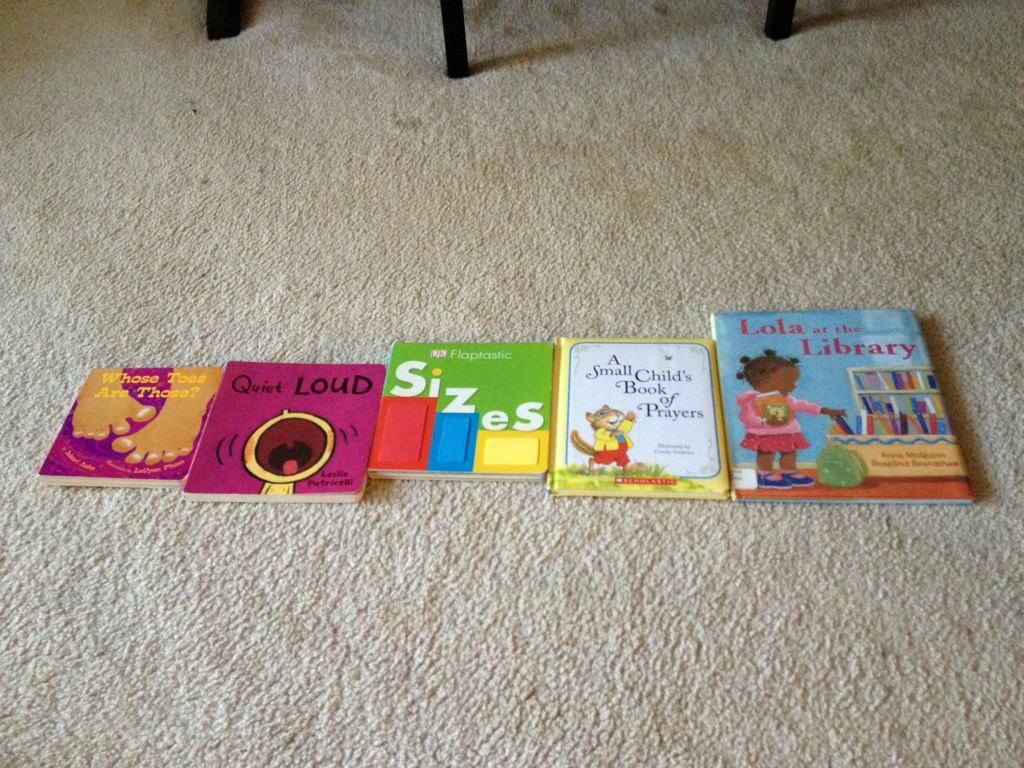
books lined up according to size, during independent play.
But speech, they break to us gently, is a symptom, not the core issue. They cannot determine, through this battery of tiny tests, how much of what we say is being understood. Perhaps she is isolating recognized words, but not grasping entire sentences. Perhaps she doesn’t answer or ask questions because she isn’t sure how to arrange what the words she knows. They tell us her play is too orderly; she is more interested in lining things in neat rows than in fashioning intricate worlds.
Were she hitting developmental milestones, in other words, she would not have just offered the bear a drink. She would’ve told us the color of the juice or charged him a million dollars for the privilege of dining in her castle.
It’s manageable, they assure us. The assessment, after all, was to determine how best to address her needs. They say that she is in a good place, at home during the day and surrounded by familiar faces who offer patience and love. They look warmly to her father’s face in my phone when they say this.
And she shows determination. Many of the children they visit run to other rooms when they won’t or can’t engage the women’s activities. Story stands her ground. She is brave.
I am late to the radio station. On air, I do not hear myself. The segment is about how single mothers “make it work.” But this is a topic on which I know too little, especially today.
Back at home, I hold Story close. We all do. I give my heart the rest of the day to adjust to the new light in which I’ve been advised to view my daughter. It is as bright as it’s ever been, as bright as the night she was born.
I crawled into you and set up camp. You were warm, steady as a strong-blooded pulse, and I was shivering. I came because I was sure I could survive. But you wanted me, remember? I did not invade; I was invited.
Soon enough, I learned you were a desert. Everything that grew easily had been gutted. You were no mirage; I touched you, beveled, pocked, and longing. Every space where you hurt hummed under my hands; I saw the blood. Sometimes, I walked away with a spot of it staining a dress. Old blood, crusted yet somehow fresh: oozing from regenerative wounds.
I saw enough — felt enough — when I leased this square inside you, already so overrun with other squatting things. I thought I understood. There were memories and guilts and sadnesses you must nurse and not evict. They are the true lay of your land. And though I did not set out to save you, I still cradled a garden in my palms: every seed I thought you’d need not to die. I still prayed that I’d grow the right balm to properly bandage your gashes.
It was easy to ignore how dry your tongue remained after giving you so many gourds of water. Your kind of thirst is difficult to quench; you wish for a well whose waters bend time. At my best and on the keenest-eyed of voyages, I will never scout you this. But we remained silent on the subject. It seemed enough that, even when your eyes were sallow, listing, they still lit when they locked on my face.
(Didn’t they?)
Sometimes I followed your gaze and saw them: a family, waiting, their laughter carrying across these empty arcs of dust and air. You would rather be with them. Our circle of seeds was inadequate.
You could see what I had yet to: the futility of tilling. But it brought you the briefest of hopes. You have always wanted a garden. Something must’ve appealed to you: the gentleness, perhaps, with which I lifted sand and primly patted it back, my cracking lips dropping promises: someday, we’ll dine. You could see it, once, couldn’t you? A feast of eggplant and lentils, of grapes so pregnant with juice that their skins pulled away from the stems?
I could be so strange, sometimes, so withholding. But I wrote you so many loving missives in the sand. (You read them? The winds will let you hold them?)
Yours is a house of sorrow but your porch was built of cedar. We sat there, somewhat happily, awaiting signs of life.
It has been months since winter. But yesterday was cold. The frost bit our first — our only — emerald tendril.
(Or did it?)
Deserts are impossible places for love, overrun as they are with so many duplicitous images.
But I know that the family is real. Some of them are waiting. I see them, even when it seems I don’t. They are waiting, but they are also watching. Do not rush to them; they want you alive. They need you to drink and revive, to grow green things again.
Tomorrow, I’ll be a guest on NPR’s nationally syndicated radio program, Tell Me More with Michel Martin. I’ve been invited to join author and family therapist Lori Gottlieb to discuss single motherhood for the show’s weekly Parenting broadcast.
Beyond nervous. Beyond excited. I’ll update when a link to the audio becomes available online. You can stream Tell Me More live at WAMU FM from 2 pm to 3 pm EST. Use the NPR station locator to find out where you can catch it on the radio in your area.


 stacia l. brown