What Contraceptive Ignorance Costs Us All.

tumblr_inline_n07m55ri231r12si9
^^ The adults in my life, on the issue of birth control. ^^

I was taught nothing of birth control. In the white-walled rooms of youth groups where we buried our noses in bibles and pretended the promise or memory of sex wasn’t palpable, we were not permitted to ask. And in our nightfallen homes, the flicker of TV-light dancing on the weary, work-ashen faces of our parents, we dared not bring it up.

I did not have friends who I knew were on it, did not discuss its dire need among the ones who were already smitten and surreptitious. I wouldn’t hear any of my girls openly, casually discuss it till we were in our mid-20s and even then, the possible side effects sounded terrifying: bloating and rapid weight gain, mysterious acne and blood clots, uncertainty attendant to possible misuse.

Contraceptives felt like contraband, something to be secreted away or shrouded in enigma and shame, if used at all. It would take years for me to truly understand the vital need for a woman’s vigilance around procuring it.

I had sex for the first time at 24, a week before my 25th birthday. A condom was used, and this set a precedent: one partner, one form of contraception, one party responsible for securing and using it (him). My first pap test was during that 25th year, with a black woman in a Midwestern city who did not press me on the issue of birth control. She asked if I was fine with condoms. I nodded meekly. Her lips became a terse line as she jotted this down in my chart. We moved on.

The same happened at my grad school clinic a year later after a pap. “You and your partner are welcome to explore any contraception you wish. Or none, if you’re exclusive and tested. It’s up to you.”

And so it was that I never saw up close the oblong compact I could gingerly open, looking down and comparing it to a theatre in the round: each compartment a tiny seat, each pill a fully paid ticket to bodily freedom.

No one told me there were springy bits of copper and plastic that could be positioned inside you for years, preventing all possibility of pregnancy. I knew little of the patches we could press to the backsides of shoulders or the sexiest curve of our hips, patches that withstood the daily pulse of shower-water and willed their potion firmly under our skin.

I was doggedly incurious and there were many reasons: the long-distance nature of my relationship made physical intimacy infrequent — far too infrequent to warrant the constant use of a contraceptive. And what would come of my body? Would it rebel, resist, reconfigure? Would I be labeled loose if the pills or patch were discovered by the women who’d never seen for to tell me they existed in the first place? Would an IUD lodge itself someplace precarious? Would I forget to use whatever I chose?

Would it fail? Would I?

I was not raised to prepare for premarital sex but rather for any number of punishments that could befall me in its wake.

Indeed, my pregnancy at 29 was considered, by some, to be some sort of handed-down sentence. Among those for whom discussion of birth control remains a hushed or silenced subject, conceiving you seemed evidence of a fundamental failing. And to the extent that it is true that I’ve failed at anything, it is at handing responsibility for my body over to a partner whose stake in its reproductive health is, necessarily, far lower than my own. It is at not investigating all the (then relatively unthreatened) options open to me. It is at leaving so many stones of knowledge unturned.

Contraceptive ignorance is far costlier than a prescription. It limits the conversations we can comfortably enter, armed with an informed opinion, an educated vote. And, to be sure, remaining willfully ignorant of the myriad roles of contraception — those far beyond the mere prevention of pregnancy, far beyond the myopic scope of stigma — makes us complicit in every legislative battle women and men are waging to retain affordable access to birth control and care.

Pretending we are not sexually active often enough to need it directly threatens the rights of those who are certain that they do.

Make no mistake, the decisions to conceive and give birth to you were entirely mine. No legislator told me I had to; I was not barred any preventive prescription I would’ve needed, had I made a different choice. I want you to grow up in a society where the same is true for you.

You are still so little. I am still so out of my depth. How will I give you a wide, unobscured berth of information when I am still cobbling my own knowledge together in bits and pieces? What exactly will we say when we whisper close, over cocoa, ’round issues of sex, reproduction, contraception, and faith?

I have time to yet to figure it out, but I am alarmed at how fast that time is dwindling. I am equally alarmed at how many of your options are dangling in the balance.

There is no way of predicting what, precisely, you’ll need. Every woman is a wonder, in her capacity to decide what is best for herself. And this, of course, is where we will begin. This is your God-given body. This is your God-given mind. This is your God-given will. These are the tools you must use to lay claim to your every choice.

The Gentrification of Online Safe Spaces.

Image
 
No space is ever truly safe, even if we are in it alone. Alone, we are subject to tricks of the mind, the echoes of others’ expectations, the sudden bombast of forgotten obligations and regrets, resounding as soon as we endeavor to rest. With others, the presumption of safety can be a perilous, even fatal, misstep. But most of us have our crouching spots and crawl spaces: a parent’s house with its abundance of downy comforters, a best friend’s guest bed, a lover’s embrace. 
 
Those of us who have the privilege of such spaces may find it easier to believe that they can be replicated elsewhere. Those who do not may be eager to find them anywhere. 
 
The Internet affords both of these camps their illusions. Here, we are at once alone and among innumerable others; depending on where we position ourselves on any day, on any site, with any moderated number of virtual friends or followers, we can imagine ourselves impervious to harm. 
 
This is one of few explanations for the many things we allow ourselves to divulge online: admissions that, if uttered aloud, would send the palms of our hands flying up to our mouths; the signs of extended mourning we hide from those who would rather hear a simple “I’m okay.”; all the secret prejudices we’ve gotten so deft at pretending we do not hold. We are telling on ourselves with alarming ease and frequency; it can only be because we have forgotten the Internet is unsafe — or that we have reached a point where we have too little left to lose. 
 
Recently, Twitter, one of the most popular of my online spaces, has been locked in bitter land wars over intellectual property and moral obligation. I’ve watched, most often neutrally, as users have registered surprise, disappointment and betrayal when the experiences and ideas they’ve committed to their public accounts have been published elsewhere — with and without permission, usually with attribution. 
 
Those reproducing their work are often doing so for daily content websites and cable news outlets — large corporate conglomerates who stand to gain revenue from the publication of tweets that writers hoped would be viewed within the confines of their online communities alone. 
 
Once that perimeter is breached, reality becomes starker: every emotion, secret, and assertion was always up for the general public’s consumption; we’d just been able to push the idea of it — that our little corner of claimed space would hold such currency for others — out of our minds. Nothing once believed to be safe ever was; the scales of insularity fall from our eyes and we see that out carefully tended online communities were never really ours. 
 
It’s easy for those who do not use the Internet (or those who use it with more strategic and sterile intent) to mock this. Always, the immediate aftermath in the face of an online community’s outcry is: Why didn’t you read the fine print? Your safe space was merely leased, never owned. Why did you entrust so much of yourself to it?
 
These questions are as central to defining ourselves as they are to nailing down why we use the Internet, despite how susceptible it leaves us to ill-treatment.
 
For those in need of attention, escape, an opportunity to deliver weighty confessions into passively receptive void, an online space will always be a tempting oasis. A dangerous community is still a community, our relationship with it wary and imperfect yet filled with the shared camaraderie of survivors. If we can still come to our online spaces, open and imparting, at the risk of identity theft, harassment, and rejection, it is safe to assume we believe there is much left to redeem in the niches of the Internet we’ve carved out for ourselves.
 
It is hard to abandon what you’ve built, even when it’s been breached, even when the confessions we sought to gate with privacy settings, block buttons, comment disabling, or tacit trust agreements are advertised to a broader, more cutthroat culture. We see in our own online musings exactly what the people who are paid to parse and promote them see: potential. Leased or owned, a homestead is worth defending, even as its former glory fades and we are enticed by the buy-out of bigger audiences.
 
Maybe these are unwinnable battles. We enter the Internet at our own risk and leave it with every risk brought to fruition. But I, for one, am not ready to give up on the power of online self-expression. I know well what offering one’s vulnerabilities to a semi-anonymous forum can do for its members. Perhaps there is something left to hold out for, after all. Perhaps we should just do so while with thicker bars on our windows and walls. 


Some of Us Just Want to Be Unbossed.

tumblr_n28fp0mFKQ1rskga0o1_400

Patriarchy wrings young women dry. It tells girls who were raised in households where men were not present that their mother’s ability to thrive in a man’s absence was not a testament to her strength but evidence of his rejection. When a mother internalizes this, her daughters are raised under a specter of spurning. Every action and word they witness is instructive: this is how to act when you are a woman and mother on your own: decisive, assertive, impatient, frustrated and curt, entirely confident and selectively cooperative. This is how to own yourself: be unapologetic; accept that it may mean remaining alone.

But a daughter raised this way may not immediately ascertain the appeal. She may be lured instead by the promise of men’s presence, by the challenge attendant to compelling them to stay. And she may act in all ways opposite her mother’s example to curry their favor.Learn to cook, she might note, not what you love but what he will eat. Learn to let a last male word — even (and perhaps especially) a foolish one — linger in the air. If it is foul, pretend not to notice its stench. Allow him its echo. The last word is a preservation of dignity. Women who shout down humiliate.

(But what of our dignity? What of our own humiliation?) 

*  *  *
I was ten when the only man who ever lived with us moved in. He told me, early and often — whenever I wanted to be heard, whenever I seemed to be more than an ornamental fixture of a marriage he barely wanted — that I was disrespectful or ungrateful for his guidance, provision, and presence. If I said: you are wrong; if I said: I’ve not done what you’re accusing me of; if I said: I am not who you’ve convinced yourself I am, he would take these words to my mother. If I brought the words to my mother first, he accused us of conspiring against him: peasants attempting to overthrow a king.

In marriage, my mother was bossed, her husband a man not given to ceding the final say. Over time, she learned to be meek. If peacekeeping meant to defer — or, as our churches taught wives, to submit — she would. But she had to contort herself to do so, had to twist like wet laundry to be left out in the wind and pretend that being limply pinned,  absorbing  her husband’s hot air, was a welcome aspiration.And sometimes when we were alone, in the quiet of a house for which he paid, she would tell me to throw the fight. Accept the charge. Nod at the accusation. You know who you are. It does not matter what he calls you. It’s his house. Let him win. 

Bossy. Boss. Bossed. None held much appeal. None were winnable.

I was not raised in the manner of girls whose anthems and aspirations instruct them to run things. I would not know where to begin, if I were told I should govern myself as though the world were a corporation and I, its CEO.

I was raised to know who I am but to keep quiet about it.

*  *  *
My daughter is months away from four. Every day for the past two years, I have watched her struggle to coax words up from her consciousness — where they seem to be quite clear to her — and out through her mouth, where they often sound garbled to the naked ear. Sometimes, she wails in frustration. Sometimes, she barrels through, happily chattering as though she is fully understood. And sometimes her expression clouds because she knows, looking into the face of the listener, that she is not.
I would never have learned the importance of raising my voice if I had not watched her wrestle so with hers. Her language is swimming upstream, but she calls out over the current. I will be heard, is what I always hear, whether I understand the words or not.

And I would not have understood being assertive if it had not become so essential to advocate for her. Regularly, I weave in and out of meetings, in and out of conversations, where her development, her hearing, and her cognition are assessed and questioned. It becomes ever clearer that managing someone who cannot manage herself requires an absence of ego, an open ear, a willingness to give oneself over to the study of what best serves her needs and her interests. This kind of leadership hinges not on being acknowledged as a boss but as a confidante, not as a superior intellect but as a constant student. We do not become assertive by telling others what to do; we do it by informing them of what we will and will not abide.tumblr_lyyqjuu3jI1qeoyjlo1_400I am an opter out of many discussions. Whether to embrace or repudiate the term “bossy” is one of them. But I know well the damage that is done when young women and girls are not taught to speak on their own behalf. I know what fighting to own oneself looks like and how terrifying it is to watch a woman go slack under the guise of submission. I have contorted myself for men who’ve seen no need to do the same. And I’ve worked for and with difficult, yet enviably self-possessed, folks of many genders.

It is always the better lot to own yourself, to carry your voice across the current, to insist that you should and will be heard. And it is often the better lot to be gentle — not only with others, but also with yourself. Label this however you will; it is an ideal way to live.

Let every man and woman who wants power pursue it, but not at your expense. Power isn’t the ability to make others bend to your will; it is possessing sole guardianship of your will. If you would be “bossy” about anything, let it be about how you will be addressed and defined. Let it be about who cannot enter your space with the intent to tamp you down. Let it be in the stead of those who have gone limp or shrugged off their wills and thrown them at the feet of someone they love. Let it be for those who have been treated as though they are incapable of governing themselves at all.

Some of us are best off calling ourselves unbossed. Like Congresswoman Shirley Chisholm, we want history to remember us, not for the professional goals we accomplished or for ascending through ranks often dominated by men, but for the larger feat of holding onto ourselves in the process.

When a (Comparatively) Carefree Blackgirl Wins An Oscar.

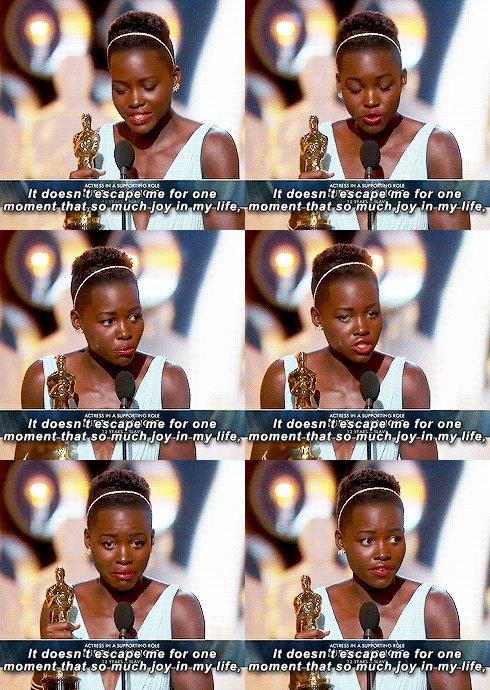
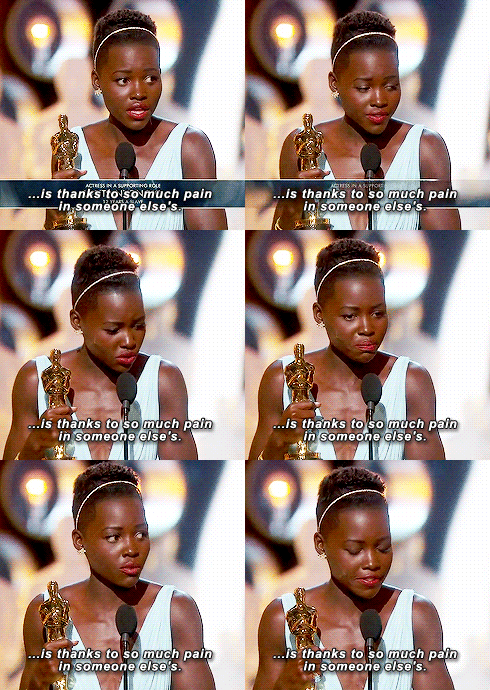
tumblr_n1uoglCvBv1smnm8eo1_250tumblr_n1uoglCvBv1smnm8eo2_250

This is a story of an elegance carefully cultivated. This is no sudden ascendancy to delicate silks and bold brocades, no tale of a girl plucked from obscurity or hardship, conferred the brass ring of Tinseltown by princely powers-that-be. It is, instead, a story of privilege, of justice. It is what happens when a Kenyan senator entrusts his daughter’s post-secondary education to The Yale School of Drama, rather than insisting she study medicine or law or finance. And these — the highest accolades in the field — are what’s expected when such a daughter is daring enough to pursue a life in pictures, within a family of professors, physicians, and politicians.

This is not a reality as well known to American black girls with silver screen ambitions. We watch our stateside actresses languish in Hollywood for decades, delivering pounds of flesh just for bit parts: girlfriends in black films and girlfriends in white films and staid, put-upon wives in comedies, action films, biopics. And yes, even now, the occasional brave domestic, even now, the harrowingly tortured slave. We see them shed their apple-cheeked innocence all too quickly, becoming more vocal and more cynical about the dearth of complex and meaty work for them to do as they age.

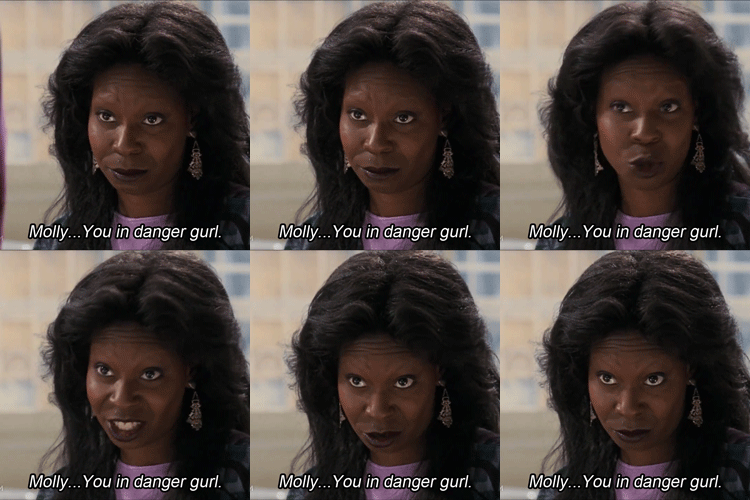
Our ingenues rarely win Oscars. It is our seasoned comediennes, sassing their way through lines like, “Molly, you in danger, girl!” or throwing frying pans at their pregnant daughters, who take home the gold. It is the reality star who belts a gut-wrenching beggarly torch song to a man already walking away or the naked grieving mother sexing the guard who executed her husband, the round, battered, quick-witted maid who bakes her own excrement into pies. They are the ones who win. And we are proud of their achievements. We take everything we get, and we are glad for, if critical of, it.

We know how hard those actresses had to work to get it, know how many low-budget straight-to-DVD flicks they made to keep themselves visible, how many blond wigs and gold teeth and fishnets they had to don and exactly how much of their bodies they had to bare — just for the opportunity to be seen. We suffered through Whoopi encouraging her ex to appear in blackface. We accept not just the existence, but the five-year run of The Parkers. And we swallow the painful realization that though many a role easily procured by a Paltrow, a Portman, or a Witherspoon could be played, if not better, certainly just as well, by an actress of color, the film would not likely be attended by as large an audience.

Because this our sisters’ lot in all of the American workforce. We are offered little, we earn less, we hustle harder and stress more — all in response to the idea that our appearance and ideas and work are not as marketable as a white colleague’s would be. Why should Hollywood be different?

tumblr_n1uyraUeOu1rdf2ito1_500

We are gathering our awe and placing it like so much frankincense and myrrh at the feet of Lupita in direct response to this resignation. This awards season she has become the boilerplate of every blackgirl dream deferred, and it is understandable. Her skin, a brown so rich and deep it seems to welcome the seeding of our hopes and the promise of harvest, is politicized (and romanticized) because such things are inevitable in any country where skin color can ignite or exempt citizens of resentment or responsibility. Nyong’o herself speaks to the significance of women who look like her ascending in high-visibility markets. She cites Alek Wek and any number of American black actresses as her own self-image inspirations. And she is similarly self-aware of what it means to be a literal projection of an audience’s desires, history, and needs.

But the story of Nyong’o’s near-instant entree to the A-list is uniquely her own. She stars in an elegant, brutal British film about American slavery, deeply connecting with part of the diasporic experience that is foreign to her family in ways it is not to the American black’s. And she graciously accepts a well-deserved Oscar for that portrayal without having to carry the full weight of the awards’ contentious racial history.

If she hears any naysaying speculation, any claims that she “only” got the Oscar for playing a slave or that the win isn’t one the black community can fully claim because she “isn’t ‘black’ enough,” the criticism will not dampen the moment, will not force her to interrogate her joy to the degree that it would for an American black actress.

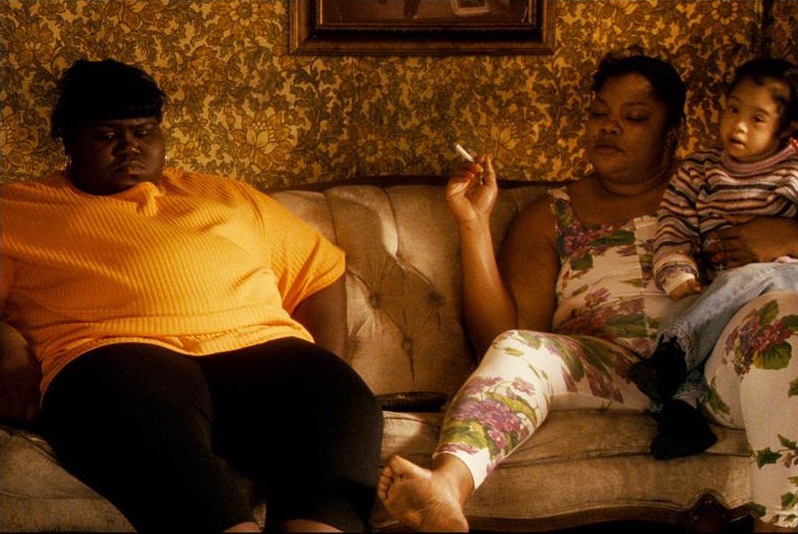
She is not saddled with centuries of diminishing returns. Accordingly, Lupita is a carefree black girl par excellence — and we have yet to see what the career of a black actress this successful with just one feature-length role under her belt, and this comparatively unburdened by Hollywood’s racist legacy, looks like. (Consider other recent black American actress nominees with one role their belts — Quevenzhane Wallis and Gabourey Sidibe — and how their reception in Hollywood and media compares to Lupita Nyong’o’s. Neither swanned through her awards season unscathed by racist, appearance-policing coverage — and Sidibe is still the subject of think pieces that actually use their headlines to implore that the public treat her with more respect.)

It is this lack of similar encumbrance — perhaps above all else — that excites me so about Nyong’o. We have yet to see what happens when a privileged black woman begins her acting career with Ivy League theatre pedigree, unchallenged fashion icon status, and an Oscar for her very first role.

It would be easiest to succumb to the skepticism I’ve been keeping at bay. I know America; it’s my homeland. It is not Nyong’o’s. I’d imagine — and I could well be wrong — that she is coming into Hollywood with the un-self-conscious approach to race that Chimamanda Ngozi Adichie’s Americanah heroine Ifemelu (and indeed, Adichie herself) have brought with them to this country.  Adichie was famously quoted last year as saying that American blackness did not initially occur to or appeal to her:

In Nigeria I didn’t think of myself as black. I didn’t need to. And I still don’t when I’m in Nigeria. Race doesn’t occur to me. Many other things occur to me. But in the United States, yes…. Also, race is something that one has to learn. I had to learn what it meant to be black…. If you’re coming from Nigeria, you have no idea what’s going on. When I came to the United States, I hadn’t stayed very long, but I already knew that to be “black” was not a good thing in America, and so I didn’t want to be “black.”

While I don’t get the impression that Nyong’o, having spent the last two years of her life immersing herself in study and portrayal of the American slave experience, would hold the same perception of American blackness as Adichie initially did, it is safe to say she can still hold herself aloft from it. For her, blackness, in a context of white American oppression, is a role. It is not intrinsic to her identity. She will play plenty of other roles, but she will not feel “relegated” to stereotypical portrayals in quite the way that American black actresses do.

I already know what Hollywood will try to make her. I know the gradations of blackness they will implore her to learn. But I do not know how she will resist. I do not know what she herself will teach. But she is entering the field with just enough privilege and confidence to inspire my hope that she will do just that: instruct rather than simply accept — and learn from black actresses (rather than white directors) how best to navigate this space.

Watch with me. And just you wait.

Stacia’s Minor Notes and Writing You May Have Missed.

Today marks the beginning of the third month of the year, and I must admit I’m feeling a bit untethered. After years of cultivating a very specific voice for this blog, I’m having a harder time conjuring it these days — and I’ve been allowing that to stop me from updating as much as I’d like. Aside from my last piece, which was the most viewed post in the history of this blog and which was picked up at the American Prospect, I’ve only updated one other time this year.

Freelance writing also seems to be slower at this point in 2014 than it was by this time last year.

Even so, here’s what I’ve published since 2014:

  • A piece on a Melissa Harris-Perry Show faux-scandal that already seems like it happened a lifetime ago.
  • Something about how white the Golden Globes are and how infuriating that was this year.
  • Musings on a mall shooting in Columbia, Maryland at the mall where I most often take my daughter.
  • And this piece, written in the wake of Philip Seymour Hoffman’s death, which I wound up really being proud of, even though I had one of the details wrong.
  • I also wrote this about mothering and teaching mothers in a college setting.

I’ve read two novels, too. Roxane Gay’s An Untamed State, not to be released until May of this year, and Gina Frangello’s A Life in Men. Here are my impressions/reviews of them on Goodreads. And did y’all know I also have a Tumblr, where I occasionally do some creative microblogging?

Here are a few pieces I’m only highlighting here because they’d be hard to find there, between my copious reblogs of Chiwetel Ejiofor photos:

http://one-offs-from-slb79.tumblr.com/post/77119720682/stop-wanting-pack-your-jaws-with-paper-chew-the

http://one-offs-from-slb79.tumblr.com/post/76710516711/i-know-too-little-about-men-ive-only-ever-lived

http://one-offs-from-slb79.tumblr.com/post/76600977441/you-know-what-youre-ready-for-it-isnt-this-it

Because 2013 was an amazing, prolific, incomparable year, I’ve been putting a good deal of pressure on myself to keep pace or outperform. But as the first quarter of the year begins to draw to a close, I’m just going to keep steadily at work. If you’re like me — prone to anxiety and hard on yourself — I’d encourage you to join me and do the same.