Stacia to Appear on NPR’s “Tell Me More” on April 16.

Tomorrow, I’ll be a guest on NPR’s nationally syndicated radio program, Tell Me More with Michel Martin. I’ve been invited to join author and family therapist Lori Gottlieb to discuss single motherhood for the show’s weekly Parenting broadcast.

Beyond nervous. Beyond excited. I’ll update when a link to the audio becomes available online. You can stream Tell Me More live at WAMU FM from 2 pm to 3 pm EST. Use the NPR station locator to find out where you can catch it on the radio in your area.

UPDATE: The audio for the segment can now be heard here: http://www.npr.org/2013/04/16/177468617/single-moms-on-making-it-work.

Love and Language.

1.

First comes the absence of accent. You hear it before its loss registers elsewhere: a flatness, frosty and far, where there were once warm lilts and bends. Your voice was a carousel, your language a whirligig. It’s since sanded itself, become polished and practiced, indistinguishable.

You are hiding your truths in places you will not so readily find them.

It is easy to tell a man you love him, easy to mean it. But over time, it morphs in your mouth, its meaning multiplying, reducing, clouding. Something is always wanting, in the translation.

You are not clear when you articulate love, because you have never understood men as more than audiences. Perform for them, but keep them distant. Perform for them, but know when to leave, when to grant an encore. The performance must be evocative, but respectable. It must titillate but it must also offer insight.

You are less actress than apprentice. You cannot tell if he is on the edge of his seat or yawning. Men, in this way, are mysteries.

But this is beside the point. Audiences owe so little: attention, at best, and in short supply. The actress owes a world.

No, never view a man you love as something to be acted upon. You mustn’t perform. You will always feel you are earning a keep. You will dance till dawn for a bit of applause and feel empty, wanton, when he withholds it.

Women learn this first with inconsistent fathers. When they are with you, you wish to dazzle them — and you do. For as long as you care to, you do. Find his heart, his preoccupations, his passions. Become conversant in them. And you will be clever and interesting because, at first, you are the most flattering kind of mirror. When he is with you, you offer such forgiving reflections. He is younger with you, time has stood still, a judgment day feels far enough at bay that you’ve nearly convinced him he’s invincible.

But he is often gone. And in his absence, you are building calluses over your needs. First it will be hard and hurtful to articulate them. Then, you will not feel the need to do so at all.

What is love, if not knowing when to keep silent?

The beginning of new relationships is when your accent is heaviest. Love leaves your lips easily, and love on his lips takes a razor to every callus.

I want to know everything, you whisper. I want to tell you everything, he responds.

You hope to dazzle him, and you do. But soon, you will want your distance. And in the distance, the calluses crust over.

2.

My daughter’s speech is muddy, a mix of water and silt. It floats out, as if behind gauze or a veil. I understand her, sometimes, but less than I’m told I should by now.

I am not one of those mothers who begs and borrows and steals to acquire the trendiest literacy aids. I do not own an iPad. I believe in board books and conversation and sunshine.

She watches television. (And I realize, at this point in the reading, someone is sending me to the stocks or the noose in old Salem. But understand, at this point in the reading, that if my daughter did not watch television, I could not be writing this. If I hadn’t watched as much television as I did growing up, I wouldn’t likely have wanted to be a person who writes things down.)

Now that she is closer to three years old than two, I am told her speech should not sound like it is being sifted. She should be clear, responding to questions, asking them, forming simple sentences.

Because she is not in daycare, we have both been spared the intense developmental comparisons we’d find there. But whenever she does get to mingle among peers, I am concerned with her insouciant acquisition of language.

She is no loafer. Story is an empath, a firebrand. She is intellectually curious, musical, startling perceptive. She is creative, a gesturer. She cobbles her own expressive roads.

But she does not speak in ways that are easily understood.

Even mothers like me, neither tigers nor minimalists, know when to be concerned about their children. And for us, it is rarely overreaction.

I worry that she has inherited my ambiguities. I do not often know how to speak, either. Perhaps it is just that the words morph in her mouth in more literal ways than they do in mine.

But here is where that similarity ends: my daughter knows exactly how to love. It is not complicated. It is in the eyes, in invented songs, in laughter, in the folding of her bony limbs and skin around mine. It is all the kisses I give her, returned. It is alphabets and gifts of toys, constellations, saying hello to the moon, to her mama’s smiley-face mug in the morning.

It is not confined to the way her words are formed.

3.

Nearly a fortnight ago, in the basement bar of an East Village restaurant, I slid onto a stool, waiting for a lithe, sparkly-eyed twenty-something to transfigure an excerpt of fiction I wrote last year, in a fit of pique. She was first in a lineup of actors cast to read the works of writers, both established and grappling. I am the latter, of course, the non-resident only in New York for a few stolen hours, the sole writer featured without a published book to sell.

In Baltimore, it is easy to forget who you are. It is not so often affirmed. In New York, if you are literary, neither affirmation nor criticism are ever in short supply. You are among kinsmen fluent in the language of representation and publication, professorship and craft. You are among people who amass rejection and do not identify it as masochism, but as love.

I had never heard my work publicly read aloud by anyone besides myself, let alone performed. New York is the only place where I’d want to.

The audience waited for the first line, spoken by a seven-year-old twin to her conjoined sister: “Do you think Mommy loves us?” It’s a play on an age-old theme, a lifelong wonder. Are we allowed to interrogate love? And when we do, will we ever be ready for the result?

The girls are black, sharing organs at the lower torso. One is developmentally delayed, the other fairly precocious. In this scene, they are in conversation. It is difficult to imagine this going well. The actress is white and grown, her body positively un-twinned.

But the language is universal, her interpretation thoughtful and quiet. She draws the attention of our intimate crowd, pulls them toward the words, and for a moment, they are not my own, and she is no longer there. There are only the twins, those susceptible twins, and their questioning of a mother’s love.

My friend Shelly, who co-organizes the event, tells me witnessing this often makes writers as nervous as if they were reading their own words aloud. Indeed, it is a foreign thing to see something intended for silence enlivened. It is strange to surrender a sliver of an incomplete novel to a room, to see the way your own words land on other ears.

This is is what readers do all the time, Shelly reminds me. They take our words into themselves, add their own inflections, superimpose their experience. They gasp, perhaps chuckle, and occasionally, they call into question their loves.

It is risky to be let in on this process. Day to day, we understand the words we write as spores, floating out and off and overhead, but rarely touching down.

Here, I was watching cupped hearts catch them. I could see them sink into the loam.

I had my answer, then, about the way I communicate love. Mine is an adoration mapped with words. For the utterance of a loving word is the loudest act there is.

Becoming Gazelles: A Mothering Story.

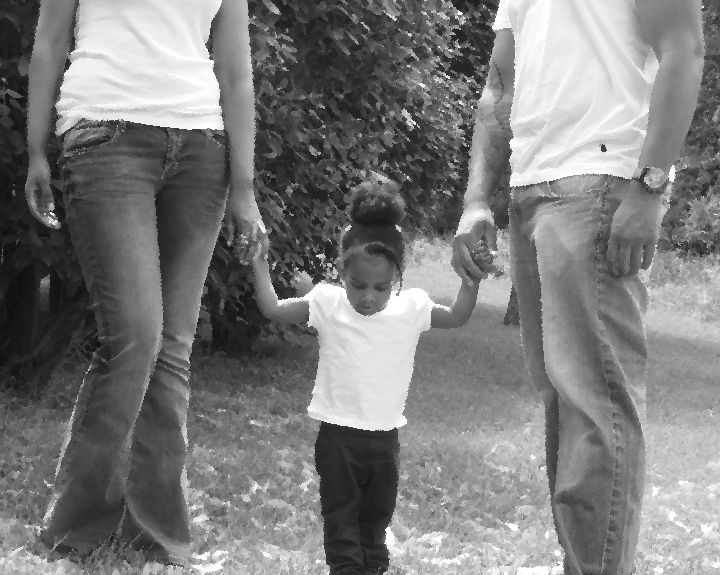
Story, age 2.5, and I. Photo credit: me.

Years before I had her, I snapped a photograph of a majestic, whimsical girl’s bed in a discount furniture store and immediately began to dream of the daughter whose slumber it might bear. Tiny but preternaturally strong with hair the color of starfish and sand, she had eyes that saw even when they were closed, even when she was sleeping.

The bed cost over 600 dollars. It was not worth this much. Shaped like Cinderella’s pumpkinesque carriage, its framing was forged of thin, cheap metal. It did not come with the shimmering sheers that would’ve completed its transformation into a thing fit for a dream-daughter. Still, its price forced me to imagine a life in which paying for such a thing, its fancy so fleeting as to be outgrown in five or fewer years, seemed possible.

I have never wanted to be wealthy. At turns, I’ve dreamt of life on a converted schoolbus or in a fully furnished RV. When I imagine a home, I think of modest two-bedroom apartments, of cheap and unloved houses of the type that are all but abandoned in favor of the plywood monstrosities that keep popping up and displacing the deer in my community. I dream of a dwelling that does not further alter a city’s ecosystem.

This has not changed much with motherhood. I have not been struck with a sudden compulsion to amass everything ever invented for the modern American child. Despite the occasional twinge of guilt over what material things I must forgo, I understand those things as the ephemera they are. That tiny, strong, perceptive girl I once pined for at a furniture store display exists now. And mothering her looks far different in practice than it did in my imagining.

What is sure is that she deserves all I am capable of giving her.

But what has become most important for me to give her is not a bed that will compel her to buy into our rampant princess culture, is not a life of excessive and bottomless longing. What is essential to her inheritance are the things only I can provide for her — and those things cannot be procured with mammon.

We do not yet live alone. For her whole life, we’ve had company. First, there was her granny, my mother, boarding in my one-bedroom space in the Midwest. Now we, all three, are boarding with my grandmother in a two-bedroom place back East.

This has its certain magics: that my daughter can tear barefoot ’round a corner and be caught in loving arms while I write; that at any moment, I might overhear her sharing conversation with a woman 68 years her senior; that I can leave home with her seeing me off at the door rather than from behind the walls of a daycare center. But this multigenerational home-life also has its downswings, not least of which is the feeling of deference our domicile tends to elicit.

In the homes of others, I have always assumed a silence, a compliance with the established rules and roles of the owners. And this is doubly true when I am among foremothers. I have never learned to stand steel-backed before them and say: I have grown. I am not just womanish but fully a woman, no longer a post-adolescent girl over whom one must hover, dispensing stray insights.

Among grown women, stray insights are best held on the tongue till solicited. The wisest women solicit often — but they also know when to stem the tide.

I am still learning this wisdom but it is critical to raising the girl I have birthed. More important even than finding the means to afford us rooms of our own is the ability to stand sure-footed in any room and to declare that which is and is not acceptable to say or do to me and mine.

Boldness is bought with a price I was unwilling to pay before becoming a parent. The cost of being too often disliked was greater than the satisfaction of feeling assertive. I have rarely born well the rejections of those who find themselves surprised, displeased, or disappointed with me, after I’ve staked some claim or held some ground they would rather have seen me cede. Always, respite from the expectations and approval of others has been easiest for me to find when I am farthest away. But a mother should not have to become a vagrant to infuse her own voice with certainty.

Assertiveness is the gift every girlchild needs most, that quiet self-possession that can state without tears and with total composure: this is the line you will not cross.

Yes, more than money, bedtime carriages, or even our own home, it is an unshakable sense of herself I work hardest these days to preserve, and an unshakable sense of my own self I work hardest to provide.

In so doing, I’ve discovered there is no greater need for these gifts than in our interaction with each other. For we are gazelles, alternately locking horns and spurring each other toward swifter, surer, and more graceful gaits.

Holy, Holy, Holy.

There is a sign at the sight of Thee. There is none beside Thee.

This year has been a reckoning, a humbling. Each day and every breath, a reminder of your mercy and our own mortality. This year, we have lived our own Massacre of Innocents. In advance of this holiday, we were informed anew of the cruelty inhabiting Earth and of the compassion it will take to overcome it. In every telling of your origin story, the most improbable point for me has been that a king would slaughter many in an effort to obliterate one, that a man of great might could feel so strangely threatened by children.

I need no longer imagine.

This year, You have been a sickle, gathering unto Yourself those we’ve loved. Though we know there is no better place for them than with you, exulting in this has not been easy. Even as we commemorate God’s infinite love made manifest in You, we, like the parents of Bethlehem, are haunted by loss.

It is our charge, then, as this trying year begins to finally recede, to restore our faith in the Incarnation, to reclaim whatever wonder has slipped from our grasp.

The beauty of your birth must never be blotted by our sorrow. That You have come to us and that You continually pine for the renewal of our faith are gifts whose value cannot be measured. That You are able, morning by morning, to transmute our misery and usher in the kind of love we could no longer imagine, is the reason we rise each year on this holiday and proclaim you holy.

You are what we cannot be.

Stretch.

The sky can be sliced, can be serrated. When we fly, clouds pull apart, the first heaven reconfigures, an unblemished celestial landscape forever alters with exhaust. It has become commonplace, flying. We view it not as an enchantment, but an inconvenience. We are not awed by the height we reach nor the speed with which we may exit one icy clime and find ourselves in the warm embrace of another. We forget that this is only possible — earbuds stuffed into auricles, pillows plumped under our heads — because someone stretched.

Someone enacted an idea with a reach that exceeded his grasp. With a pounding heart and a galloping mind, he sketched, he planned, he fashioned and tested and failed. He had help. He was lifted, both by those whose ideas dovetailed with his own and those who doubted his ability to ever reach higher than they could. He s t r e t c h e d, and in so doing, built something that serrates the sky.

I have gone whole days without stretching, gone full weeks, many years, a lifetime lifting toward spots much lower than those I could reach. I’ve been meek. Once my nana accused me of shrinking: you’re too young to be losing height and too old not to stand like you know you’re tall. Stretch.

Her mother was diminutive. She lived to be 95 and in her final years, when you entered any room where she stood, it felt hallowed. After decades of curling down, she felt close to heaven. My great-grandma trained as a teacher then married a factory man-turned-preacher and raised 10 children, quietly. Old photographs show her sitting, stoic and adolescent, amid her sassier sisters who would grow up to buy land, write poems, perform monologues, ride camels in Egypt.

I like to believe she was content. Perhaps family was her reach. Perhaps her laborious, love-glazed meals were all she needed to grasp. But it was only when her husband passed and left her with a decade alone that I saw her s t r e t c h. She ventured a joke, a smile, a risque repetition, and basked in the laughter that followed. She tested opinions on her tongue, rolled advice around her molars, conjured a voice more confident than I’d ever heard her use. By then, the bones in her back had calcified; her spine, not unlike a comma, separated her new and independent will from years of dependent clauses: if the children are well, if my husband allows, if the weather lets up, if the grandbabies need me. If I can.

Stretch.

My posture is not what it should be, nor is my opinion of myself. This, like my talents, desires, and eyes, is an inheritance. But so are long arms, a galloping mind, an appreciation of aircrafts and their ability to serrate the sky.

Stretch.

This year has been one of reaching, of fingertips pushing past practical possibility. I have stretched my perceptions. Stretched the confines of an INFJ personality. Stretched my patience till it was pulled thin and pliable as taffy. Stretched writing past entertainment, past preciousness, past secrecy till I reached activism. Stretched a dollar till it hollered, forgot its diminished value, and yielded to my will. Stretched beyond my agenda to help others reach an apex. This year has felt like a rack, like I was not so much the agent of my reach than a slave to it.

Stretching is rarely triumphal. It is born of discomfort, desperation. It is born of disgust and necessity. It comes from dangling: yours from the end of a rope and that of the thing you most desire, within sight but just above the air you can touch.

It aches, makes you painfully aware of the parts of yourself you neglect. Stretching intensifies your accountability: the stronger it makes you, the more you can carry.

I am carrying so much more than I ever believed I would.

S  t  r  e  t  c  h.

Penance: On Teaching an At-Risk Populace.

Sometimes, the student is a felon. When this is so, he will likely tell me in the first draft of our first formal essay, a narrative. He may write it directly: When I was in prison… He may feel the need to finesse it with euphemism: For a while, I was away, and no one visited. He is, on average, seven years younger than I and used to disclosing this upfront, lest it come to preclude opportunity, lest it force him to temper his personal investment.

If you are to change your perception of me, the sentence seems to suggest, do it when we our in our separate homes. Give us both time to sit with this decision.

This is different, then, from the students who write during our first-day icebreaker, of who they’d like to meet, living or dead, then tell our small circle of strangers, “My father.” It is different, too, from the questions they say they’d ask: Why did you leave? Where have you been? Did you love my mother?

These, they have no problem saying aloud the first time ever I’ve seen their faces. They do not look up from the page or read our expressions as they speak. But airing the words enlivens and steels. The writing is for them. The sharing, also.

For the narrative, there is no such prompt. They give whatever self-definitions they will. The felons share their convictions. The privacy they afford me, in marking their pages alone, is not for empowerment but protection: a gift for me, a shield for them.

In either case, at the lectern or alone, I do not wince at their sentences. A College Composition course is a confessional, and you must never flinch when you take confession.

Sometimes, the work reduces the likelihood of recidivism; sometimes it reinforces it. The student whose eye is a lomographic lens, every reaching beyond the confines of campus, may have learned this way of seeing during his bid. The young man for whom a syllabus seems a cell and a sentence is not likely to make it to midterms.

Whether he serves or flees, he leaves something indelible: a smile, either wan or determined; an evocative paragraph or a series of curiously used words (impropriety, boastful, besmirches); an essay that, with a bit of commitment, could stand alongside the work of R. Dwayne Betts or Nathan McCall.

It is then that the distance closes. They are no longer abstractions for whom we advocate or persons we are taught to fear. They are not cinematic constructs nor guileless innocents devoured by their environments. For better or worse, they have become their own men, their identities writ large in decisions they will never forget, in charges they keep close to the vest, in quickly-scribbled statements of conviction.

But in my courses–for better or worse–no felony can define them as fully as their scholarly interests can liberate them. Like everyone else, they enter as blank slates. So do I.

Each term, we earn each other’s definitions.

I’ll be teaching a summer writing course through my freelance business, Wings to Write Consultation & Coaching for five weeks. I’d love for you to join us. 🙂

And Our Little Child Will Lead Us.

First confront the shame. Shame is the behemoth, the Goliath. Fell it, and anything else insurmountable will shrink to scale. The great transmogrifier, Shame takes any form you let it. It may shapeshift into a messy divorce, into unmarried coupledom gone awry, into the solemn head-shake of a disappointed God and the gloat of His more judgmental congregants, into pitying married couples arranging blind dates as though the sight of you alone is as heartbreaking as a one-eyed limping animal in an ASPCA commercial.

Shame, for me, is a vapor: insidious, poisoned, barbed. It is a twin air, near-indistinguishable from oxygen. In order to lessen its paralysis, I have fashioned an elaborate mask, a filter. It traps negative observations and complaints; it purifies the dark confession. It clears the air. But there is always seepage, in places where air is its thickest, in rooms with invisible elephants, in restaurants and grocery stores that become mini-high school reunions.

When the air is too thick to be cleared, when smugness is acute enough to smother, when the task of answering pointed questions threatens to close your throat, it is best to remove the mask. If Shame intends to suffocate, let it come. Let it stifle if it must, but hold deep with yourself, in flattened diaphragm, in taut, expanded lung, in blood that pounds what’s truest through the heart, the knowledge that you can withstand it.

Once you learn to circumvent the shame, develop convenient amnesia. Curtain the crueler scenes, the ones which hinder progress and impede impartiality. Do not rehearse the ugly dialogue, nor swell with the indignation necessary to deliver a self-righteous soliloquy. Forget the well-dressed set, with its four poster bed center stage, where you spent months weeping and rehashing in the fetal position. Retire the ticks you cling to, the shorthand you use to decide on an appropriate emotion. These things will not serve you well in the upcoming acts. Take a red pen to the past. Slash all things that do not matter. They will be many. Focus on the empty pages before you, on the ending that as yet unconceived.

This is how you’ll fill them: start with the loveseat you sat in together last weekend, with your toddler between you, turning bony somersaults across your laps. She stops and glances first at you, then at her father; she has only seen you together at length a handful of times, but never quite so cozily curled as the three of you are right now. She does a double-take, eyebrows raising, and the wisdom of all of her 21 months converge in the knowing curl of her lips. The smile she gives you both–appraising, befuddled, approving–speaks volumes of her expectations.

She wants you civil. Relaxed. At genuine peace with one another. She wants you statuesque and grinning within the white-edged confines of photos. She is not here for your bittersweet memory or mourning, cannot conceive of a life spent reminding each other of wrongs. What she wants is the loveseat. And she will not split hairs about the kind of love it offers, will not scrutinize whether her parents’ affections are romantic or filial, as long as their love for her is unconditional.

This is what you owe her, a relationship as uncomplicated as sitting. This is not something you would’ve been able to give her at birth. It has taken failed previews, missed openings, and more rewrites than you’re capable of counting. It has taken a meticulous removal of the cataracts of offense, which warp and color everything according to their own pain. It has taken admission of your own fault, of the strange revelation that there is more than one way for the two to become one flesh, of the recognition, stranger still, that your incarnation of one flesh streaks through sprawling fields of grass. She casts glances over her shoulder and expects both of you to follow.

As you do, first tentatively, then with reckless, laughing abandon, you forget all the rules you’ve assigned yourself. You are, more than a former couple, more than realigning allies, more than two people who’ve hurt each other profoundly. Your daughter has reminded you that, above all, you are a family.

In this manner, she will ever be your guide.

Submission–

is Pandora’s box, is a false bottom, is essential. Is an open palm–even if pried, finger by finger–and an open mind–even at the risk of losing it altogether. Is to relinquish what you were certain was all yours: free will; personal space; emotional independence; your art. Is an uncomfortable exposure, a public nakedness, an objectification.

Submission is the virgin’s dive into the volcano.

*     *     *

Over months, perhaps even years, the pen has courted the page. One gave, one accepted. They were gracious; they were at odds. They were unabashed, then apologetic. They created a life, then left me with it. They’ve moved on to other mating rituals, other memories; the pen and the page are migrants, gypsies, pilgrims.

But the life they’ve left behind is my responsibility, and I have been dutiful, keeping my promises, even after I had grown too attached to simply let go when the time came, as I told them I would.

It was whole, fully formed, complete—or complete enough to survive without my constant tending. Its paragraphs no longer needed pruning. Its sentences could manage their own cowlicks. Its chapters crossed their legs and sat properly. It behaved, but also knew when to rebel.

I re-read it once, this living thing, this manuscript, this daughter. Just once, for errors, for reasons to hold it back. But at all turns it held up, held its own, and I knew it was time to submit.

I gave it, like Hannah gave Samuel: freely but with great trepidation.

*    *    *

There is something sacral in the ending. You reach it and do not know how it arrived. Now here you are, with something arduous and wonderful behind you, and some great and glowing mystery ahead. The prospects, both for what you have just accomplished and for what you are about to undertake, are exceedingly vast.

And becomes clear: whether you are ready or not, someone will publish you. Someone will read and represent you. Someone will advocate for the proliferation of your work—even if that someone must be you.

This is only the case because you have been brave. This is only the case because you have submitted.

*    *    *

There are people to thank. We achieve nothing alone–and gratitude should not be reserved only for the inner flaps of published books. It should begin at the inception of a battle, not held until after a victory. It should begin long before the page reserved for acknowledgments. It should be ongoing.

Thank you to each reader. Thank you to those who have commented. Thanks to the people who’ve alerted someone to this blog’s existence. Thank you to PostBourgie and  HuffPo and Clutch and the other publications who’ve provided me with a platform, however temporary, or who have allowed me to feel what it’s like to be monetarily compensated for my creative writing (which is, really, all I’ve ever wanted in my professional life). Thank you to the woman I’ve never met who heeded her dream and the voice that told her the dream was about me; thank you for sending the gift. Thanks to my daughter for being a wellspring and an education, to my mother for helping me raise her, to her father for being gracious about my need to tell our story; to my nana for being a stalwart; to all of my family for their continued investments, both financial and emotional. I can be difficult, and you are all lovely enough to overlook it.

I am thanking you now, because thanks is owed you. I would have submitted nothing–not time, not vulnerability, not perseverance–were it not for you. I would have succumbed to everything–to fear, to shame, to self-doubt, to second-guessing–were it not for you.

When the manuscript I’ve finally finished writing is picked up—and because many of you have told me it will be, I am choosing to be courageous enough to believe you—just know that it absolutely would not have been (because I would’ve been too terrified to submit it to anyone at all), without the encouragement and engagement of every one of you.