Psalm 37:25.

I have been young, and now am old; yet have I not seen the righteous forsaken, nor his seed begging bread.

On occasion, I imagine myself as a woman of wisdom and means. I am 56 or 64 or 73 and several ebony strands still assert themselves in my cirrocumulous hair. During my nightly constitutional, I pretend I live near the Ganges. I imagine myself standing open-palmed under Victoria Falls. I let my mind drift to places eternities away from where I’ve settled. Gauzy, hand-dyed fabrics drape my body; the wind whips through them and I feel at peace with a fast-approaching future wherein I, too, will exist as little more than wind, whipping though another woman’s sails.

In my pockets, there are many keys.

I live without regret, save for a mild but persistent pining for days long past. Youth, as is often said, is useless to the young. I do not wish to see this foregone squandering in you.

When you visit, we curl into the hammock on my screened porch, tittering like sandbox girls as we teeter. I allow you this levity, this feathery love that daughters so seldom get to feel with their worried mothers. Then, I pull you close, two thin and veiny fingers ’round your wrist, like a cuff, like the strong arm of law, meant to warn you: This is serious. I look at you, curled and soft as a mollusk—at 27 or 35 or 44—and your face has made strides toward solace, awareness and confidence that mine did not, until I was much older. But there is still the residue of self-questioning there, an uncertainty skulking along the brow, a sadness in the sanguine rim of the eye.

These are unfortunate inheritances.

I tell you first that I wish you had taken the part of me that is feral. I wish that after all these years it no longer made sense to hide the wildness inside us, that our culture had come to terms with the ferocity women must hold onto in order to survive. I wish it were freeing, rather than ignominious to lay oneself bare in the open. I wish that, for us, there were no triple consciousness, no necessary switching of codes for white, for black, for patriarchy.

But this will never be so. There are too many men who siphon power by depleting ours. It is too tempting to spend scarce and precious time convincing them that, though society often seems a soundproof room, we have voices. They echoing in corners, through caverns: We deserve… We deserve… We deserve…

But stalactites have no ears, and we winnow centuries at this war.

The hour is late. And the light of your youth has grown dim. Have you listened to the men, to your father, to me, to everyone who’s admonished you to, “Be a good girl?” Oh, how I wish you hadn’t, I lament, lifting your chin.

We always expect more for our daughters than for ourselves.

I tell you to dive and note the beauty of the bottom. I urge you to annually step into the baskets of hot air balloons and remind yourself how small it all seems when you’re soaring. I implore you to marry the man who compels you, whose interests swim in synchrony with your own, who hears you, understands you are not a caged thing. Tell him, “This lioness has no need for taming.” Tell him, “If I am to answer to you, then we are to answer to each other.”

For the sake of your God and your country, do not accept the hand of the man who prefers you porcelain and pirouetting in a music box of his making. You will find yourself pining for days long past, imagining the Ganges, the Falls.

When I am gone, I whisper, I will leave you all the keys in my pockets. I will leave you the possibilities beyond each door.

You whisper, In the meantime, just use them. Mother, you were meant for much more.

A Blues for Emanyea.

Let me paint you two portraits.

The first involves a twenty-year-old, walking down an unfamiliar DC street at dusk. She’s on her way to a concert at a church and fears she may’ve hopped off the Metro at the wrong stop. The street is deserted for about a block, and the young woman feels increasingly vulnerable. Then, about 100 feet ahead, an old man materializes. She’s relieved, hoping to ask him for directions. But as she parts her lips to speak, he cuts in–making lewd references to her mouth and his genitalia, his eyes hungrily sweeping up and down her body. The whole exchange lasts 15 seconds, and years later, she will not remember his exact words, but she will never forget the eerie, demeaning humiliation of being propositioned on a city street.

This is sexual harassment.

Here is the other image: a nine-year-old boy shows up to his fourth-grade classroom and finds a substitute teacher standing at the front of it. His eyes dance with that childhood light our culture seems so intent on prematurely extinguishing, and he feels something small but powerful unfurl inside him. It is the green, translucent sprout of a crush. When he’s older, he will know plenty of phrases that can describe this sensation. Some will be poignant and flowery, others lewd and blue. But at nine, he knows only one word that captures his feeling about this impermanent, pretty presence standing behind his teacher’s desk. He leans over and whispers the word to a friend. The word is “cute.”

The twenty year old in our first portrait is now the 32-year-old author of this article. She has heard many words used to describe herself and the women she knows that were designed to harass and hypersexualize. Those words have been demeaning, pejorative, and explicit. They are familiar to far more women, young and old, than they should be.

“Cute” is not one of them.

In the context of elementary school, cute is often considered the highest compliment a child can give or receive–and in that pre-pubescent environment, it is the also most innocent, the most benign.

This is what made the suspension of Emanyea Lockett, the boy in our second portrait, so deeply disheartening. Brookside Elementary School in Gastonia, NC barred him from attendance for two days, on the grounds of sexual harassment. In a local news video, Emanyea confessed that he had no idea what sexual harassment meant—nor should he, at nine years old, unless he’s inadvertently committing it.

If his own account of this event is to be believed, he most certainly wasn’t. He wasn’t even skirting an inappropriate line. Sexual harassment involves intimidation, coercion, and unwelcome advances of a sexual or solicitous nature. It can be subtle. It can be unintentional. It can result in misunderstanding. But under no circumstances is the one-time description of a teacher as “cute”—or even as “fine,” as the school’s official letter claims—an example of it.

Now that Emanyea has been told that it is, now that he has been formally accused (and convicted, by way of suspension) of sexual harassment, his elementary school is forcing him to confront language, definitions, and situations from which all nine-year-olds should be insulated. They’ve labeled him a delinquent. And perhaps worst of all, they’ve criminalized that most universal of childhood experiences: a crush.

Post-millennial black boys are having a hard enough time developing healthy and untainted attitudes about love, relationships, and sex. In fact, if the ubiquitous studies and statistics on these matters have any validity, we all are. In an age when, by most accounts, academics, news anchors, and psychologists are routinely stacking the odds against him reaching adulthood with his optimism intact, the last thing Emanyea Lockett needs is his elementary school telling him that it’s dangerous to call someone cute.

The Thin Line Between Wise and Foolish Virgins.

Daughter, we are not endangered, but by all accounts, we should be. It is true that there is something hardy coded into us: a kind of eye that can observe the grotesquery of a husband’s flogging without scaling over, without growing dim; a kind of breast that will still produce milk for a mistress’s infant, after it has been forbidden to nurse its own; the kind of womb that manages not to expel a child even as it churns and bumps and wrenches its way through the Middle Passage. But we are not invincible. We are still disproportionately susceptible to ailments that weakenmaim, and kill. Even those of us who live to a ripe old age find themselves accosted, if not by physical ravages, then by bureaucratic ones.

It is no small feat, surviving black womanhood in this country.

But you are not without your powers–and the powers you possess are substantial. This is particularly true, when it comes to HIV/AIDS. Because African American women account for thirty percent of all new cases of HIV/AIDS in this country, and because 85 percent of those cases are the result of heterosexual sex, we can be assured that though few assaults on our bodies are as deadly as this one, there are even fewer that are this preventable.

Today, you are sixteen months old. If all is ideal, the decision to have sex will be entirely yours to make (many, many, many years from now). It will not be thrust upon you by predators. It will not be as the result of a callous boyfriend’s months-long erosion of your self-esteem. And most mercifully of all, it will not be stolen, as it is for so many girls of color abroad, by a man who believes that sex with a virgin will reverse the effects of his own virus.

If all is ideal, you will always retain your autonomy. As your mother, I would be remiss if I did not do everything within my power to ensure this. And so this is what I can tell you about sex: it mystifies. It inspires a wide range of philosophies. It has been known to factor into the collapse of empires. It can create human life; it created you. It is an exchange of bodily fluids, through which a great many infections can be carried. And occasionally, it results in the contraction of HIV which, coupled with other opportunistic infections, has caused the untimely loss of some of the most promising minds this world has ever known.

It is quite likely that you will not remember all of this, under the prom night stars. It may not spring to mind when you have surrendered yourself to a potential lover’s sturdy embrace. You will not recall it as you kiss him, won’t necessarily think of it when you invite him up for coffee. And should you decide to abstain until marriage, your honeymoon suite will not ring with the echoes of my admonitions about AIDS and other infections.

So it is imperative that you do not wait until these moments to broach the subject. And it is equally important that you do not wait for him to. Your health is not his responsibility. Procuring condoms should never cause you shame, nor should vigilance about protecting yourself suggest promiscuity. Any man believes you should be embarrassed about openly discussing any aspect of who you are is not the man that I wish for you, is not the man you should accept for yourself.

It is the rare HIV-positive man who knowingly or spitefully exposes the virus to his partners. What is more common is that he does not know he has it. What is more common is that he is afraid to find out. But it is not your responsibility to allay his fears; his ambivalence about his own health should not become your albatross. What is absolutely imperative is that you can confirm that you will not be exposed to a life-threatening illness, should you decide to sleep with him. Occasionally, your insistence on this evidence will result in a relationship-ending row.

This will be for the best–and if I succeed in adequately preparing you for womanhood, you will know this, even as you watch him leave.

Above all, dear heart, in matters of health, be proactive, be preventive, be aggressive, if need be. Remember the parable of the virgins. Five were wise, and five were foolish. The line between them was thin. The line between them was preparation.

Acceptance Is a Drug.

Acceptance is a drug: a rock, a vapor, a potion. Some children first feel its rush in the womb, when a mother’s rhythmic, loving touch pulses through skin and blood and fluid. Her voice tunnels down through warmth and darkness. She says: I love you. She says: I can’t wait to meet you. She says: You are mine.

Other children remain unconvinced of acceptance and its potency until they emerge from the birth canal and find a father, beaming and open-palmed, the picture of pride.

And then there are the children whose acceptance has been cut, laced, or diluted. One or both of their parents may be absent or absent-minded; inattentive or attentive to a fault, but only when enforcing discipline or inflicting abuse; or desperately distracted by the pursuit of their own acceptance.

In other cases, parental acceptance, though satisfying, just simply isn’t enough. For these children, the need for notice, for desire, for praise and validation, is all-consuming. They huff high GPAs; snort three-day school suspensions; cook off-handed compliments until they’re concentrated, then inhale them till they swell inside their chests and crackle.

No, for them, simple acceptance isn’t enough. There must be a headier love, love in its pure powder form, love that can be sifted through fingers, run across teeth, licked clean off a surface.

As with any addiction, there is more than enough blame to go around. As with any addiction, blame is futile; it does not yield solutions.

What it begets is shame.

It makes the girl whose chase leads her into the arms of another addict feel mortified when the act she believed to be a private transaction of passion hits the harsh light of day. It makes her feel mercilessly flogged and without safe haven or sanctuary. Criticism stones her in the public square. Men touting themselves at surrogate fathers will screen her one of most intimate, most illegally disseminated moments, then speculate that this has happened to her because her mother is out “being empowered,” rather than providing undivided attention to her child. He will not acknowledge or apologize for his voyeurism, even as he concedes that the exposure and proliferation of the act makes it child pornography.

There will be over-simplification: The addiction suggests a lack of home training. The addiction is everywhere, manifesting itself in children in exactly this way every day; it will work itself out, if only it isn’t exploited, if only we avert our eyes, if only the children grow up. The addiction requires the help of an agency or institution, it belongs to laundry list of drudgery assigned to social workers, court-appointed counselors, and youth pastors.

It is never a personal problem. It does not require self-reflection. Because we didn’t give or receive oral sex at 14. Because our mamas loved us. Because we had the good sense not to compress our mistakes and our flaws, our naivety and experimentation, onto video and upload them to YouTube.

It isn’t our problem because our daughters are 15 and 18 and 21 and they aren’t yet sexually active. Because we parented them “right.” We grounded them, spanked them when they needed it, set content filters on our televisions and laptops, requested them as friends on Facebook.

But as long as this can happen to one girl, succumbing to the throes of thwarted infatuation, as long as one son thinks he will become a hero through sexual conquest, as long as friends will hold a camera and look on, stifling snickers or sitting in silence, as long as a video of children having sex can go viral within hours of upload, there is plenty of work left for us all.

Motes and Beams.

And why beholdest thou the mote that is in thy brother’s eye, but considerest not the beam that is in thine own eye? — Matthew 7:3

Last night, a woman cradled her abdomen and revealed the life growing there, as vibrant and as certain as the crimson of her Lanvin gown. You are too young to know her, but she is an icon for my generation, in much the same way that the triumvirate of divas–Aretha, Diana, and Tina*–are for your grandmother’s. Her husband is similarly eminent and, as they took to yet another of what, for them, must be an endless strait of red carpets, the radiant woman basked in the rarefied air that only exists under an arc of flashbulbs.

It was a seminal moment, not at all spontaneous but with just the right amount of coyness, delight, and pride. Responses were immediate–and as polar as they were predictable. Opinions were divided along moral lines. The couple was applauded for being married before deciding to procreate: “They did it the way God intended.” and “They did it the ‘right way.'” Many offered up their hope that this would “start a trend” in the black community, of valuing marriage (as though the reason black women and men remain unwed is because they thumb their nose at nuptials). By extension, unmarried mothers were inundated with presumptuous gloating: “This is what you should’ve done.” and “Never have a child with a man who doesn’t even offer to marry you.” and “You’ll never have this moment.”

But even the couple, so lauded for their pristine ordering of life events, did not escape the critical gaze of their public. They were blasted for releasing their news in as public a way as possible; some detractors went as far as suggesting the news was meant to boost their respective album sales. Others still wanted it known that they would not be engaging in any excited, celebratory antics “over a couple they didn’t know” and wondered aloud if they were the only ones who “didn’t care” about this announcement.

Darling, there is something I should tell you.

Every decision carries with it a value judgment; every action is first magnified then dissected. This is true of the famed and the civilian, of the leader as well as the follower. There is always someone watching, always someone desperate to compare, and to come away from that comparison looking superior. As much as I will teach you that the language of “better than” is dangerous, this language is unavoidable.

There is no sense in defending yourself against people who are certain they are better than you are. That is the worst kind of futility; it not only leaves you spent, but also unnerved and inadequate. But it is no better to seek solace in your own “better” circumstances. This renders you dispassionate and smug in ways that never fail to mortify you during life’s inevitable reversals of fortune. These are slopes that descend into hells; it would behoove you not to slide down them.

I spent much of your first year of life, and the nine months before your birth building an immunity to Better Than. I am still susceptible to the lesser of its side effects, but there are some nerves I have protected from its paralysis. There are some criticisms that I will just not allow to bring me low.

I am a third generation single mother. In high school, I was lauded for escaping teen pregnancy. In college, the voices grew louder, the compliments more flowery. By grad school, I’d “escaped a generational curse” and “broken a cycle.” I was half of an “upstanding couple”–a fine Christian man and a wholesome, Proverbs 31 woman; it was only a matter of time before we married, before someone suggested that we become youth leaders, before we were asked to educate others on purity. I didn’t protest; that wouldn’t have done much good. There was no baby then, to confirm what we weren’t. But I didn’t chime in, singing solo in a chorus of my own praises, either. I knew who your father and I were to each other, and it wasn’t husband and wife. And there were few days we would’ve described ourselves as “wholesome.”

You will find that people love their narratives. They need for your life to have meaning; it must provide them a teachable moment, whether cautionary or aspirational.

But you will never be who they think you are. The more you allow their expectations to dictate to you what you should be, the more unfamiliar you’ll become with your own reflection in a mirror. You must know, even as a grade school girl—and perhaps particularly then, as children can be cruel—that you are not pitiable because your parents are not married. You shouldn’t feel excess pressure to excel because “the odds are against you,” nor does my marital status require you to defend me or yourself against the assumptions of your peers. But it also does not give you license to exalt yourself over other children whose circumstances are different than your own. You will find soon enough that all homes, whether married or single-parent, are not created equal. There is no greater example of this than this red carpet couple whose little one will be swaddled in cashmere receiving blankets, with diamond pins fastening its handwoven diapers.

We are ourselves. That is all that we are, and that is enough.

There will be days—like this one—where I will feel like I am everything others assume I am: jilted, irresponsible, and unworthy of a man’s unerring commitment. And then I will remember that I am the woman who writes to you. I am wise and intuitive; artful and accomplished; nurturing and nourishing; strong enough to tear apart and reassemble myself for you; and beautiful in ways the naked eye cannot observe—particularly if its gaze is obstructed with beams.

Futile Devices.

It’s been a long, long time
Since I’ve memorized your face
It’s been four hours now
Since I’ve wandered through your place
And when I sleep on your couch
I feel very safe
And when you bring the blankets
I cover up my face

I do
Love you

The futon is broken. A week before you came, I plopped down on it, with our daughter in my arms, and with resignation, a circuit of metal springs slumped under us. If you bend down, you can see the most fed up of the few; it’s jutting near the ground, a smattering of foam entrails circling it.

I apologize for this before you arrive, though I know this is not the most uncomfortable you will have ever been. It is not the most uncomfortable that you will ever be. But I still offer this explanation, with no small amount of chagrin.

I am amazed that I’ve retained, after everything, the habit of treating your every visit like an audition. The role is constantly being rewritten, but my performance is invariable. I am dutiful, accommodating. I anticipate need. If there is any difference at all, it is that I no longer tip my emotional hand. I play every feeling close to the vest.

You assure me that the concave cushioning won’t be a problem; you are too excited to spend time with our ten-month-old. You haven’t seen her since the winter holidays, and though I email photographs near-daily and though you ask to speak to her by phone three times a week, you will be surprised at the unusual length of her legs–on an infant growth chart, her length is in the 90th percentile–and the ease with which she unfolds them when pulling herself up to stand. She was not so autonomous at Christmas, wasn’t looking at us and saying “ma ma” and “da da” with intent. Her hair hadn’t gotten so long that the ends of the plaits in the back grazed her lower neck. You have never experienced the unsettling joy of watching her thoughts progress on her face, each eye its own sprocket, each impish smirk a cog. You have not seen her, with five teeth.

I listen to you speak of her, listen to the softening of your timbre, the smile that creeps into your every utterance of her name. You sound, finally, like a father. In exchange for this yielding, this acquiescence to what has been reality for me since two Novembers past, I am expected to pretend that you have always sounded this way, that there has never been a lapse, a hardness, a turning. But this part of the role I cannot play convincingly. Try as I might, I cannot forget the Twilight Zone in which we dwell, where you are no longer a man possessed—wild-eyed, wounded, pulling away from a situation you’ve convinced yourself is a trap—and are instead kindly, ingratiating, and generous.

For you, this visit is a five-day furlough from your life out West, a time-pocket wherein our child is tangible, rather than an apparition whose absence haunts you. For you, this is an act of proof that you are “trying,” that you are willing.

For me, it is five days.

It is the welcome sharing of weight, both literal–she is now twenty pounds–and figurative. It is a nice respite, this ability to wake you when she rouses herself at 4am and again, for the day, at 6:30 and hand her off to you just long enough to make a bottle, think, brush my teeth, pee. It is nice not having to negotiate these things, to assess whether it’s worth it to leave her in her crib in my room, if the whole time I’m gone, she’ll be racked with dramatic and furious sobs.

I appreciate the sudden parity and the absolute lack of complaint. You are so kind to me now, so readily deferring certain parenting decisions to me, your tongue ever poised to prepare an apology–even if the infraction is minute or imagined. This is an interesting turn. This is a return.

But this is not our lives.

There is something false between us now, something stilted in our interaction, a barely discernible counterfeiting. It is so imperceptible that it often seems imagined.

But I know the things I haven’t said.

I am not okay.

I love you, which no longer computes. I shouldn’t, it would seem, considering. But I do—for there was always this underpinning, beneath either romance or rejection, apart from togetherness or separation, that bound me to you. Something that existed before intimacy and long after it, too foreign a sentiment and to odd an admission to make, aloud. But here it is, after all of it, just lingering.

You are my Laurie. You are more my Laurie than the lover that I made you. We were made for the baring of our deepest secrets, for adventuring in attics and abroad. We used to share journals, writing reams of minutia and epiphanies then mailing them or passing them hand-to-hand in a ceremony of secret exchange. And I wouldn’t seem surprised if, in some fugue state long past, we spit in our palms and pressed them together or sliced crimson slits into index fingers, mingling blood.

You will always be here. We are brothers. And this is why it all backfires.

And I would say I love you
But saying it out loud is hard
So I won’t say it at all
And I won’t stay very long

But you are life I needed all along
I think of you as my brother
Although that sounds dumb

And words are futile devices

Sojourner Songs: A Mommy-Daughter Mixtape.

In just over two months, you will be one year old. You are what I imagine you will be: preternaturally strong, exploratory (insomuch that you have made every square inch of our apartment your personal safari), and formidable (insomuch that I’m almost intimidated by the way you lean forward, stare me down, and growl at me when I scold you).

To celebrate your upcoming voyage into newly broken ground, I am packing you a satchel full of things you’ll need to know and of things I hope you’ll come to love.

I have written it before and I’ll repeat myself often: growing up a blackgirl in our country is a singular experience. It is, at times, an iridescent wonder; at other times, it’s an odyssey more treacherous than treasured.

But thank our God that you were born to this lot; it is a lovely one. And in the event that a tempest tosses you off-course and you forget how magnificent our syndicate of sisters truly is, pull back the flap of leather that preserves these mementos of self-worth and remember, my love.

Remember who you are.

1. Lena Horne Sings the ABCs

Lena Horne is our royalty, our Glinda. Benevolent and achingly beautiful even dressed down in denim. She is the embodiment of elegance, and I like to believe we are all born with a measure of what was given to her in abundance. Tap in.

2. India.Arie Sings the ABCs

You already love this. Perhaps when you’re a bit older, you will tell me what value you’ve found in it. I’ve found my own. We’ll compare notes then.

3. Patti LaBelle Sings the ABCs

I’m not a big Patti LaBelle fan, but even I can’t deny how far she dug her foot into this little ditty. For your part, when you heard this for the first time, you leaned in as you are wont to do when things are important to you, and you watched the Muppets shake gospel tambourines to what is, arguably, one of the most important songs you’ll ever learn. You always absorb the alphabet. Though you can’t yet recite it, you understand its potency, that from it, all the words of our everyday world are formed. And what better way to hear it than with flat-footed soul?

4. Paul Simon Sings “Me and Julio Down By the Schoolyard” (with a little blackgirl accompanist)

Paul Simon is an incredible musician, but note how he’s nearly upstaged by the little girl beside him. This is the bold and expressive spirit I wish for you, the shoulder-shaking, full-lunged timbred, quick hand-clapping confidence of a girl who, at the young age of eight, has already found her space in the world.

5. Savion Glover Raps and Taps

Okay, Mommy admits this doesn’t entirely belong here, on a playlist of beautiful colored women. But Savion is always a good idea. You’ll see.

6. “Freedom is Coming” – Sarafina soundtrack

Leleti Khumalo is one of the most gorgeous women I’ve ever watched flit across a screen. As Sarafina, she is equal parts graceful rhythm and open defiance. Her performance is a cautionary tale about how close a young woman can come to losing her humanity in her fight for independence from injustice. Take note of this lesson and heed the position of the needle that guides your moral compass; it will serve you well.

7. “Mundeke” – Afrigo Band

We’ve danced to this. It is a Ugandan love song and you must be able to sense how much I love it, because you’re always quiet for its entire run. It’s almost as if you understand the language. Perhaps, in your way, you do.

8. “Kwazibani” – Nomfusi and the Lucky Charms

This song was written in honor of the singer’s mother, who passed away when she was 12, one of millions of victims of the AIDS pandemic slowly ebbing away so many of the world’s black women. May a reversal of this devastation reach our world within your lifetime.

9. “A Lovely Night” – Brandy, Cinderella

I can’t watch any part of Brandy’s Cinderella with you without crying. It reminds me of how miraculous it is to have a daughter, to whom I can impart all the wonders of my girlhood, with whom I can finally share all the pixie dust I sprinkled alone as an only child.

Listen closely.

Repeat all.

Rest in Peace, Phoebe Snow.

1952-2011

I have a lot that I want to say about the passing of Phoebe Snow. But I don’t have time to truly do it justice. So I’ll just state my intentions and hope they resonate with you. I want to talk about how listening to her makes me feel closer to my father, because without him, I may not have known who she was. One of my best memories with him is listening to “Poetry Man” for the first time, as he drove me around. At the time, I was constantly plagued by this idea that I didn’t know him well enough. All my knowledge felt superficial. Like, I knew him to be a fan of doo wop, R&B, and funk. I knew he likes Earth, Wind, and Fire and The Whispers. But watching him reflectively listen to this quiet song of longing gave me insight into a part of his character to which I’d never been exposed.

I want to talk also about how I just learned today that, while her career was at its peak, Snow gave birth to a daughter with severe brain damage and paused that career to care for her. When her daughter died four years ago, she started to perform again, as a kind of catharsis. But within three years, she too would experience brain trauma; she hemorrhaged in January of last year. As a relatively new mother who’s also at the genesis of a productive writing career, I can’t imagine how different life would be if my daughter hadn’t been born healthy and cognitively independent.

What wonderful mothering. What enduring song.

Rest in peace, Mother Snow.

Remain Calm.

Story cries out in her sleep. This is not uncommon. The cry is usually singular, urgent, distressed. Her face contorts, then settles back into sereneness. I rub her back and wait for the eventual ebb, the customary return to cherubic tranquility. Instead, her wail persists. I scoop her up, still expecting the calm that had marked her sleep, just moments before, to return.

This is one of the acts at which I am beginning to feel efficient: scooping my daughter up before she’s fully awake and rocking or bouncing her back into slumber. My success ratio is one to three; I’m proud of it. She still isn’t as comfortable in my arms as she is in my mother’s. She’s with her for twice as many hours a day as she is with me and has been since she was four weeks old.

But at nearly four months, we’re working ourselves toward a rhythm. I hold her securely now; she no longer squirms and flails until I hand her to her Ganny. Now, as a gesture of burgeoning trust, she wraps her tiny arms around my neck and rears back to take in our surroundings, like my shoulders are the railing on an open-top tour bus.

This is different. Walking makes things worse; she is beside herself, her lungs pushing gusts up through her throat, out of her quavering mouth. Her arms are striking out at air; her body racks with sobs. As is usually the case when she becomes this inconsolable, I sit with her and look at her face for something readable.

This, too, yields me moderate success. A certain sigh or shriek or grimace can be quickly diagnosed: Milk. Comfort. Restlessness. She never cries because of soiled diapers.

I’m still learning her. Tonight, there’s little to discern. She’s reached the point where she doesn’t bother to look at me; she knows I don’t know what to do. This is a moment that immediately follows the stage of the plaintive stare: as I’m trying to read her, she’s trying to convey her level of distress to me. This is a fleeting opportunity, already lost to us tonight. She takes the bottle I offer, but only for three sips. The milk on her tongue lends a gurgling effect to her protests.

I look to my mother with questioning eyes. She tells me that Story is sleepy. She’s frustrated that she’s woken herself up and, by sitting her upright on my knee, she thinks I have no intention of helping her back to sleep. The idea infuriates her. As I watch my mother analyze intensity of the cry, it stops short. My head swivels back to the girl in my arms, and her face is frozen, her mouth agape, her eyes wide and brimming with terror. I turn back to my mom, my own eyes alight in terror.

She closes the space between us in a flash and claps her hand on the baby’s back until she begins to cry again. I’m shaken.

“She’s done that with me before,” Mom says, reassuringly.

I remember her telling me about it. It was weeks ago. I hadn’t thought much of it; by the time I was home from work, any evidence of a breath-halting episode has erased itself from my cooing daughter’s face.

Now, I’m acutely aware of how critical a two-second cessation of shrieking can be.

In my relief at the sound of her hollers, a nervous chuckle slips from my throat. “I don’t like that,” I whispered.

Mom begins to walk her. My panic abates. My chest loosens. As usual, my mother has everything under control. With newly empty arms, I sit in a living room chair, pondering (as I often do) this curious conflation of roles: in many ways, my mother seems mother to us both. In many ways, Story seems more her second-generation daughter than her granddaughter. Mom would disagree with this—and has, whenever I’ve brought it up. Of course Story has an inimitable relationship with me; we’ve been together nine months longer than she’s been with anyone else. But, occasionally, it’s difficult for me to believe this.

Our relationships to one another continually defy my expectations. I knew I’d be inexperienced. I figured she’d be able to sense my situational uncertainty. But I thought we’d be bonded by biological imperative. I thought the nine months might count for more, that my touch and my scent and my voice would compel her to prefer me over anyone, always. Instead, she honors time and presence more than biology. While I’ve been pacing back and forth in college classrooms, pining for her, she’s been nestling and cooing and smiling and sleeping in the soft and warm blanket of my mother’s body.

Of course, I’m grateful for this. Without Mom, Story would spend much of her day with strangers, in a room that smells of disinfectant and damp diapers, listening to the plaintive wails of other infants, bonding to someone I barely knew. But part of me longs for preference, that parlor trick most new mothers have mastered by the fourth month: an immediate, contented silence when she’s passed into my arms.

Story’s still screaming, but this is normal for 7 pm. Her witching hours begin at 5 pm and last until whenever she drifts off for the night, typically between 9 and 10:30 pm. Mom has taken her into the kitchen. She is bouncing her, and I’m waiting. When she’s soothed, we’ll begin the slow work of putting her back to sleep. Dim lighting, a muted and flickering television, perhaps soft hums and whispers, swaying while walking from room to room.

The shrieks intensify. They are shrill and nearing a fever pitch. Then: silence.

“In the name of Jesus!” my mother screams, piercingly.

I rush to the kitchen. Story’s body, rigid and eerily quiet, is tilted toward the floor. Mom is clapping her hand against Story’s back; hollowness echoes.

Two interminable seconds pass before Story’s cries consume the stillness of the apartment. Her face is flushed and terrified. So are ours.

I’m groping for a useful response to this scene.

“Call the pediatrician,” Mom says.

I do, knowing that I’ll have to go through a maddening process of reporting details to an operator, who’ll then hang up and relay them to an on-call nurse. The nurse will call back, repeating the details I’ve already explained, then waiting for me to confirm their accuracy. I worry over the length of this process.

In the darkness of our bedroom, I pace at the foot of the bed and, with sweaty palms, pounding heart, and halting speech, I explain to the woman on the other end of the line that my three-and-a-half-month-old daughter has been crying so hysterically, she’s repeatedly lost her breath.

Tears slide down my cheeks. I’m alarmed at their paucity.

“A nurse should be reporting in nineteen minutes,” she says. “Would you like to speak to someone earlier?”

I stammer. “I’d… like to. Yes.”

“Okay,” she says and I can practically hear the shrug in her voice. “We’ll have someone call you soon.”

Story has stopped breathing twice in less than ten minutes; nineteen seem impossible.

I begin to contemplate 911. If it happens again, I think, even if invoking the name of Jesus and a vigorous slap tot he back still revives her, this is a legitimate emergency. We have no way of knowing if the next time will be the last. We have no idea what’s happening or what’s causing it.

“In the name of Jesus!” Mom cries from the kitchen.

I dart out. The sight’s still the same: Story’s stiffened body tilted downward. Vigorous slaps to the back, her face a frightened mask.

My daughter could be dying. Right now. Right now, as I stare at my mother, who’s managing to keep clutching a thread of composure as she waits for Story’s cry to return.

I don’t believe she’s dying. It is not a belief I can process. I’ve had practice. Long before she was born, there were discussions about whether or not she would live. I decided then that, inasmuch as I had any control over it, she would. I decided that, inasmuch as I didn’t, she would. And she did. And she is. And she will.

Still.

“Should I call 911?!” I yell stupidly, over the sound of Story’s freshly restored hollers. Why can’t I just follow instinct? Why do I need a second opinion?

“Yes,” my mother confirms.

I dial. This is the first time in life that I’ve had to.

Dispatch answers; I repeat details: hysteria; silence; no breath. She initiates a three-way call with an emergency responder. He can hear my daughter in the background.

“If she’s crying that loud, it’s a good sign,” he says. “She’s getting enough oxygen. But we’ll send someone out to check her.”

Things settle significantly in the ten or so minutes between the call and the arrival of the EMTs. I talk to the on-call nurse, who tells me that, sometimes babies get hysterical and they can’t catch their breath, but it isn’t serious. “Is there something that you want me to do…?” she asks. I answer no, because I can’t think of a caustic retort.

While I’ve been making calls, Mom has calmed my daughter. Suddenly, I no longer care who she prefers; I’m just glad to have emerged from the depths of dark possibilities.

I think of the future. I think of her as old enough to tell knock-knock jokes and climb into my lap on her own. I think of tea parties featuring confections she’s prepared in her EasyBake oven and whispering secrets by flashlight.

*  *  *

In subsequent days, we’ll know more. We will know that this may’ve been a breath-holding spell: an involuntary cessation of breath, triggered by anger, frustration, or unpleasant surprise, occurring in less than five percent on all children, possibly recurrent, through age 2, when over 80% of those affected age out of it. We know that, whatever the trigger, the multiple events mostly likely had something to do with her fear at losing her breath and her alarm at being so vigorously revived.

We know now that Story can read our worry. We must mold ourselves masks of tranquility.

Story will be reticent and worried, particularly in the evenings. She will look around, wide-eyed and uncertain; she will calm herself when she feels an escalation in her cry. She’s intuitive; she knows that something critical happened to her and senses it had something to do with her frustration.

But she’s returning to herself. And so are we.
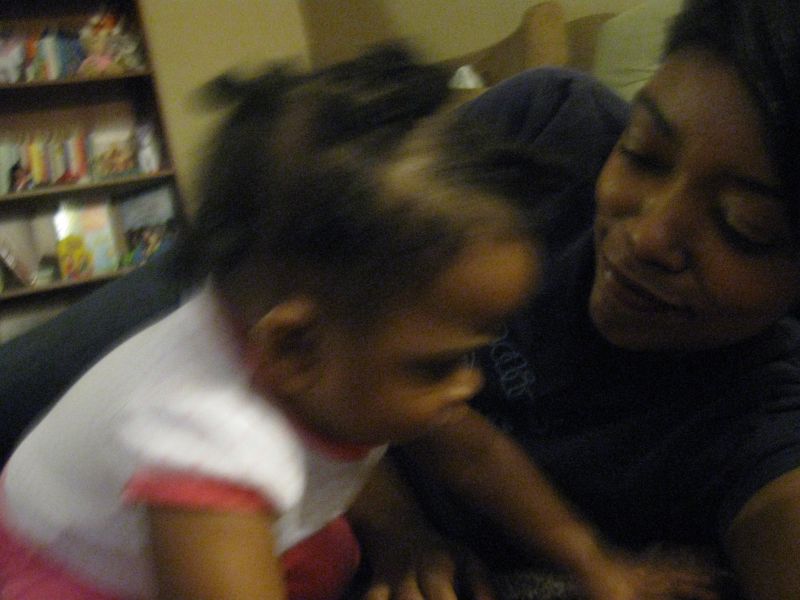
Sloughing

for Story

1.

–And after you, the seep:
a bloody comet’s tail, eight weeks,
arachnid crawl
of clots, the slow
retraction of a slackened core.
A self unrecognized, a shell
awash on foreign shores.

2.

Daughter,
you have made me something
akin to Lot’s wife: forewarned
to shuffle off
regret, to slough
the longing
for abandoned lands.

3.

Love is a dermis, earned
by the measured erosion
of ego, a molting of
parsimony, a flaking of
our sin. For you,
I will slough all
my skins; I love
beneath the bone.