A Post-Pentecostal Musing.

People hear that you grew up religious, and they can’t imagine you’d have a complex relationship with faith. If you believe one part, you must believe it all. But who gets more chances to see the absurdities than the devout? An answer that’s satisfying on Sunday becomes contradictory by Wednesday night. Belief is a wrestling match that lasts a lifetime.

— Victor Lavalle, Big Machine

What I am is haunted: stalked, reticent, silent. I can’t dance to any song, watch any film, hold any man without feeling surveilled. No thought goes unheard; no motive remains mysterious. I am hawked, dogged, tracked. There are no restraining orders. I can’t speak to the degree of shell-shock in others; I have only my own to catalog, to manage. What I have are memories, of an elderly woman shoving a huge leather-bound bible into my hands so the devil the pastor was about to cast out wouldn’t “jump into me,” as I sat waiting two rows behind the altar; of a man lifting a leg to the back of his neck and standing on one foot while ministers prayed for him; of the HIV-infected visiting prophet whose testimony involved locking himself into his church for three days until the spirit of homosexuality left him.

What I have is a residual belief in the strangest of all my strange experiences, a lingering pre-intellectual instinct that keeps me from being an entirely rational thinker. Some nights, I still think I’ll see a demon at the foot of my bed. Some mornings, I still wake and panic about whether or not the Rapture occurred while I slept and I, for whatever transgressions I committed between dusk and dawn, have been left behind.

What I see when I envision God is a vapor overlaying everything. A voyeur, a protector, an executioner, depending on the day. Binocular eyes, a sword to slay giants, and sickles for hands. Body of stone and body of air, at equal turns.

What I see when I envision Jesus is a hippie, barefoot, in blue tattered dungarees and a white linen tunic embroidered with navy thread. Listening and pacing and staring through the cookie-sized holes in his palms. Smiling and running frustrated fingers through crazy-thick hair.

What I hear when someone tells me he/she is a prophet is an echo: an imperceptible white noise beneath loud and sincere speculation.

In some half-carved hollow that logic can’t touch, I believe everything. No matter how thoroughly the messages of my brain excavate the corners of my body, they never find this hollow. Their reason can’t be heard here. I believe that prayer has the potential to animate paralyzed limbs. I believe people who insist that their malignant growths have shrunken to non-existence. I believe a bush can burn without being consumed. I believe a too-wistful woman can transmogrify to salt.

No amount of evidence or education can completely erase my socio-spiritual imprinting. What is there will always be there.

But age intensifies suspicion. Experience encourages examination. I cannot be a scholar without questioning. I cannot be a woman without relinquishing some of my naivete. I know that I know very little for certain, and wondering calms me.

I know that the answers I’ve always been given are not quite whole answers at all.

36 Tweets About 9/11.

This morning, I found myself on Twitter, reading a lot of reflections on the collapse of the Twin Towers. Usually, I don’t write about 9/11 because I don’t feel like it impacted me as profoundly as it has many of my friends, friends who were there, friends who lost loved ones, friends who’ve since gone to war. In short: it’s never felt like my story. It’s never felt like something I’ve earned the right to write about. But today, it just happened.

These are my tweets.

here’s where i was: in an elevator, surrounded by suits & secretaries. “someone bombed the world trade center.” “again?” was the bland reply.

we were expecting to arrive in our respective offices to find news of a corridor or even a floor taken out by a small handmade explosive.

my own boss sent our office home. “go be with your families,” he said, clearly speaking to himself, having forgotten he wasn’t alone.

we scattered, with words rapping woodenly against our intellect. “one of the towers collapsed!” “oh God, the other one, too?”

we couldn’t fathom it–and without footage, with only words to paint the picture, it hardly seemed real.

at the time, i was living in a foreclosed house with my mother, every day fearing the arrival of a sheriff and eviction minions.

when i called my mother to tell her i needed to be picked up, she was wholly annoyed b/c she’d just dropped me off.

“they sent us home b/c of the world trade center bombings?” i said, words like “collapse” receding under my vision of a small-scale attack.

“somebody bombed that place *again?*” mom said. she huffed, “fine; i’ll pick you up at the train station.”

the streets of baltimore were all but empty at 9:30 am. the deserted thorofares were what first struck fear in us.

9/11 wouldn’t be real for me until 10 am, when i got home, sat in front of a TV and didn’t move until 10 pm.

i was afraid to pee. afraid to eat. afraid to leave the foot of my mother’s mattress.

we sat there, watching peter jennings report himself parched & haggard, with rolled sleeves & red rimmed eyes, w/tears caught in his throat.

“the people who jumped, ” mom whispered, “some of them were flapping their arms.” determined to fly.

mom swore she heard bin laden say, “i did not do this thing. but praise allah.” i’ve still never heard this. i wonder if it was imagined.

i wonder if our hearts heighten villainy when our eyes and ears disbelieve it.

years later, i lived in yonkers. @feministtexican & i could see twin shafts of light shuttling into the firmament, from lamps in manhattan.

@feministtexican and i were determined to get to ground zero that year. “let’s go see the lights!” we got stuck in traffic.

we detoured first, for cupcakes.

we didn’t make it till midnight. no longer 9/11.

but there were still lingerers, poring over the pictures and withering petaled bouquets. the lights still coursed toward some spot above sky.

i remembered a weeping CEO who blamed himself for being out of the office the day he lost all his employees.

i remembered a 20/20 profile on all the immigrant workers who lost their lives that morning, working their shifts at Windows on the World.

i remembered.

i never write abt 9/11. so i don’t know what made me do it just now.

there are things i’m leaving out, like how i called a frenemy to make sure she was okay. she answered, agitated and spooked.

said she was walking from manhattan to brooklyn b/c the trains were closed and the roads were gridlocked.

she described the sediment, rolling like clouds.

that day, as always, i envied her.

it was a child’s envy: there she was, centered amid the mythos, while i was at the foot of a mattress, unable even to imagine her experience.

(i hate writing honestly.)

and i’m not even being *as* honest as i should be. i haven’t talked abt how my mother and i laughed that day.

laughed the way family laughs at repasts.

i haven’t confessed my wry commentary while @feministtexican and i were bumper to bumper with mourners.

i didn’t mention how my own drama diminished my ability to absorb the full impact of the images i watched that day.

Our Little Boys are Growing Up!: Mutemath’s Armistice.

Mutemath’s sophomore album (if you’re only counting the full-length LPs and the Warner Bros.’ releases) dropped two days ago. I preordered it, something I’d never done in the several years that I’ve had iTunes, so I was almost startled Tuesday at the crack of midnight, when it became available to me. (What? So soon?) I downloaded it immediately thereafter. I was flying to Grand Rapids from Baltimore that day, so I didn’t get a chance to listen to it in earnest until I was at the airport, and even then I resisted.

You want your first listen to a new project by your favorite band of all time to be exclusive and undivided and hallowed.

So when we boarded the plan at 2:20 pm, only to learn from our pilot that we’d be captive on the tarmac for at least an hour, I finally pulled out my iPod.

I’ll admit that, on first listen, I wasn’t entirely impressed with this album. There are songs on it that practically scream: “Maybe this’ll be the one that lands us that headlining gig at Madison Square Garden!”

I almost let myself feel a bit betrayed—and I’m usually not one of those toolish indie band fans who gets genuinely irritated when its band “goes mainstream.” I’m usually not one of those people who has to stand on a soapbox and rage into a bullhorn, “I knew them when! I had them first! You don’t deserve them!”

Because it’s pretty lame to get downright proprietary about people you don’t even know.

Even so, this wasn’t the Mutemath to which I’d grown accustomed. The sounds on Armistice are milder, quieter, tamer (appropriate, given the album title, but still). Whither the Paul who shouted through most of the tracks, backed by frenetic percussion and landfill-funky bass? Whither the songs that allow you to envision exactly the moment at which Paul will handstand on his organ in concert? These songs simply weren’t as full of bangs and blasts and crackles and roars.

One thing seemed certain: gone were the days of the Atari.

Rest of the article and video after the jump.

Constants for the Wanderer: Mute Math.

I first saw Mute Math in concert at The Knitting Factory, not long after I moved to New York.  I was so excited, I think I might have completely lamed out and worn a band t-shirt. I knew there was a distinct possibility that I’d be the only Black person there and I didn’t care. My live experience with this band had been years in the making and I wasn’t going to flake because of any race-related awkwardness. The fact was: I knew I belonged there. I belonged there so much, my skin prickled with goosebumps when I walked into the venue.

That I love this band is a given. They’re great showmen. Paul Meany used to do handstands on an organ at their shows. Just because. Darren duct-tapes headphones around his head during sound check, because he’s such a spastic, frenetic drummer that they’d likely fly off if they weren’t secured. Roy has an unflappable cool whether singing back-up, plucking an upright, playing bass or banging drumsticks on the sides of speakers. Greg has an open, earnest face at which you can’t help but stare when he open shows with the battle cry at the beginning of “Collapse.”

These men are an electric spectacle.

But my affinity for them goes far beyond their showmanship or their lyrics or their instrumentation (all of which are remarkable in limitless ways). You see, like Desmond Hume is to Daniel Faraday on Lost, this band is one of my Constants.

Truly, I’ve told myself on many a day, “If anything goes wrong, Mute Math will be my Constant.”

In the years leading up to the fateful move to New York that brought me face to face with my favorite band of all time, I was going through a painful separation. From my church. That’s a long, different story and one I won’t belabor here, but by the time I started grad school, I wasn’t regularly attending any church and wasn’t in any particular rush to find one after relocating.

The fact was: even when I attended church three times a week, which I’d done for the majority of my youth, I’d always felt like a bit of a misfit. For starters, I wanted to be a fiction writer—and not the kind who writes morality plays or romances where some reprobate finds faith through his love for a righteous woman. I wanted to write stories about women fighting over the death of a crack addict they’d both taken as a lover or tales about a biracial Canadian who infiltrates a slave plantation or simply stories about girls who drink beer and don’t wait until they’re married. And that didn’t really bode well for the pursuit of holiness.

So I hid my dreams of writing mainstream fiction (or my dreams of becoming a Professional Liar, depending on your point of view, I guess), and I wrote spiritual, spoken word poetry instead.

In the ’90s, rapid-fire spoken word was the thing. I came of age before the Love Jones trend hit the pulpit, so what I was writing seemed intriguing and anomalous to congregants. I penned critical poems about the trappings of materialism and greed and how true religion and undefiled before God was more about tending to the fatherless, widowed, hungry, sick, and afflicted than about building massive infrastructures within which to hold exorbitantly priced, cliché-laden mega-conferences.

People would clap at the end, but I felt largely unheard. In the intervening years, I realized that I was, in fact, noticed, if not wholly heard (and to be fair, I was quite difficult to follow with my mumbly, super-swift delivery and my inaccessible vocabulary). I’m still asked if I write these kinds of poems, poems that I felt were rebellious, anti-establishment, locust-and-honey-filled rallying cries. I do not. And mostly, I’m okay with that.

But even though I left my church and started writing whatever I wanted, rather than solely focusing on what would be acceptable to utter in front of an altar, I’ve always retained a reverence and concern for my faith and its survival—and that reverence and concern isn’t always easy to maintain.

Enter Mute Math. Well, no. Enter Earthsuit.

Read more

The Incomparable Jessie Redmon Fauset.

I’m fairly certain that I first encountered the work of Jessie Redmon Fauset in early high school. Someone had bought me an anthology called Revolutionary Tales: African American Women’s Short Stories, from the First Story to the Present. Her short story, “Emmy,” was nestled somewhere between the writings of Pauline E. Hopkins and Ann Petry and after a while, it became the only story I re-read. In fact, I read it again and again and again—as voraciously as I would’ve read a missive from a bygone love. It was almost novella-length, which appealed to me, because of my own tendency to write overlong short stories, and because of the subject matter (and all its attendant melodrama).

“Emmy” is about the titular character’s perfect, almost smug satisfaction with her deep brown skin color (a satisfaction  achieved after years of ostracism and ridicule) and the turmoil it causes when her childhood sweetheart, Archie, grows up and reluctantly decides to pass. Archie is described as olive-skinned and, even as a child, he laments his inability to be easily identified as one race or the other. Emmy’s mother is graceful, fashionable, intellectual, and proud and shapes her young daughter into a woman with the same qualities. Archie, before leaving home to seek his fortune in architecture, proposes to Emmy, who accepts in what seems a near-fit of ecstasy, and off he goes with promises to claim her in a year, when he’s certain he’ll have made a name for himself.

Archie does make a name for himself, of course, but he does so by allowing his employers to believe he’s white. On holiday, he tries to bring Emmy to his Philadelphian haunts but soon, they both realize that he’s trying to hide her. When they encounter his boss on one of their strolls, it becomes painfully clear to Emmy how Archie’s been spending his year. Emmy, devastated, ends their engagement and returns home, sick with disappointment and betrayal.

The story doesn’t end there, but it may as well. Themes of color complication emerge in most, if not all, of Fauset’s fiction and regardless of whether she decides to neatly resolve those complications with a happy ending or opts for the much more satisfying open-ended character-haunting, ultimately race is the thing. It’s what makes her work so singular and analytical. It’s what makes her characters so hateful or lovable.

I recently, finally, read her last novel, Comedy: American Style, the darkest of all her works (no pun intended, although… cool pun. lol). The novel seems erratic in focus, divided as it is into acts, one of which focuses on a tertiary character at a time when I really just wanted to stay with the main folks. But ultimately, it’s about a light-skinned family with one dark skinned son and a matriarch who can neither stand him nor claim him, simply because he’s unable to pass. The rest of the family hides from him the true reason for his mother’s coldness: her desperate, toxic quest for whiteness. But their attempt to shelter him backfires with devastating results.

Fauset fascinates me. All her work is about upper-middle-class Black families of varying skin colors, negotiating their places in society. There’s something Victorian about her writing, full as it is of gentlemen callers, unrequited loves, high-stakes misunderstandings, hidden or altered identities, and clandestine passion. She wrote very formally; her work seems quite prim compared to contemporaries like Zora, who of course, merrily peppered her stories with dialect and who wrote about characters who were far from upper-middle-class.

As we know, Zora emerges as the hero in black literary history: an anthropologist who captured and exposed our folklore, the novelist who gave us Janie and Tea Cake, the queen of Eatonville, Florida.

But Fauset’s no slouch. She was the first African American woman to graduate from Cornell University–and the first African American women to graduate in Phi Beta Kappa. She earned certification from the Sorbonne. She was the literary editor of The Crisis for seven years–and did all the magazine’s translation in French, which was vital to their coverage of the annual Pan-African Conferences. She retired as a schoolteacher in ’44 and died of heart failure in ’61.

Why don’t we hear more about her? I wonder, for instance, what she did during that post-retirement decade. I wonder what it was like for her to lose her mother as a little girl, then watch her father remarry (and to a white woman) and have additional children. Was her father passing when he met his second wife, Bella Huff? If so, what was her first reaction to young Jessie? If not, what was her lot in life that she willing took on a black man and his motherless child in the late 1800s? I’ve always wanted to do really extensive work on Jessie Fauset–particularly as part of a PhD dissertation, but I’m rethinking the PhD, so my Fauset-fascination must be temporarily shelved–or must it? Hmm.

Anyway, if you haven’t read anything by Jessie Fauset, you owe it to yourself to check her out. I haven’t even mentioned Plum Bun: A Novel Without a Moral, which is her best known work and, arguably, her best work. It’s also my favorite. Start there.

Parisienne Top Ten (Plus One).

(in no particular order):

1. When you stop to take pictures of buildings and monuments, Parisian passersby actually halt, on either side of your shot, until they see you lower your camera, content with your photo. They’re so respectful of their own culture and your admiration of it that they pause for you. Those pauses resulted in my ability to get shots like this:

basilique du sacre coeur
i loved these little guys, over the doorways of some seemingly important louvre-adjacent building.

2. Parisians seem to love our president. Whenever someone inquired about our nationality, they’d exclaim, “Barack Obama!” with these huge, impressed grins. One particularly wistful boy named Sam, who was the waiter at our favorite eatery on the last night of our stay, said his dream is to come to America and pursue his professional boxing dreams. He ran down a list of Paris’s flaws, scoffed at his president Nicolas Sarkozy, and ended his merry diatribe with, “I prefer your Barack Obama.”

Read more

Purple Haze.

I’m back. I have a lot to write, but for those who want an initial response, some encapsulation of what it was like and how I felt, I have only one word that would make any sense: transformative.

Paris was transformative.

Here are a few pics to hold you over until I process everything and recapture my ability to form coherent thoughts:

in the latin quarter

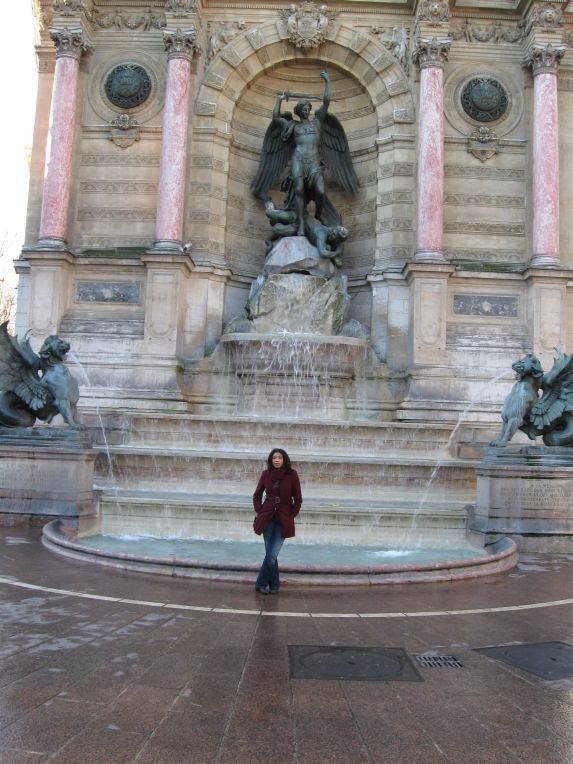
at st. michel fountain
at the butte montmarte
grilled perch at cafe montmarte
la tour eiffel, night view.

A tout à l’heure!

I’m going to Paris tomorrow.

Typing the sentence above, reading the sentence above, and embracing the reality of the sentence above are nothing short of astonishing. Like many accomplishments before it, traveling overseas seemed wholly inaccessible… before I found a way to access it. And, like many accomplishments before it, traveling overseas this first time makes me entirely confident that this experience won’t be isolated. It’s a good thing; travel and I have a longstanding affinity.

Even when I was little, my skin prickled at the prospect of living in (not just visiting, mind you) foreign nations. I remember, for instance, being singularly enthralled with Samoa for a while during middle school. I was convinced I’d move there after college graduation, live in a solar-paneled house and marry some hulking brown, curly-haired “brother.” I also dreamed of England where, I was certain, I’d inhabit a castle, and Italy where, I was certain, everything would seem unyieldingly cerulean (the sky, the water, the architecture). For a while, I thought of Switzerland, until I read James Baldwin’s “Stranger in the Village.” Heh.

Ironically, Paris wasn’t really on my radar. I thought it was too touristy for the type of girl I wanted to be–far more expatriate than visiting outsider. Whenever I considered France, I thought of Cannes and Nice (not yet realizing that these, too, were not exactly the “hidden homelands” of the country).

By the time I finished college, though, with tens of thousands of college loan debt nipping at my heels (debt that made studying abroad impossible), no job prospects to speak of, and a looming family-home eviction, the wind and whimsy were knocked right out of my sails. Like most adults, I got really caught up in earning and spending. Like slightly fewer adults, I also pretty much wrecked my credit by not establishing enough of it and knotting up what little I had.

My dreams of intercontinental jaunts dwindled during the first half of my twenties. There were whole years when I couldn’t seem to imagine a life beyond the borders of Baltimore anymore. And I cried more during those years than I ever have.

Then, the spell broke and I moved to New York, the first of the aforementioned unlikely accomplishments. I got a grad degree–another dream deferred, then regenerated.

I started to think, as I saved a nice lump of money living with roommates, that this leaving the country thing might just be doable, after all.

But I was a little more concerned with getting a job that constituted the tens of thousands more in college loan debt I was acquiring in tandem with that extra degree.

Strangely, I wound up here. In Grand Rapids. Working part-time, sleeping on relatives’ spare-room convertible couch. Of all my life’s circumstances, this is the one within which leaving the country would seem least feasible.

Seriously, even if a seven-foot angel had materialized in a cloud of shimmering dust and told me that I wouldn’t get to leave the country until I didn’t have a place of my own to live and I earned what amounts to above-average part-time wages with no health benefits, I wouldn’t have believed it. I just… wouldn’t’ve.

But here we are.

This Sunday, I’ll be taking two walking tours* of “Black Paris.” I will see where Baldwin spent the final years of his life, where Josephine Baker was buried, where Richard Wright and Chester Himes wrote some of the most popular works.

On Monday or Tuesday? I’ll go to Pere Lachaise cemetery and spend hours searching for the graves of dozens of famed authors.

I’m going to see all that kitschy, must-see stuff like the Eiffel and the Louvre.

I am so doing a happy dance right now. I should upload it (on the little videocamera thing I bought for the journey), just to prove it. A virtual pinch, if you will.

… said all this to say: if you find that your dreams–any of them are deferred, make sure they don’t stay that way.

I’ll see you soon.

* Please. Click the embedded link. I’ve had the loveliest experience with this company and I haven’t even left yet! I highly recommend them, tourist site unseen.

(Click the Baldwin link, too. “Stranger in the Village” is a really great essay.)

You Know How I Know I’m Black?

I write about Blackness.

Check out this piece on “Cultural Purgatory” I penned for PostBourgie:

Sandmann’s isn’t the only establishment that triggers my racial-acceptance-related paranoia. I also keep my head down at the beauty salon because I don’t want the women with the fingerwaves and rhinestoned acrylics judging me by my hair’s length or lack of “adventure” (just relaxer, no dyes, no gels, no ‘fro/locs/braids) and deducing that I think I’m “better” than they. I worry, whenever I go back to the storefront church where I grew up, that the congregation will take one look at me and somehow assume that I live in the gentrified part of downtown. (I don’t, by the way.)

Read the rest here.

Musings on ‘Push: Based on the Novel by Sapphire.’

It took me a long time to write about Sapphire’s novel, Push, being adapted for the silver screen. But write I did and here’s what I came up with:

People who love this book will tell you that it’s a triumphal story of hope in the face of brutality and despair. And it is. But for me, hope appeared too late in the work and retreated without a satisfying enough redemption for our heroine. I couldn’t stop mourning her abundance of tragedies, no matter what brief victories she won.

So when I found out Push was being adapted for the silver screen, I cringed at the prospect of revisiting Precious’s bleakly rendered world. I dreaded watching in technicolor all the awful things I’d imagined while reading. And I reeeally didn’t want to return to the hollowness that haunted the ending. What possible reason would Hollywood have for further dramatizing an existence as heinous as Precious’s?

Check out the article in its entirety over at Postbourgie.com.