Mother and Daughter Defy the Time-Space Continuum.

She is in a cloche hat and chunk heels, one strap across each ankle, her calf-length dress all lavender fringes and lace. Defly, she waggles her legs in ways that make the guests all laugh until they forget how hard it is here, to be black and act citified. The flat has gone hazy with smoke; its wood floors scuff and rumble under those who’ve chosen to dance.

A quarter earned everyone their entrance, but contraband is fifty cent a cup. When the air grows warm and dense with corn-liquored breath, she counts the contents of her can. There is rent enough for three months.

You do not worry, in 1926, whether she’ll make it. You needn’t wonder what she’s working toward. Wit and resourcefulness go far here, and here, her sand-and-copper hair, glittery eyes, and throaty laugh can insulate her. White benefactors have not yet taken to flinging themselves from the rooftops of neighborhood Savings and Loans.

Ten years later, though, she would be uniformed, her smock itchy with starch and the color of storm clouds. At seventeen, she’d be languishing as a maid, lamenting that the renaissance she’d hoped to age into had waned without much warning. Even the white folks were hungry — and the ones who employed her were keeping their crusts. She would be six feet tall and underweight, a dancer but only when everyone else was away from the rooming house where she could barely afford her fees. Her landlady would knock nightly, demanding the two weeks rent she’s owed. Somehow the girl, weary-voiced and hair rollered, is able to charm her with solemn promises, down payments, conspiratorial grins. Her resourcefulness is still intact; her wit is a bit worn. Here, in the 1930s, she has to hide more of who she is.

Your hopes are higher when you find her in the ‘40s. It’s wartime and, because she’s used to working, because domesticity has always been a gig rather than her life’s goal, because she believes that our men have been forced into under-employment and marrying one would be akin to taking a second mortgage when she hardly qualifies for a first, she joins the war effort, paints fighter jets, develops a fixation on flight, flits to Paris for a pilot’s license. But there, she meets a dapper soldier whose elegance and acumen for aviation rivals only her own, and she marries him, because the man who disproves what you believe about men is a flight all his own.

She would begin the ’60s bouffanted, sneaking into the main floors of movie theaters for better glimpses at Warren Beatty and Natalie Wood. Danger would feel like something to court; she barely trembles at risk, barely flinches at the baring of billy clubs. On the theater’s first level, she is, of course, not wild enough to actually sit, but she is wily enough to become a shadow puppet. Her own silhouette flashing on the walls like she’s part of the moving pictures. Your daughter enjoys small subversions. She understands the keenest of all her injustices as balconies banishments and missing-paged schoolbooks. She is always reading, always watching. She knows when a law is worth breaking.

In the ’70s, she wouldn’t go in for white women’s feminism. She would be wary of connecting her politics to her underthings, her level of liberation to her libido. Free love cost black women too much, and she has always been a conservative spender. But she would write down dirges that render men and women rail straight in seats. Her hair is a perfectly rounded arc, meant to draw the eye to her face. Audiences would find many things there, but most all an otherworldliness. Pinned as they’d be to the melodies, they would miss what is true about artists: we are not after equity so much as immortality.

In the ’80s, her first car is a Delorean. Her first “I’m grown” haircut is asymmetrical. She does not sweat the technique, survives Reaganomics, mourns the death of Optimus Prime, shares your love of the film adaptation of Annie. There is little political about her, though she does sense the danger — new drugs and old policies — skulking just outside her periphery. As a black girl in a black town, where black people are not just allowed but expected to be middle class, her world — and her possibilities — feel open. Everyone around her is intent on becoming a Cosby.

The ’90s are the last decade you can bring yourself to imagine her. They were the last years you yourself felt safe. It was a false safety, you know this now, but she wouldn’t have known it then, not with her gele and her incense and her glove compartment full of De La and Tribe Called Quest CDs. Her college quad still would’ve felt like sacred ground whenever she walked it, and earning her degree — likely in fine or liberal arts — would not yet have felt like a toil in futility. You do not want to think of her after 1996, finding her first, real love in a chat rooms, entering the aughts importing all the wonders of breathable, tangible analog life into the slender flip phone in her palm, and finding herself, by 2009, constantly wondering if there is anything truly left to say, any new terrain to discover.

You certainly do not want her here, in the last quarter of 2013, where no one seems to value old Nigerian poets till they are gunned down in malls and everyone clings to the inevitability of mass shootings, when with empathy and openness, advocacy, medication, and legislative reform, so many of these tragedies could, in fact, be prevented. You do not want her watching her government give up on its citizens, in part to spite the black president whose election they still deeply resent. Were it up to you, you would will her to other times, before we knew what was to come for post-segregation black America. You would teleport her to an era where our fantasies of a free future were a clean and powerful fuel.

We are cynical now in ways that we can only be because we have reached an end. This is an “Are you happy now?” era of blackness, where even some of our own believe we’ve already overcome, where when we continue to fight, we are considered delusional: shadow boxers on crowded and bustling streets, hollerers in an online echo chamber. And I would rather you lived in a time before this technological revolution, before its bells and its whistles had built us a callus against the suffering beyond our shores (and the much of the heartache within our own borders) by reducing it all to banner ads and think pieces we can simply click away and forget.

I am afraid for us and our melting glaciers and the crumbling cliff’s edge toward which everyone is being pushed, the pit at its bottom rapidly filling with impoverished, unemployable bodies. We are becoming a nation that records and airs its citizens, burning their bodies and bursting through government barricades, begging for treatment and shelter and mental health care as its Congress bloats on self-interest, glories in its myopia, surfeits on its uninterrupted salaries, lifts food from the mouths of babies.

As your mother, it my job to imagine an improved elsewhere. I am supposed to chart a course that prepares you to survive even the bleakest of fates. But I have never myself imagined that I was see, so early as 33, as bleak a state as this. Perhaps we will recover; we have before. But it has become, for the first time in my experience here, quite possible that we won’t. This, dear child, is not hyperbole.
If you are alive on the other side, if we can regenerate everything we’ve destroyed, remember. Mankind may be meant to squander all its chances, every generation becoming more adept at readying itself to die off. But while we yet remain, we must live with an intent to leave the best of ourselves behind. We do this so that when future mothers begin to wonder when the most auspicious moments would’ve been for their children to be born, our now can belong to their narrative. We are knots for them to hold, touchstones on a seemingly endless stretch toward eternity. And that will always mean making the best of what is bleakest, believing that the idea of better will never be a thing of the past.

In Baltimore, Someone is Always Dancing — Even If Only on Graves.

photo 1

In Mount Vernon Place, we were once kept as slaves and not meant to meander in admiration of the grandeur around us. Being here conjures a blood memory, perhaps because so much of its historic loveliness has been preserved. I can almost hear the clomping of horse hooves, the transport of jangling chains. This weekend, I pushed the umbrella stroller you’re quickly outgrowing across an uneven cobblestone circle at the top of a concrete hill. We did this many times, while white tents surrounded us. Under each sat a writer or bibliophile, wearing the pained, but hopeful expression universal to sellers of wares.

I am bad about rejection, whether I am gently administering it or bearing its brunt, so it’s best for me not to make eye contact with anyone whose books I don’t intend to buy. I take too long to recover, spending months remembering the crestfallen, the maskers of disappointment, the overly cheery, “Thanks anyway”s. There is an art to letting people down easy, but I am more adept at pretending they’re invisible or prostrating myself to break their fall.

When the time comes, I expect that you’ll be more direct.

Look at them all, smile with empathy, let your gaze express how well you understand what it means to slice thin pounds of flesh and press them, fresh and bleeding, onto pages for public consumption. When you speak, do it in a voice that conveys how acutely you know that peddling their novels and research and sacrificed years at three-day festivals wasn’t part of their recurring writerly dream. And then, if you so choose, purchase or politely decline.

But, please — if you remember nothing else — swiftly move on.

*  *  *

Down the children’s lane, near a fountain encircled in green metal benches, a balloon sculptor attracts a small crowd. With his handheld air pump and a half-smock filled with limp, multicolored oblongs, he looks down toward the stones as he narrates each of his creations. He tells us, this ragtag half-circle of parents and small children, that he’s good at what he does, that his balloons are high-quality, that he can make over 150 animals and objects.

I can tell that no one else will retain this. No one else will wonder what he does when festival season is over, whether he makes his winter living booking birthday parties or takes special orders for wacky couples who want 150 different balloon centerpieces for their wedding receptions. I wonder how his craggy personality would translate at a Chuck E. Cheese or in the sprawling backyard of a pampered and petulant Roland Park child.

The balloon man, with his nondescript grey t-shirt and oversized pants, cannot seem to hold real conversations. He talks nonstop as his hands twist each balloon into something briefly magical, but his words aren’t meant for us; they’re marking time. He has not set a price. He is taking donations.

On Saturday, he bends you an elephant. On Sunday, he folds you a flower. You are still holding tight to the elephant on Sunday. He doesn’t let me finish explaining how fond you’ve grown of it overnight before he stammers that he’s flattered.

photo 2

I want you to be thoughtful, like your father and I are thoughtful, to seek the eyes of the people who can’t seem to meet yours. But do not expect to find anything there. Sometimes, an artist’s gaze is empty. Her eyes are not the windows to her soul. Soul is in the words or on the canvas or inside the balloons. You are taking it, bit by bit, whenever you read a poem or you purchase a talisman, whenever you listen to someone carefully consider a thing before he speaks.

Often, eyes are inscrutable, and souls are not windowed structures. They are not structures at all.

*  *  *

I have again grown weary of this city; Baltimore is as wrong for me as the first man I deeply loved, just as beautiful and as damaged. When I was younger, I would’ve stayed because I thought I had infinite time and because, once I have deeply loved, I do not know when to let go. But I am older and we’ve only returned because we’ve had to. There are things I have needed to reclaim. Baltimore has become a box of post-breakup belongings.

We are not supposed to be here. I cannot explain why except to say that this is another way that cities are like men: you know when you have nestled into the wrong one’s arms.

*  *  *

In Baltimore, when you fall in love, every cathedral comes alive; every rowhome raises its brow in wonder. No county or township forgets. And long after the love itself has waned, riding through the roads where it first rose and shone regenerates its memory. You may say this is true of any city. But it is only in the desperate and dirty ones, in the ones that are eroding, either under the wear of bloodshed or the veneer of gentrification, that this accessibility matters.

You understand with surety the power of love’s pull when it can still be felt in an undercurrent of carnage or unwelcome reinvention.

*  *  *

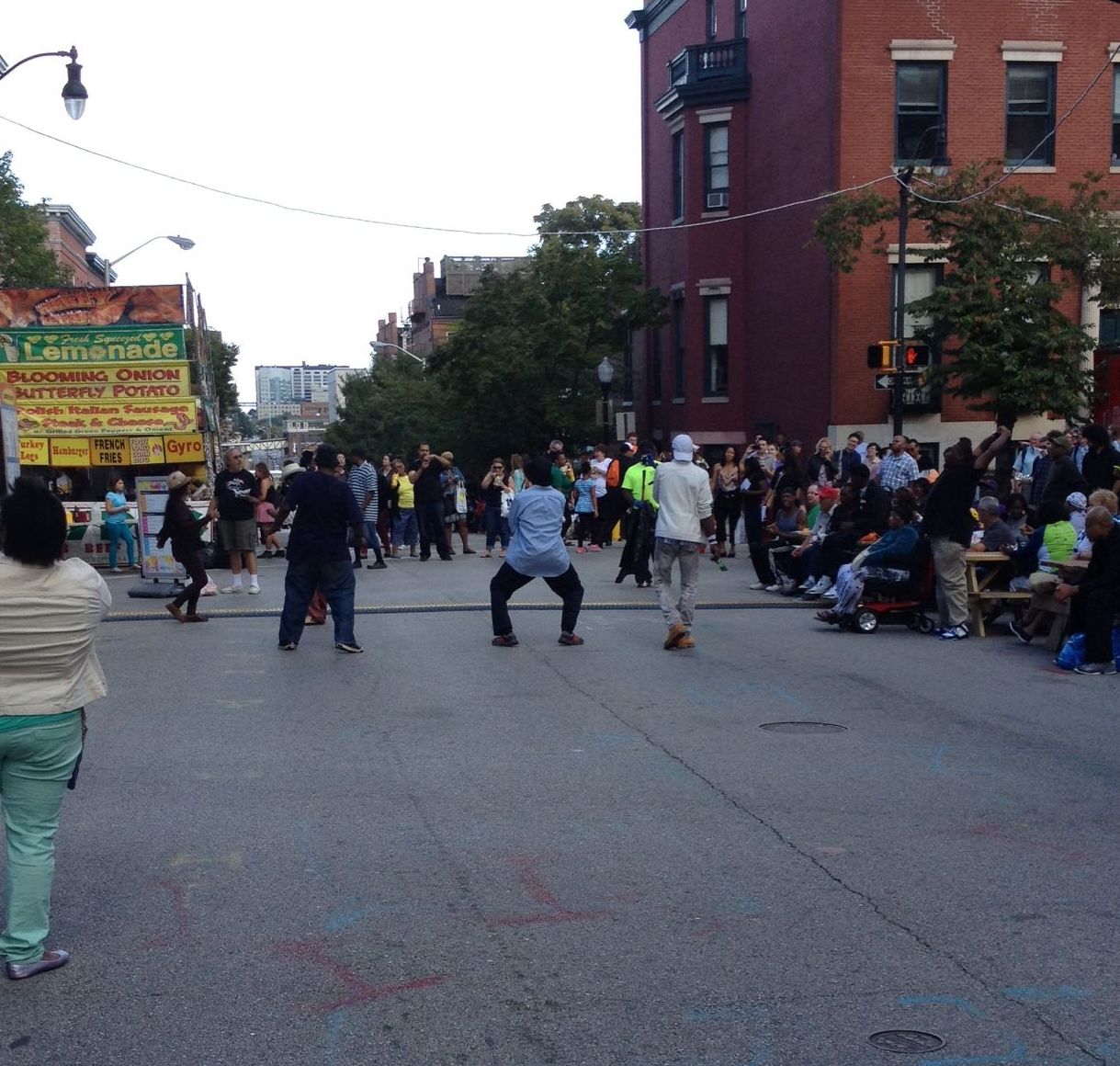
I looked too long at two women standing in a pink-plastered tent and purchased two books I did not want. Later, I bought two books for eight bucks each; the next day, they were reduced to five. This is all a gamble, isn’t it? Perhaps the old men on heroin, pop-locking in front of the soundstage, understand this best. Within 72 hours of this festival, our federal government will shut down. Our president’s authority will yet again be undermined. Thousands of employees right here in town will be in flux. But in Baltimore, someone is always dancing — even if only on graves.

photo 3

Baltimore, with its impenetrable neighborhoods and nonchalant homicides and its leaning addicts, is also full of flowering trees and trickling fountains and mansions, of men who have soaked themselves in what they believe is bliss while the rest of us bemoan the price of books and the obstinance of governing bodies. This has always been a city of unsettling lessons.

You seem happy enough in your stroller, wielding your balloons. This is not a weekend you’ll likely remember. I expect we will have left before you’re old enough to come here on your own. But before long, you will begin to sense what this city does to your mother, how it buoys and buffets and baffles her, why she always wants to beg it off. Maybe my life life here before you will become your own blood memory, beckoning from beyond future festival tents, when you can’t figure out why you feel so deeply compelled to dance.

Against ‘Other Fish’ Theory.

Words are the last to wane. Outliving feeling, they cling: barnacles on the underside of our long-capsized boat. I have written them to grip; they are meant to make promises, meant to melt ambivalence, perhaps even meant to sting, if stinging means they’ve touched you. These words want to plug the hole, want to right us. These words want to float oars out to us; they want to write us rudders. If they reach you, will you help me row? Only that. Will help me row?

Here is a bottle full of unaddressed issues. Here is what I say when I’m certain you want to hear nothing. When whispered aloud, these words are their own sea, a beacon: illumination, after you’ve stopped looking. You are lost on a part of the sea where land is a mere suggestion. For you, this is not loss; this is laughable: a scattered rain. (For me, it is a nor’easter.) You don’t want to be set sailing again, not by words — or at least, not by mine. You want salt, the sun on a thousand ripples; things within which you will find a greater portion of yourself. You want the life you can see on the face of the water, the song — just the song — of the siren who writhes at the bottom. You want the same grappling of the crabs in the cage you’ve crafted of broken boat parts. There is something in the tightness, in camaraderie with clawing things, that calms you.

But here, you are freer than you’ve been. When procured like this, freedom is simply a different confinement.

It will be, as it’s always been, your own ideas that ease you. May they ever be more useful to you than these watery words. Of course you can sustain yourself more easily alone. You’ll subsist on the reminder of the many friends who bring you laughter and wisdom rather than this surfeit of bottled sadness.

I am told there are other men in the sea, that they are slick as fish, but when their pulse finds itself under the right warm fingers, they will not long to wriggle free. I am often possessed of the stillness and patience it takes to grasp what intends to elude. I would be fine with hands held underwater for hours, for days, for decades.

But these words wish to wait, and they are wearying. They wish to urge you toward a day when love is an immediate shore and not eventual flotsam we must fashion into rafts. They do not want slick men like fish. They want the man who only prefers the sea because he has forgotten the feel of land.

The Wall and the Air: Meditations on Post-Poverty Life.

Hold the wall. Your fingertips should always graze the tile. It is unsanitary. Do not lift your fingers to your mouth or to your eyes. You could become infected; you could die. The walls underground are filmy with sewage, are coated in the filth of those who’ve died and who’ve survived. Survivors hold the wall. They do not allow themselves to forget where they are. They know that no wall is endless, that someday their fingers will again find air.

You will be hungry, often. The occasional mole person you pass will show you all the manholes, will tell you where the dumpsters are the richest. And you will decide whether it is worth it to breach these stark parameters and dive. This act will prolong your stay; but sometimes, the lengthier stay is the wisest. Sometimes the lengthier stay will be your last. You will determine whether or not you’d rather starve or eat what is surely the innards of rats, proffered in the thin skins of sausages. If you have a bit of money, you will count the costs of low-cost markets, of bread two days past molding, of fruit not just bruised but left to rot. Your children must eat when you will not. Try not to be ashamed of what you feed them. Humiliation does not kill as quickly as hunger. After they are sated, do eat their crusts.

When you are alone, when money is no longer your currency, when you’ve seen too few people with whom you might barter, when you no longer understand the function of days, this is when you are closest to the feel of nothing, to an opening through which you can grovel and claw, escape.

But it does not end with air. Freedom is never as simple as breath. Breath is a beginning. You have exited into the world of the employed, a world you once knew well and have forgotten. For so long, this has been a citadel on the other side of a sea. The underground has been neither a bridge nor a buoy. And here, you can no longer feel the walls.

Soon enough, a way, however winding, will become apparent. Employment is an invitation; depending on its type, it will arrive on filigreed parchment or on an inscrutable scrap. But neither the invitation nor the work will reacclimate you to air’s architecture. It will be the pay and how far you can stretch it. It will be how you behave, above ground, when there is nothing left.

You will remember how thoroughly forgotten you were when you were too poor to be more than cellophane to the people who now use expense accounts to treat you to lunch. You will avoid mirrors, because they portend a regression into your more desperate self. It is in the shabbiness of a too-worn dress, in the raggedy soles of your only shoes. It is in the hair and the skin and eyes — you swear it — that film that cannot quite scrub off. It isn’t permanent for people like you, up here, experiencing air. Poverty above ground is a different beast’s belly. Roomier. You can slosh around; you can wait. This beast regurgitates. And when it does, you will find yourself, at least temporarily, free.

But there is something wrong in a world where some live in constant fear of being swallowed whole while others remain blissfully unaware of the rampage. If you have ever been poor, if you have scraped to afford furnishings then found yourself hastily throwing them away in a sudden move to a city with more livable wages; if you’ve been down to a dollar, swinging wildly at debt collectors to stave off an overdraft fee; if you’ve begged for payment arrangements; if you’ve been denied a bank account; if you’ve eaten Saltines as a meal: you are at war; you are being hunted. And an estimated 80 percent of the people in this country are crouching and flinching and looking over their shoulders right along with you.

Someone wealthy will tell you it is peacetime. You are no longer eating entrails, so we are in recovery. They are wrong. It is neither the opinion of wealthy nor the condition of the world that will determine when you are in recovery.

Only when you are no longer so reliant on walls that you waste whole years building them yourself, only when you are no longer afraid of what may await you underground, only when, upon seeing a hand emerge from a manhole, you can kneel and clasp it and pull with all your might — without fearing it will snatch you down before you can lift it up — will you know that you’ve reached recovery.

Stacia in the Press: HuffPost Live, Salon, and a New Gig.

photo (6)
Why am I so happy? Read on.

Just a quick update before my next blog entry (which will probably be about calling a comeback a comeback, even if you’ve been here for years).

A few things have been poppin’:

On Thursday, I appeared on a HuffPost Live segment about black unmarried motherhood. Please watch when you get a chance.

  • I wrote a piece for Salon about The Melissa Harris-Perry Show’s recent segment on black single motherhood, which you can watch here. The piece was featured on the show’s Facebook page.
  • I’d also written another piece for Salon that I’m not sure I’d announced here.
  • And a recent one for The Atlantic that I know I didn’t mention here.
  • In other somewhat old news, I was one of five “Single Mom Breadwinners” featured at Disney’s Baby Zone site last month.
  • Just this morning, I tweeted about the importance of emotional restraint in personal writing (something I still struggle with, as I’m sure you can tell by my blog entries). If you’re a writer of nonfiction, you’ll want to check out the Storify slideshow there. Please note that one tweet should read, “Tell your emotions. But don’t sell your emotions.” The don’t is missing in the tweet.
  • I also Storify’d a tweeted tribute to Trayvon Martin this afternoon. May be always remember not just what we’re fighting for but for whom we’re fighting.
  • And finally, I’ve started a year-long fellowship with the illustrious Colorlines. I’m their 2013-14 Editorial Fellow for Community Engagement. This means, I’ll be helping them find ways to further connect with their readership through Google Hangouts, Twitter conversations, and article comment engagement on their website. It’s an exciting development as I’m a longtime fan of the pub and a stan for many of their writers/staff. Last week was my first week and we’re off to a swinging start. 🙂

In the next few days, I hope to have another blog entry for you. In the meantime, I hope you’ll check out the linked works above and let me know what you think. Thanks for reading, and thanks for being here.

Hold Fast, All Ye Who Prolong Suffering.

The right day will come. You will trot to the water and, accepting — finally– the sand on your throat, you will drink. And the sand will dampen. It will clump and castles will congeal in the pit of you. Every man you have kissed until parched, your eyes open, your face a reflection, a vacuum of longing; every truth you have swallowed dry and its lonely aftertaste; every rightful and wondrous desire denied; all the people who named you Ungrateful when you did nothing but prostrate yourself, deplete yourself, and lie to make peace with the lies they have told you; every person with sight who insists she cannot see you; and that well-meaning man who loves you in ways that are not water: they will find their prison here. The castles will close around them. And your long and even pulls of water will be their moats. You have flaked enough of yourself away; there are layers to replenish. Let them live on all of the you you’ve already offered, the eagerer you, who denied herself as though she were part-Peter, part-Christ, who questioned her worth whenever they behaved as if she had none, who pretended and still pretends she is unharmed. They will not die. You have been kind enough to fashion them these fine accommodations. Sand can be gorgeous as glass. You will not throw stones, lest you grow ulcers, lest you lengthen the hours of worry and wring yourself to this arid point again. You are strengthening now; you are gulping, the skin on your arms has uncrinkled. Your tear ducts have regained their dew. But the castles are becoming uncomfortable. Water dislodged the sand from your throat; you have grown a voice, but you are still housing so many hindrances. You are letting the small, incurious world of you’ve left resettle itself in you, elsewhere. You are no oyster; this past will not yield you pearls. These clumps are no castles; they’re a gathering shit.

When you are well enough — when you are whet enough — release it.

How to Love a Man Who’s Lost Everything.

Don’t. But if you must, dive in. This will be fleeting; it is not a sustainable love. Seize it, like a hand does a flame. Understand that you are not a restoration. You are not a gutted frame on which his hopes can be re-hinged. Neither offer yourself as a cipher to be filled. You are already full; you have never been so emptied, and perhaps this is what’s drawn him in the first place. Know that, at times, you resemble everything that was stripped. Know, at all times, you can compensate for nothing.

There is no pity in your attraction; you needn’t worry there. You cannot save him; you know it. This has never been your aim. It is simply that anguished men are often wisest. It is their wisdom that draws you, that stalwart, measured carriage only known to those who, having conquered, have been conquered, and are certain to conquer again. Their world, unlike the rest of ours, is flat. Only things that are able to float above that bare horizon are considered worthy of notice. You are worth his notice, and it deepens your sense of purpose. Were you made to love him? Are you here to, among other things, arc the edges of his earth? No. You may hover, but you will sink soon enough. You will blend into some faraway butte.

Get used to being called foolish. Get used to feeling foolish. Be foolish. This is not a regenerative affection. There is only one chance; you mustn’t squander it. You are not those women of grandiose lore who can love a man back from the ledge. You are the ledge; you are merely where he stands to keep from falling. You will not bear him up for very long.

For the man who has lost everything, the best you can be is a friend. When he believes he is falling in love with you, you become something more to lose. When you believe you are falling in love with him, you are already lost.

Close your eyes. Keep them shut. The best of it all is beneath your lids. This is the bit that your reflex can control, the bit that can be contained. Look at him there; he is smiling. Look at him there; he has not been brought low. And no one feels guilty and no one is broken and it seems, while you pretend to be asleep, that he is your favorite dream.

Juneteenth.

1.

We turned to each other when we heard the decree. You are free. And freedom felt like lead ’round my ankles and I asked you if this was what you wanted and you shrugged and said it was what needed to be. We did not know that we were late, that we could have ceased work on this borrowed land long ago. We could have earned something for each other. All this time. All this time, we should have been holding each other without punishing ourselves, for wanting what we could not have, for promising what we could not give; life need not have looked this way. And the sky was full of those rolling clouds you love but you said, Freedom don’t make me feel no closer to ’em, and I knew what you meant and I know who you are and I hated what was happening.

How long and how low pain lingers when they take away the tethers; you can see where they were forever. The gashes ooze and they fester and it is no real comfort for fresh air to hit them. There is no true salve for what lies beneath.

2.

I tell you that I need a drink, and you walk with me to get one. We pass two blocks of rowhomes — at least one where the lawn is overrun with weeds and you point to the dandelions and tell me you always believed they were flowers. This is how it feels to be free: miles between us with shoulders almost touching, wanting to reach for your hand, to run my thumbs over your bitten-down nail beds, to feel your skin again and to claim it, to realize that makes me no better than a slaver, restraining myself. You can do what you want now, say what comforts you to whomever you want, and I get to pretend that I don’t wish that person were me. I am so bad at pretending — and so weak, for not wanting to be free. At the corner, you cross against the traffic; I don’t follow you. A car darts between our adjacent curbs. Nothing was coming, you call across to me. We are facing each other, effacing each other, and I already know I will miss feeling tethered to you. There is something ancestral in this distance, something the crow knows, as he circles overhead. Something we will soon forget.

3.

It is Juneteenth, and everyone is reveling o’er belated liberation.The freedmen are advised to remain quietly at their present homes. We all know what it means to overstay, to read into a broken bond an invitation of nearness. Freedom may be our noble and God-given right but first it will feel like the radical, paralyzingly jolt of too much choice. What I wanted most when we were first free was that small and muddied hut I shared with you, that borrowed time and that bottle of wine you uncorked when it was over. What I wanted was the attention we could give when we had nowhere else to go.

Liberation is lonely for the once-loved. I have longed for your letters, now that we are free to write them. But we are not where or who we were. Everything I send you returns to me unopened. I have heard you’ve gone off to another war, but you did not need to leave to be a warrior.

I am drinking Shiraz from the bottle. You have been gone for years, for generations. This is what freedom has become: laughing and turning my face to the rain, finding that you are in these clouds. You have reached them after all, and you are giving me a taste of what they hold.

Post-It Note to Younger Self.

Admit that you always wanted lovers, long life, and longish letters secreted in boxes and scented with dead-rose sachets. You were never guileless. No nunnery ever awaited your arrival; you were not holy. And often — yes, often — you did not want to be. You still aren’t, but some days, now, you do desire it. This comes with firsthand knowledge of what it is to be fairly besotted. You will only want to be cleansed when you’ve allowed yourself to be sullied. You are still very afraid, still intimidated by others’ brazenness, still startled somehow by your own. You have not stopped hobbling your inner sprinter.

Admit that, before you were grown, you wanted to straddle chairs and tilt your head while a painter tried to capture something inimitable in you. Now that you have straddled more than chairs, you wonder if there is anything inimitable in you. Are we ever as singular as we think we are?

Admit that you wanted God to turn His head while you made love, because you never really intended to marry, and He knows that you never mean Him harm. You may’ve dreamt of weddings but never of the rugs that would need beating once a month, the bleaching of dingy boxer-briefs, of breast-milk-encrusted bras and a lifetime of servitude. You will not come to view marriage as much different than you do now; you will not tie it in many meaningful ways to the motherhood that precedes it. You always meant to flit about without that kind of accountability. And even when you are your most lonely, even when you are penitent, even when you confess all your sins: you still do.

Admit that you did not want to comport yourself as you did, closing as quickly as a small aperture. You imagined yourself as magnifying glass, translucent, enlarging, but never entirely seen. It would not have been terrible for you to be a watery blur of unconsidered colors. You could have been what happens when pewter commingles magenta, when olive meets cornflower.

I am taking you to task. You haven’t learned. You haven’t learned. And for all your attempts at honesty, you still make yourself duplicitous when you want most to be loved.

Who are you now but the girl that you were, without so much pretending? Who are you now, but someone who lives a bit beneath herself, wants the wrong things, and hopes to raise a less apologetic woman?

Dimly, As Through Glass.

I tend to bend toward ambivalence. Romance is a whirl I can withstand; romance does not quite uproot me. It is the man who makes me question why I have come, who leaves the silence draped around us in an open room, who is kind but, in every way that matters, begrudging. He is the leveler.

For him, I will be all three rings of circus: here, the contortionist, pretzeling with anticipation, folding in and unfurling when it doesn’t seem to bore him; here, the fire breather, holding for far too long in my chest whatever ignited my ardor in the first place; here, the tightroper. (I will spare you suspense: I fall.)

Even as the tents collapse, I am cycling, juggling, looking for signs other than exits.

It is curious, how rejection becomes an intoxicant, how similar being slighted can feel to being loved, how easily a shrug can absolve a lover.

Because I am as often a pusher-away as I am the pushed, I understand the value and artifice of open ends. I respect the intentional blur. Like breath wiped from glass, I can see the hint of a message, an illegible trail left by fingers whose nimble urgency once beckoned me near. It is still there, beneath the smear. With love, there can be no clean erasure, and as it wanes, I will always, always cling to the streaks left behind. Are they kitschy nostalgia or coded promise?

Here is where I will linger, on a sidewalk outside the glass. I will come here to hope long after I’ve trained myself not to expect, to continue questioning silently what my pride has stopped me from pressing aloud, to venture sentiments into the silence, bracing for nothing but echoes.

Beyond the smudges, I can see him moving on. There is no greater delusion than believing I can slow or reverse this and no greater hubris than wondering how my every movement may have impacted his choice.

But these are the possibilities that surface so simply in fog. This is where imagination breaks free and runs.

I want to hit the glass, or better, to break it as though this were an emergency. Instead I wipe the pane, collect the smudges somewhere along my sleeve, and accept for fact the sight I’d always second-guessed.

When he spots me, I will mouth: This is how far apart we’ve grown. This may well be as close as we’ve ever been. Let us light upon each other and not look away. We will never be so clear again.