Black Faith in a Time of White Supremacy.

1.

When the mothers of the church got to casting out demons, they’d set their massive weathered bibles in our tiny laps and tell us, “Whatever you do, don’t let go of the Word.” And we wouldn’t. We’d clutch those King Jameses in our trembling hands and we’d wait out the after-service exorcisms.

We were children of parents who spoke in other tongues, danced themselves to ecstasy, prayed themselves apoplectic. The adults addressed the devil directly sometimes, told him he couldn’t steal their joy, demanded back the years he had stolen, the relationships he’d severed, the health he’d destroyed.

They told us we were waging a war unseen. We’d best be prayed up and gird ourselves against principalities and powers, spiritual wickedness in high places, miscellaneous, but terrifying minions from hell.

We believed them.

2.

I talked to a friend from that childhood church a few years ago, one whose parents, like mine, were on leadership staff there. That one of mutual friends had died suddenly, young and wed and parenting, still zealous about his own faith, was the reason we’d gotten in touch at all. We were trying to make sense of it.

I was thinking of how late we would stay after service as kids, waiting for our parents in the semi-darkened sanctuary, security volunteers posted, yawning, at the entrance and exit doors, all but the most fervent among them, longing to head on home.

“Do you ever think about how we were raised, how different it was?”

I was asking as if gazing back at something we’d survived. I was asking as a woman who considers herself logical and rational now, but who also still hopes for heaven and shivers at the thought of hell.

I wondered if he remembered the bibles in our laps, the prayer warriors and their wrinkled hands, all those conversations about demons conspiring to lure us away from our Lord.

He was calm when he answered. “All I know is that without being raised that way, I’d be dead or crazy now.”

My grip on the phone loosened. He didn’t say any more. But the weight of a dozen secret, sidestepped disasters walled themselves high behind his words. I couldn’t push back, even if part of me wanted to.

I believed him.

3.

We welcomed the white folks in. And over the years, they came. Some poor and some polished, they came. We broke bread with them. We prayed for them. Aware of what we guessed might be their discomfort with our traditions, our language, our liturgy, we sometimes went out of our way to assuage their unease. We laughed alongside them. Thought nothing of it.

They rarely stayed.

4.

I needed time away from church because it began to feel too much like a house of superstition than a respite reserved for communal worship. I did not want the strength of my faith to be predicated on the material blessings I stood to gain by believing. I just wanted to believe. Even when babies were killed by those closest to them. Even if those professing to share the same faith as mine committed unspeakable acts of violence. Even if I never earned more than I did at my poorest. I didn’t want to think that by tithing or praying I was somehow more insulated from harm than my neighbor, that my church attendance or my own unfocused stabs at righteousness would protect me from worst of life’s fates.

John the Baptist was beheaded. Four girls burned. As have countless crosses. Myles Munroe and his wife died unexpectedly in a plane crash, on their way to work for their ministry. Our Christian friends and relatives contract diseases from which they die as often as they are healed. We are not all spared. And what good is our belief if it can be shaken when God doesn’t step in to prevent the calamities we don’t think we deserve? What good is our faith if we base it on the dollar value of the bills we place in an offering bucket or on uttering a certain combination of words during prayer? What makes any of us think we will never have to stare down unimaginable despair, simply because we’re devout?

I needed a God who felt all the more real when the world was at its worst. And to test that He was the one I had vowed all these years to serve, I thought I had to get away from all the other Christians who sought to define Him for me. I had to interrogate what I questioned, what I doubted, what rang false, even after a series of itinerant preachers echoed it during revival.

There comes a time when faith can no longer be absorbed secondhand. Wheat — what you alone are certain you believe — and tare — what you’ve been taught but have never bothered to question — must finally part ways. And the voice that exits your body in prayer must be clearly recognizable as your own. It cannot mimic your mother’s or be tinged with the sweetness of Grandma’s clichés.

This is your life. You alone will answer for it. And the only voice you’ll be able to access then will be your own.

I wandered a while on a long stretch of road, the light on its path possibly dim at turns. It took entire years. I left markers along the dirt, not entirely sure I wouldn’t find myself returning to them.

5.

My meandering days were numbered when I had a child. It was clear to me as she ripped her way out and the nurse rested her in my arms: this girl was not the work of her father and I alone. She had not gotten here by sheer force of my bodily effort. She was not a result of mere biological function and, because of this, part of her would always be unknowable to me. I’d need help then, to reach that part of her. I’d need a mediator whose presence among us was also not the mere work of mortal hands.

The church friends I made as a child are still, by and large, still fervent about church and faith. Even the ones I wouldn’t have guessed would be. Most of them are parents. They are raising their children the way we were raised. They are doing this because it works. If they, having ventured away from our sacred, if cloistered, community, and having seen and survived the darkest days they’d known, and having found themselves right back in the house of God , alive and there to tell, then so would their children. Most of them.

This is reason enough to return. This, and days like this one, when the words to explain how this happened, where and when it happened, could not possibly come without divine intervention.

6.

7.

Before the massacre at “Mother” Emanuel in Charleston, SC, I had been inching ever closer to God. He came at church on Sunday, when the pastor told us, “You have to cope before you can conquer,” and later asked us to turn to our neighbors and declare, “I am raising my faith to the level of my fight.” He came though a long conversation with a friend that night. We prayed for one another. No. More accurately, he prayed for me and I stammered a few well-intentioned words in return. But he told me that God did not feel the same way about my faith as I did. He didn’t see it as feeble, flagging, inadequate. He didn’t consider it something I was “struggling with.” I am not a case study in what it means to falter. My faith has been sufficient, even when it’s seemed small, even when I’ve had a hard time voicing it. It’s been sufficient because I wouldn’t let it go. It’s a seed and, as such, it retains its ability to grow.

When we doubt, the friends who believe alongside us are often the light that keep us drawing nigh, lest we float away. We hold onto them when horror rushes in. We remind them, “Whatever you do, don’t let go of the Word.” In that moment, they are the Word in motion. And if we must die, for welcoming the troubled white supremacist 21-year-old whose boyish face looks as innocent as the brain behind it is wicked, if we must die for praying alongside him, if we must continue waging a war as unfathomable as it is unseen, there is no one better to be with in the end, than the people who kept us feeling closest to God when we felt farthest away.

There is no greater lesson to be gained for believers than to keep believing, right next to those with whom and for whom you would not mind dying. We are what we need most, now and ever.

8.

Yesterday, I sang a worship song. I haven’t done that, unprompted, in a while and I’ve never recorded myself singing one. I am glad to have that moment now, when freedom feels like such an improbable farce.

I echoed the words of a popular tune, one that the congregation had crooned in church on Sunday. I sang that I’d withhold nothing. I meant it and cried as I often do when I sing a prayerful song and every fetter falls and I feel — however fleetingly — free.

I sang it twice.

Hours later, nine other people who likely knew and sang that song and whose hearts promised the same, lay dead just feet from their church’s altar.

Here, Lord, is my desperation.

Here, Lord, lay my anger.

Here is the love I hope won’t not kill me.

Here, my longing for retribution.

Here, the depth of my unforgiveness.

Here, my hopes for their souls’ safe passage.

Here, my desire to see them again, in a life beyond this often terrifying one.

Here, every doubt I have about what was and what is, and what’s still to come.

I deny You nothing.
The Racial Prism.

It is a peculiar sensation, this double-consciousness, this sense of always looking at one’s self through the eyes of others, of measuring one’s soul by the tape of a world that looks on in amused contempt and pity. — W.E.B. DuBois

An American, a Negro… two souls, two thoughts, two unreconciled strivings; two warring ideals in one dark body, whose dogged strength alone keeps it from being torn asunder. — W.E.B. DuBois

I made it (Thanks to so many of you. I’m incredibly grateful).:

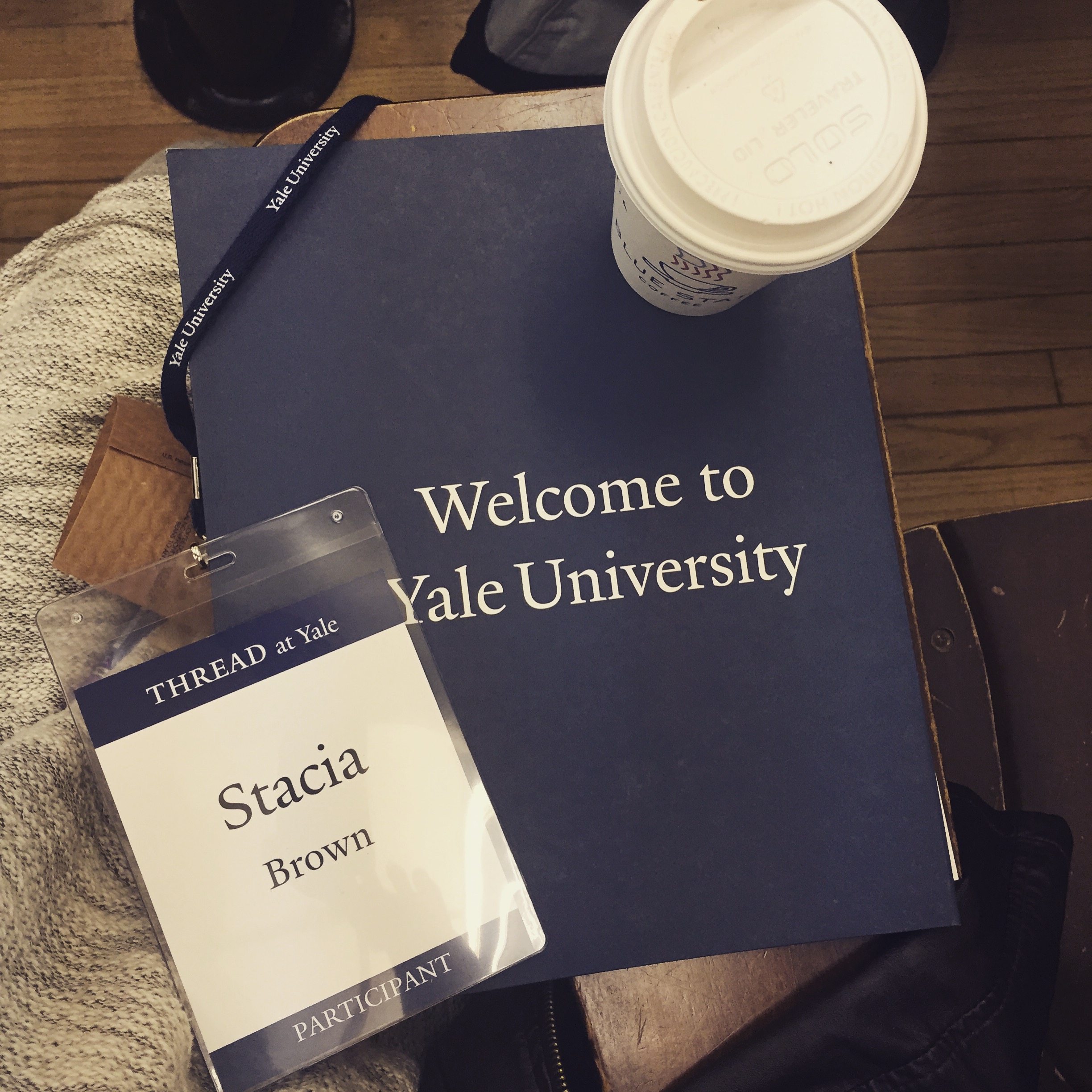
IMG_8674But last night, when I got here — to this previously inaccessible institution for this improbably-accessed opportunity — I made the mistake of catching up on the news. In my dorm suite, I read about the police assault on a young black girl and her black friends at a pool party. I was lying down on the spare, thin mattress when the news hit social media that Kalief Browder died, following years of trauma at the hands of of the NYC judicial and correctional systems broadly, and at the feet and fists of Rikers Island guards and inmates, specifically.

I have been elated since I arrived. There’s a frequency of bliss, a thrilling current of excitement buzzing through me every single minute I spend here. 

But in the midst of my euphoria at having barely scraped my way into this respite, hours away from the rigors of my daily life back home — the just-getting-by of it all, the constant, intimate, semi-secret worries I tend to share a bit too much of online — I’ve also felt an intense and all-too-familiar need to grieve. 

The private joy must make room for quiet mourning, the mourning for performing public joy. 

To vent the grief, I tweeted these things. Early.  Before even leaving the dorm:

This is hard, this divided attention. But it isn’t just an emotional and intellectual focus divided by half. This is no mere doubled consciousness. Race in this country, with each successive generation, with every historical echo, and for all our technological advancement, has become a prism. This new racial prism — this 24-hour access to every horrible, three-dimensional detail of black trauma, requires constant, multiplicitous division. I can anticipate occasional euphoria, but I will always do so with the understanding that injustice will disrupt my joy. That is its own kind of violence, a forced splintering of identity, intellect, and emotion.

Here, in New Haven, where I want to enjoy an undisturbed experience of enrichment and networking, I find my thoughts drifting to the black folks I’ve seen on the streets and in service jobs. It’s hard not to devote concern and curiosity to what seems an obvious and stark class distinction between Yalies (white, black, and brown) and black New Haven residents (or transients or commuting workers).

And once that rope of care has lassoed us, once we have gathered into each other, huddling against our shared and separate sorrows, it’s hard not to cast our rope further, out to Kalief Browder’s mother, who discovered him hanging outside the window of their home, out to the teenage girl in McKinney, Texas, kneed in the back, left all the more vulnerable to police-manhandling, while still wearing nothing but her sunny orange and yellow bikini, out to her friends who will feel the terror of that memory rippling through them at unexpected moments for the rest of their lives.

I almost felt weightless here. At times, I still do. To the outsider, the briefly affiliated, only partially initiated outsider, Yale seems a space devoid of regular burdens. Come here, and forget the cost. Come here, and mere proximity to those for whom money is either no object or an object that capitulates to their will, will make you feel temporarily unfettered. Even as your financial worries gather just outside the card-access gates of your dormitory, even as your awareness that your three-day visit is sifting quickly through your fingers and the pressure to make each minute, each meeting meaningful mounts as if the trajectory of your entire future depends on it, even as you know for sure that your future is not as secure as some of the baby-faced summer session undergrads strolling jauntily by, Yale beguiles you like a tropical resort surrounded by hovels might. It does not resemble the lives of those just outside its gates. It is no vacation for those who cannot leave. Yale is not your real life, either, until, for a triad of incredible days, it is.

Even here, in the space of the briefest of days, here, where praise and promise are plentiful, ironies cannot be sloughed. Grief cannot be shed. I can’t escape the maladies in McKinney. I can’t pass Yale School of Law without wondering if Kalief Browder’s name will ever be uttered in a classroom there. And I know that I wouldn’t want to.

I’ve wondered. Could this ever be a place where all my splintered pieces, all these race-bent beams of light and looming shadows, could ever be fully known?

It’s possible. But perhaps only for the middle-aged woman with the teeny weeny afro, I’ve seen sitting outside powerwashed storefronts displaying wares she and I can’t afford. Perhaps only to the security guard at Walgreens who told us when we asked for directions yesterday, “I’m not from New Haven.” Perhaps for the black student-worker who bussed our tables tonight, inside a storied old boys club on campus. 

And even for them, it may only be possible when they are looking full-on at one another, each catching the refracting light in the eyes of the other. 

Say nice things about Baltimore (and Prince!).

prince-performs-new-song-with-zooey-deschanel-on-new-girl.gif.pagespeed.ce.HssEoAiWa9

In a story I wrote two weeks ago, I briefly mentioned my old church on Park Heights Avenue, directly across from Pimlico racetrack. (I always mention our proximity to the track because I vividly recall when we’d walk out of church and see trainers beginning to run their horses for each new season. In retrospect, it underscores the gross inequity in that area, within the fence, hundreds of thousands of dollars in invested and gambled revenue are being spent for Triple Crown season, while just beyond the Pimlico gates lay one of the city’s roughest communities.)

I’ve written here about that church and my childhood friends before, but to recap: the friends you make in a church youth group are of a particular sort that you do not forget. They’re different than school friends because you see them at their most vulnerable, through interaction with and admonition from their parents and siblings; working in service of something beyond themselves; ushering or a joining youth choir or feeding snacks to smaller children in children’s church. When elementary, middle, and high school grade levels or choices to attend private, public, or magnet programs begin to separate school friends, church friends remain together, under the same roof, seeking the same sanctuary, sometimes their whole lives long. And when they worship, when they weep or dance or yell or collapse, when they wear suits and dresses on Sundays when no one else in their social lives has ever seen them in one, you learn to keep their secrets.

Nikia was one of my best church friends around the end of middle school, going into high school. She and her little brother Eugene (aka Junior)  came to the church with their aunt, Vernetta, around that time and I remember them as inseparable. If some brothers and sisters bug each other senseless, these two seemed to have an enviable understanding of one another and a love and respect that just radiated whenever they were together.

I still ride for my youth group friends, but when I when I left that church at 16, I fell out of touch with most of them (until the rise of social media reconnected us).

Three or four years after I left, Junior was killed by Baltimore City Police. The shooting’s officer’s story was published in The Baltimore Sun. Nikia’s account of the last moments of Junior’s life have never been given similar weight in print. Until now. One of the greatest honors I have as a writer these days is being trusted to amplify the stories the people I love have guarded and carried and wanted to share for years, with anyone who would care even a fraction as much as they do. I’m glad I finally got to honor Junior’s legacy in this piece about Marilyn Mosby’s decision to charge the cops who killed Freddie Gray and what a few Baltimoreans think may be next for the city in The New Republic.

In other news:

  • I was on a Chicago-based radio program called This is Hell last weekend, discussing unrest in Baltimore City. You can listen here. (Also check out the May 1 broadcast of The Bill Press Show, where I offered a few remarks.)
  • Pulitzer Prize-winning poet Tracy K. Smith wrote a memoir about life with her mother, who succumbed to cancer when Smith was in her early 20s. For Slate, I wrote about why the quiet, uneventful grace of the story is revolutionary in a publishing world that doesn’t often make room for healthy slice-of-life vignettes about black mothers and daughters.
  • Prince gave an incredible, moving show in Baltimore on Mother’s Day and I still can’t believe I not only got to attend but also to write about it for The Washington Post

IMG_8060

  • There’s still time to donate to my Thread at Yale fundraising campaign — but if you want to contribute at this point, please do so via the PayPal option. I explain why here (Scroll to the last few paragraphs.), but the short of it is that I won’t be able to access the funds I raised a month ago until well after the New Haven trip is over, and I have to use my own extremely limited resources upfront to finish making tuition payments and to travel there, then reimburse myself on the back end. If anyone’s ever been through that, you know how dicey a process self-reimbursement can be. I know you’ve all already been amazingly, staggeringly generous, and I thank you for it. If there’s anyone else who didn’t get to give and would like to, however, you can do it via the Indiegogo link by selecting PayPal (the only option that releases contributions immediately) or contribute directly through PayPal.com with my email address: stacialbrown at gmail dot com.


I’ve been writing about my beloved city. 

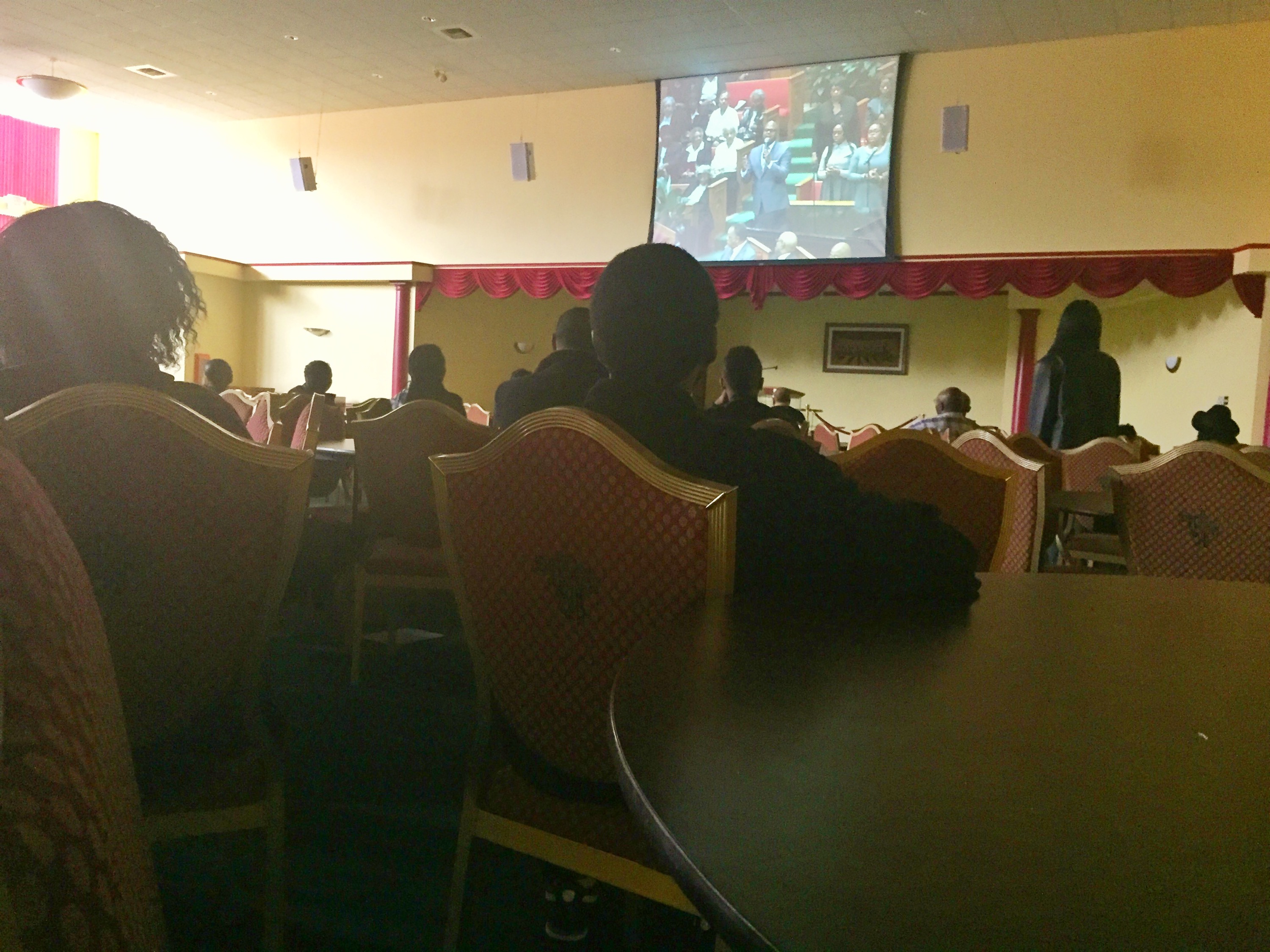
The dining hall that doubled as an overflow room at Freddie Gray’s funeral on Monday, New Shiloh Baptist Church

I wanted this post to be longer but in order to keep it timely, here’s a micro-post with links to all the writing I’ve been doing this week. I hope to do a more in-depth recap of this wild week in writing later. Until then:

  • I attended Freddie Gray’s funeral at New Shiloh Baptist on Monday — and left about 90 minutes before the riots broke out within blocks of the church.
  • Baltimore has had black commissioners and black mayors, off and on, since the early ’80s. It hasn’t done much to improve relationships between government and poor black citizens.
  • I’ve been glued to local news since Monday. Here’s why I’ve favored their coverage over MSNBC’s and (obviously) CNN’s.
  •  All Freddie Gray did to set in motion the fateful events that led to his death was look an officer in the eye. One chilling thing I learned writing this: running from police “unprovoked” is grounds for “reasonable suspicion” and subsequent arrest  — but only in “high-crime” (read “poor, predominantly black”) areas. When the Supreme Court ruled in favor of this, Justice Antonin Scalia used the following scripture as rationale: “The wicked flee when no man pursueth.” — Proberbs 28:1a.

Bits and Bobs: WaPo Column Recaps and Rihanna-Inspired Writing.

tumblr_nm1mo3kexb1t2yls4o2_500

Yesterday marked the publication of my third column at WaPo’s Act Four (if you missed the news, I’m a weekly contributor there now. Seriously. Pinch me.). I wrote about Trevor Noah, who I knew nothing about until it was announced Monday that he’ll be the new host of The Daily Show. My second piece was about Mo’ne Davis. The first was about the transition of an amazing multicultural bookstore inside 14th and V’s Busboys and Poets location in DC to a Politics and Prose satellite store. I love Politics and Prose, but it’s pretty white by comparison. For context, 85% of the children’s books at the old store, Teaching for Change, were either by or about children of color, which is unprecedented. The rest of the stock was similarly targeted toward readers of color and it was a rush walking in there, every single time. It’ll be missed.

tumblr_n6lxx1t0Eh1r2zbdqo1_500

I also wrote about Rihanna, ’90s black pop princesses, middle-school bullying, and my long learning curve for self-advocacy yesterday, over at Medium. If you read that one and dig it, please share it. It could use a bit of a push.

I’m considering starting a weekly newsletter for writing links and announcements like these and for letting y’all know what I’m reading on- and offline (right now, I’m knee-deep in James Hannaham’s Delicious Foods, Tracy K. Smith’s memoir Ordinary Light, a re-read of James Baldwin’s If Beale Street Could Talk, this interview with Kiese Laymon, and hopefully, Paul Beatty’s The Sellout, which I’ve borrowed as a non-renewable digital copy from my local library. It’s due back in about 11 days and I’m not sure I’ll get to it before they gank it back).

If that kind of Tinyletter deal is something that interests you, something you’d sign-up to have emailed to you on a weekly basis, leave me a comment letting me know. I’d like to gauge interest before I start anything else.

Also, apropos of nothing, two days ago on YouTube, I found this long lost unreleased Dilla beat I rocked for months after he passed away back in 2006. It still goes. Y’all should give it a spin today:

For Bobbi Kristina.

IMG_7008

I hope there is a meadow and treetops without end where you are, the grasses beneath you so thick they catch and hold the voices calling out to you from your bedside. I hope you hear your mother, too, ululant on the wind. You are not alone; hear the voices. You are not alone; tell your demons. You are loved, even by us, the fickle, cruel-faced public. You are loved by the Maker you may be poised to meet. Wherever you are, girl, I hope you are climbing, and from an uppermost perch, I pray you can see clearly the truth of who you are.

We remember the girl you were, the woman we prayed you’d become — even if the becoming itself would’ve required a miracle. Instead, the miracle is that you’ve held out as long as you have. Instead, the miracle is that you still have time.

Over the years, we lamented your odds, raised as you were with parents whose wealth often waylaid their efforts to keep lucid and clean. We rooted for you in spite of them and rooted for them, in spite of themselves. We are still rooting.

But I also understand where you are: someplace distant and exacting. You are hanging from a limb that you are no longer gripping. The snag and the crack are conspiring. Soon that limb will turn you loose. There’s no telling where you will return. Perhaps you will be here, awake, surrounded. Your father weeping, your siblings sighing, your truest friends deeply relieved. Or you may open your eyes elsewhere, a flatline braying in the breeze.

I am unbiased. I believe you should float toward the sounds that bring you greater peace. I believe you should be where you feel you most belong.

I was 14 when you were born, the embodiment of your parents’ frenzied, fully public love. You were born under the glare and pop of flash bulbs, the light too harsh for your soft brown eyes. You were pulled toward center stage with pride, and you stood under the beam of your mother’s spotlight. But you were always timid there, waiting where she asked you to, unsure, but echoing the words you were told. It was clear that she wanted to build your confidence. It was also clear that you would’ve preferred those lessons to be meted out in the privacy of someplace sacred and silent.

I remember worrying, in those moments when it was most obvious that your parents were unwell. You were a family, laughing, traveling, spending. You were a family, unraveling. We all worried over you, some of us even voicing unkind predictions. Armchair clairvoyants that we we were, we saw your future forging itself with sorrow.

But this is not what any of us wanted for you. A tub, a tomb, like your mother’s. There are other ways to get back to her. There are other ways to get back at her. I wish you’d found the healthier ones. And maybe you may find them still.

If there is, in fact, a meadow, if there are towering trees and voices in the grass, if there, you can understand how much you are wanted, how imperative it is for you to be well, then where you are is where you should be. And when the bough breaks, may the arms into which you fall be loving, baptismal, and warm.

Ava Taught Me and First Impressions of 2015.

Untitled

I wrote something about Ava Duvernay and black women bold enough to interpret history — their own and others’. I published it at Medium, rather than posting it here, because it didn’t feel like it was a fit for this space.

Every January, I reassess what I want to do with this blog. Every year (for the seven it’s been in existence), it serves the purpose it’s meant to.  I was fortunate enough last year to have appearances and publications to announce, as well as meditations on news and culture to publish. I’m not sure what 2015 will hold. Maybe more of the same. Or maybe the landscape will change.

I just know this year has been strange so far.

First, I was paid an extra month’s salary for my last contract job. It was an oversight. But it was I’ve never been on the receiving end of that kind of financial oversight: a full check — directly deposited — for the entire month of December. I didn’t work the month of December; my contract ended on November 30. I really, really could’ve used the money. Seeing my account balance after its deposit really drove home that point. And it wasn’t clear how soon anyone in accounting would catch the error (if ever). Of course I knew I couldn’t keep the money. But knowledge and action found themselves briefly at odds.

The first thing I did was start telling people*. And the first person I decided to tell was a great friend who I suspected — but wasn’t entirely sure — would see things as I did. In situations like these, when I need a minor pep talk to prepare myself to be as ethical as I know I have to be, the people I consult have to be people who won’t tempt me. They can’t be people who’ll remind me that I’m not working or point to the bills I could pay with the money or spend a half-hour calculating an invented New Math about labor-to-time-to-worth-to-pay ratios.

I just need someone who will calmly confirm what I need to do. In this case, I chose the right person and set about doing the right thing. (If that pays off in any obvious, estimable karmic way in the future, I’ll let you know).

What the incident reminded me is how closely we have to monitor our ethics, how intentional we have to be about listening to our consciences. People always talk about listening to your inner voice — and/or to the still, small voice of God — but that isn’t always the immediate, logical response. You have to quiet worry — which is loud — and your propensity for sketchiness, which can be quite imperceptible at first, in order to follow the suggestion of your conscience.

The only other big thing that happened this year is that, in catching up with a friend I rarely get to talk to, I accidentally texted the very person we were discussing. And what I was saying wasn’t glowing. It was hurtful and infuriating to the unintentional recipient and it severed an already taut, hair-thin cord we’d both been working hard to hold up at its ends.

What that incident is teaching me is that I am not the same person to everyone. To some, I’m caring and kind and generous and fair; to others, begrudging, bitchy, and patently unfair in my characterization of them.

As a person who often wants more than anything to please and to remain unobjectionable and inoffensive — even at high personal cost — it bothers me a great deal to know that I can be hurtful and nasty, ferociously unlikable. It scares me, in fact, because I am inclined to believe the worst about myself. If I know that someone I care about finds me hurtful or given to betrayal of confidence, or inflexible or unforgiving, even cruel, I worry that he isn’t the only person who sees me that way — or worse, that I’ll eventually reveal myself to be that way with everyone I love.

But what’s real is that every person views us a bit differently than the next — which means that each encounter with any of them gives us a new opportunity to be the version of ourselves we hope (but often fail) to be, with everyone. We have an inexhaustible capacity to be incredible for some and deeply offensive to others. And when we have been the latter, there may be no convincing the offended party that we can be better to them than they’ve experienced us to be in the past. Sometimes, we have to settle for being someone’s personal definition of terrible.

I apologized. The jury’s still out on whether or not it will be accepted, but I think in accidentally revealing what’s frustrated me, I feel like a more genuine, if less likable, person. Losing my place in a person’s high esteem feels worth it if, in the end, I’m not pretending to be better than I actually am.

… At least that feels like the lesson today. Check back with me in a week or two, and I may sound like someone else entirely.

Read the DuVernay piece. I’ve been told it’s not too shabby. I hope you’ll be able to concur.

* I tell someone nearly everything about myself. I don’t know why; the reasons change. The person changes. It’s part accountability and part confession/absolution. Sometimes I just need confirmation that I’m not irrational — or that I am. I’m not a talker, by any stretch, but as someone who spends as much time close-lipped as I do, I’m a near-full discloser. Secrecy, in my personal experience, has proven overrated. Discretion, on the other hand, has value beyond measure.

The Hope of Christmas in an Hour of Oppression.

The story of Mary, Joseph, and the newborn Christ deserves graver contemplation this year.

As Christmas nears, I am remembering not the miracle of the virgin birth, nor the pageantry of an angelic announcement. Not the damp stench of dung in the manger, nor the frankincense and myrrh that staved that stench from the newborn Christ’s skin. Days before the holiday, I am remembering Herod the Great.

He has come to the fore of my Christmas contemplation, because we have too often overlooked his part of the narrative. This is a time to revere a messiah, but it is also a moment to mourn the massacre that followed his arrival.

This year, cruelty has been charging forth, unpenned, throughout cities across the nation. As our annual gift-shopping frenzy ensues, protesters are pretending to be dead in the halls of commerce; they are splaying themselves on unyielding concrete, channeling ill-fated ends. Children are raising “Am I next?” signs over their heads when black citizens die unjustly at the hands of police. And now, unions of officers may be seeking street retribution for the killing of two of their own. Now, they are declaring war on communities they once swore to serve and protect. Now, they are equating the shooting of unarmed children with the possibility of death in the line of duty, as though the latter is not a known and accepted hazard of their chosen profession.

It is fitting, then, to recall the cruelty of King Herod during this holiday season, as carols seem inadequate and shopping is more an act meant to numb than to heal. This year, the wintry air, which often feels more fit to breathe when it’s this icy and crisp, is oppressive instead, as we chant reminders that breath, for some, is no longer regarded as a unilateral right but a luxury.

I am thinking of what happened after word reached King Herod that a new heir had been born, one without earthly father or the scourge of human sin. I am thinking of the soldiers the king sent forth wielding swords, all the mothers whose sons were ripped from their arms as they cooed, boy-children beheaded before their eyes. This is a message. This is a message. This is the message: There will be no savior. Your plea for mercy will go unheard. The lives of your children do not matter.

7dd951c046b72218380f6a7067000c6f

Herod meant only to protect the institutions he’d raised. He wanted to preserve his own rule. If it meant the bloodshed of every child with the potential to grow up and challenge his authority, he reasoned, it was a small price to pay to keep his peace.

I am thinking of those who would run, Mary and Joseph among them, fleeing in time for the census, back to a place where they believed they could keep their newborn safe, a place where his birth would be counted, a place where his life would matter.

And there were, in fact, serene years. Years their son Jesus spent in prayer and in study at temples, years of learning a meaningful trade, years of wedding feasts and thousands of unthreatened births.

These are the years on which we meditate when Christmastime is nigh. But there has always been a pall cast over my heart as I regard the infant in his swaddling clothes; for Easter will also come, and with it, the annual reminder that our Christ was kept safe for over 30 years just to die at the hands of a government as treacherous as Herod the Great’s.

When we celebrate the promise of salvation rushing forth into the world, we do it with full understanding that salvation is not an unbloody enterprise.

This is the time of year when we commemorate the emergence of promise in a desolate time, hope in an hour of intense oppression, faith that must be guarded amid palpable terror. At no other moment in recent memory has this nuanced facet of our celebration been as relevant as now.

The symbol of our belief knew well this tension, this peril. He knew what it was to have parents who feared for his safety whenever he left home, who warned him of how best to interact with authority in order to preserve his life. Of course, our Lord was not here for self-preservation. He came not to bring peace, but a snare. He came to die.

This Christmas, we must remind one another that the emergence of a savior is not the end of the story. It is the beginning of terror for the mothers of countless firstborn sons. It marks an era of martyrdom, both witting and unwitting.

But it is also when we ask the most essential questions. Why do we continue to believe? How do we continue? I cannot speak for anyone else, and even my own answers vary year upon year. Today, I believe because there are far more people patterning themselves after Herod than after Jesus. There is far more tangible evidence of terror than of salvation. And this is all the more reason for me to hold fast to the hope that I am not here alone. I am not fleeing to a land that does not exist. I am not praying for the safety of a black child whose ill fate is already sealed. There is still the hosanna to sing. There is still breath to declare a glory as yet unseen. There is still someone waiting in the celestial wings, with knowledge of a world yet to come. I believe because this — the deaths of Tamir and of Eric and of Dontre, the deaths of Rekia and Tanesha, of Ramos and Liu — is not the first massacre of innocents. It will not be the last. And still, each year: tidings of great joy.

For unto us a child is born, unto us a son is given: and the government shall be upon his shoulder: and his name shall be called Wonderful, Counseller, The mighty God, The everlasting Father, The Prince of Peace. Of the increase of his government and peace there shall be no end.”

I believe because these words, recited, return to us each December, even as so many of those we love do not. I believe because there is comfort in their recitation, in the tradition of their endurance. Something else is coming, something that succeeds us all. For a moment, this stills my trembling. For a day, I welcome all that we will never understand.

A Crazy Half-Week and a Today Show Appearance.

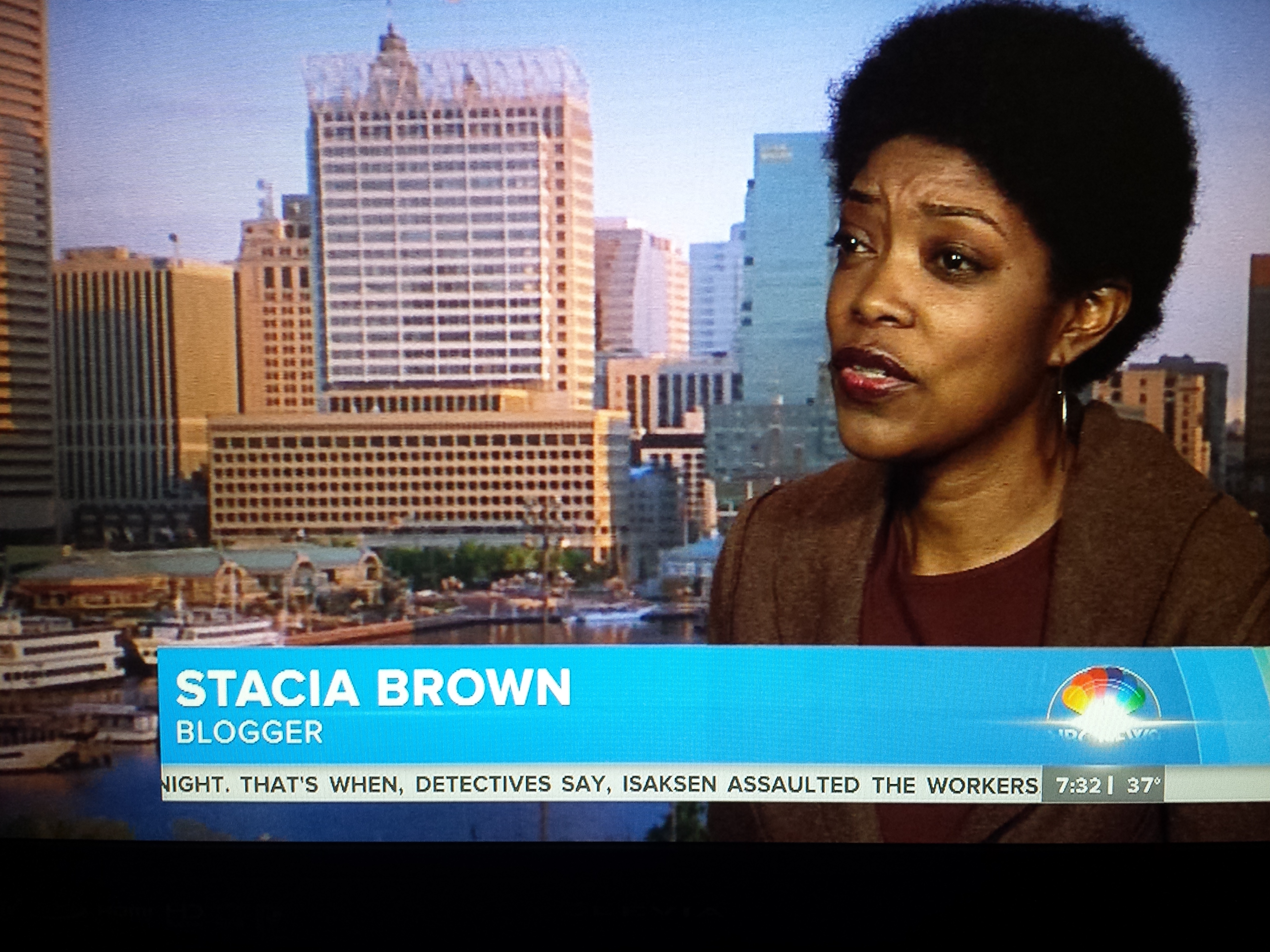
2014-12-16On Monday night, I recorded a segment for The Today Show. But that wasn’t even the craziest part of that day. I’d spent much of the morning and afternoon in a job interview (of the type where you have to actively fight the urge to pinch yourself to ensure that you’re even there and also fight the urge to take photos of the building front like a tourist). The next day, I had a phone interview for a different job. And today, as I type this post, I’m headed to New York to interview for yet another position.

I’m not someone with a history of multiple job interviews at once. I’m someone who doggedly applies to things for months at a time without many bites — or with bites that never make it past the first or second round of “quick chats,” tests, and interviews. I’m the person who cobbles together a living, out of multiple part-time or freelance gigs, painstakingly chosen to allow for the most time I can spent with my kid. This? This is new air for me. And it is a mighty, rushing wind.

I don’t know what will come of any of this. But I know that it bears out all those adages you hear about there being no overnight successes and how slow and steady wins the race and what happens when consistent practice meets opportunity.

I never get used to succeeding at things. I always enter new opportunities a bit uncertainly, more than a little awestruck, even as I carry with me all my previous wins. That’s because, alongside those wins, are the more vivid memories of losses. Risks that didn’t pay off. The job offer I wished I hadn’t taken, the poorly-timed personal life choices. The Am I capable? whisper never entirely fades.

But I do feel more capable than I did when I made those choices or took those risks or accepted the first offer of employment, because I really didn’t know what else would come or how long it would take. A willingness to bet on yourself, a refusal to undersell your skill set, doesn’t emerge from the ether one day. Self-confidence doesn’t come solely through outward affirmation (though that helps and certainly, it’s helped me, when it’s come in the form of readers like you, who leave sweet, honest, encouraging comments on this blog). But ultimately, that kind of temerity comes best in the form of work. It comes simply through proving yourself to yourself. It comes from questioning yourself until your “yes” is less mumble than shout. yes, i am capable. Yes, I can do this. Yes, I have the clips to back this up! YES; I AM CAPABLE!

Life is a loom at 35, all loops and snags and corrective weaving, brake pedals. Once patterns come together or reveal themselves to be ill-advised, it seems obvious, and I unravel, cut, stop, change pace, begin again. But at this point I know how the loom works. I know what it takes to make something sturdy and beautiful.

The loom is still large and intimidating, every new idea comes with a yard-length of questions, of doubts. But now, there is less hesitation. Accomplishment is becoming part of my muscle memory — even if it doesn’t reoccur as often or as quickly as I’d like. Even when I don’t feel ready, I’m confident that I can get ready. Fast.

The Today Show producer called around 6pm. I’d barely made it back to town after my job interview. She asked if I could come to the studio at 30 Rock. I called back and said I lived in Baltimore. I can’t. Without any hesitation, she said I could tape here in town. In 90 minutes. To discuss news that’s broken while I’d been stuck in traffic. Did I have an off-the-cuff opinion? Could I process potential implications and parse problems — right then? Yes, I said right away, remembering a time when I would’ve been too intimidated not to just echo my previous can’t. Yes, I repeated through a few more logistical phone calls, I can.

It’s the briefest clip and I know I have a tendency to romanticize small and fleeting moments, but I’m there. In it: the moment, that clip. Ready in a way I would not have a been two or three years ago. Ready, even now, traveling north on a train, in hopes to present my most competent self to potential (amazing) employer, and reminding myself all the way: I can, I can, I can. .

More at Buzzfeed, on Beauty and Sorrow.


Untitled2

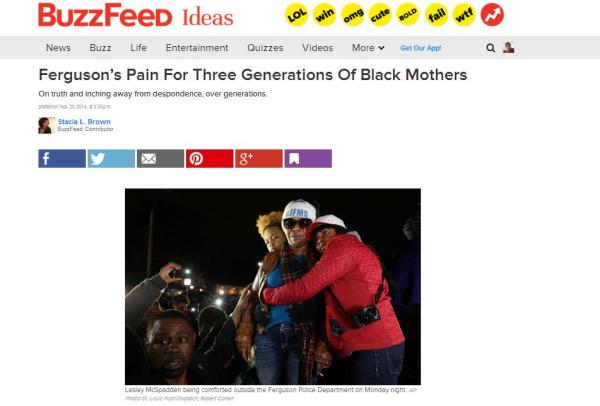
It’s been a really rough week and I’ve written three hard pieces. One is hosted here, about Tamir Rice and his far too untimely, unjust death). Before that, I wrote about how the role of makeup has changed for me after becoming a mother.  That was published last Sunday at Buzzfeed Ideas, but I don’t think many people had time to read about that between all the national tragedy we’ve been managing in the days since.

Then the night of the announcement that the St. Louis grand jury would not be indicting Darren Wilson, despite his testimony about why he murdered Michael Brown sounding like something straight out of D.W. Griffiths’ Birth of Nation, I started writing this piece about how the women in my household were processing the news. It went up the next afternoon. (As an aside: I really like writing for Buzzfeed Ideas, and that’s largely because of Doree Shafrir, who edits my work there. Pitch to her, writers.)

Untitled

I think I was so busy trying to write something about the announcement that I didn’t immediately process it. I also think that because I was so deeply invested in the outcome of the George Zimmerman trial and I’m still not entirely over his acquittal, I couldn’t put much stock in the outcome of this grand jury consideration of an indictment. It’s been clearer with Ferguson. Every agency of authority in the state of Missouri has conspired to protect the shooting officer here. And that’s been terrifying for every day since August 9.

Anyway, it’s the day before Thanksgiving and I’m trying to hold love and hope and gratitude in the same crowded heart that’s already so swollen with anger and defeat. So I’ll let what I’ve already written speak to what I’m currently feeling. I wrote about Michael Brown and Ferguson six times this summer. Not much has changed there.

On a cooler note, a Twitter friend told me that my very first Buzzfeed Ideas piece, on parenting and empathy, is now available as an audio-read at Umano.