I’m back. I have a lot to write, but for those who want an initial response, some encapsulation of what it was like and how I felt, I have only one word that would make any sense: transformative.
Paris was transformative.
Here are a few pics to hold you over until I process everything and recapture my ability to form coherent thoughts:
in the latin quarter
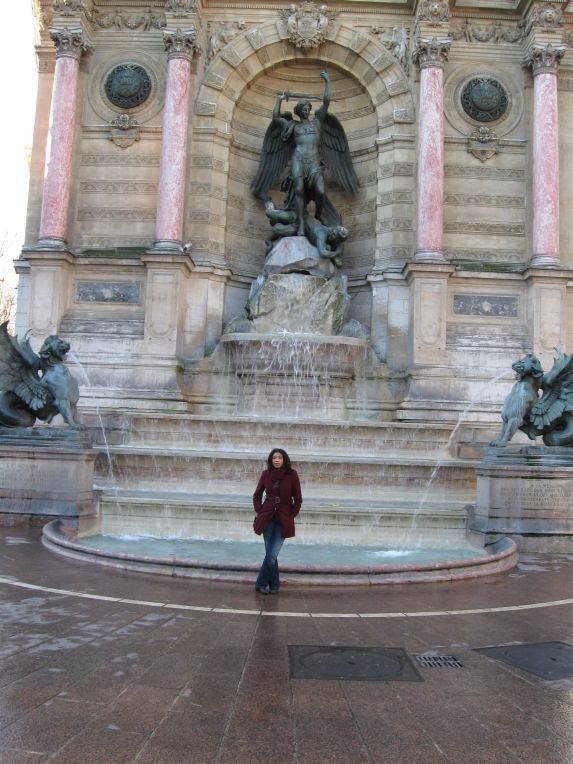
at st. michel fountainat the butte montmartegrilled perch at cafe montmartela tour eiffel, night view.
Typing the sentence above, reading the sentence above, and embracing the reality of the sentence above are nothing short of astonishing. Like many accomplishments before it, traveling overseas seemed wholly inaccessible… before I found a way to access it. And, like many accomplishments before it, traveling overseas this first time makes me entirely confident that this experience won’t be isolated. It’s a good thing; travel and I have a longstanding affinity.
Even when I was little, my skin prickled at the prospect of living in (not just visiting, mind you) foreign nations. I remember, for instance, being singularly enthralled with Samoa for a while during middle school. I was convinced I’d move there after college graduation, live in a solar-paneled house and marry some hulking brown, curly-haired “brother.” I also dreamed of England where, I was certain, I’d inhabit a castle, and Italy where, I was certain, everything would seem unyieldingly cerulean (the sky, the water, the architecture). For a while, I thought of Switzerland, until I read James Baldwin’s “Stranger in the Village.” Heh.
Ironically, Paris wasn’t really on my radar. I thought it was too touristy for the type of girl I wanted to be–far more expatriate than visiting outsider. Whenever I considered France, I thought of Cannes and Nice (not yet realizing that these, too, were not exactly the “hidden homelands” of the country).
By the time I finished college, though, with tens of thousands of college loan debt nipping at my heels (debt that made studying abroad impossible), no job prospects to speak of, and a looming family-home eviction, the wind and whimsy were knocked right out of my sails. Like most adults, I got really caught up in earning and spending. Like slightly fewer adults, I also pretty much wrecked my credit by not establishing enough of it and knotting up what little I had.
My dreams of intercontinental jaunts dwindled during the first half of my twenties. There were whole years when I couldn’t seem to imagine a life beyond the borders of Baltimore anymore. And I cried more during those years than I ever have.
Then, the spell broke and I moved to New York, the first of the aforementioned unlikely accomplishments. I got a grad degree–another dream deferred, then regenerated.
I started to think, as I saved a nice lump of money living with roommates, that this leaving the country thing might just be doable, after all.
But I was a little more concerned with getting a job that constituted the tens of thousands more in college loan debt I was acquiring in tandem with that extra degree.
Strangely, I wound up here. In Grand Rapids. Working part-time, sleeping on relatives’ spare-room convertible couch. Of all my life’s circumstances, this is the one within which leaving the country would seem least feasible.
Seriously, even if a seven-foot angel had materialized in a cloud of shimmering dust and told me that I wouldn’t get to leave the country until I didn’t have a place of my own to live and I earned what amounts to above-average part-time wages with no health benefits, I wouldn’t have believed it. I just… wouldn’t’ve.
But here we are.
This Sunday, I’ll be taking two walking tours* of “Black Paris.” I will see where Baldwin spent the final years of his life, where Josephine Baker was buried, where Richard Wright and Chester Himes wrote some of the most popular works.
On Monday or Tuesday? I’ll go to Pere Lachaise cemetery and spend hours searching for the graves of dozens of famed authors.
I’m going to see all that kitschy, must-see stuff like the Eiffel and the Louvre.
I am so doing a happy dance right now. I should upload it (on the little videocamera thing I bought for the journey), just to prove it. A virtual pinch, if you will.
… said all this to say: if you find that your dreams–any of them are deferred, make sure they don’t stay that way.
I’ll see you soon.
* Please. Click the embedded link. I’ve had the loveliest experience with this company and I haven’t even left yet! I highly recommend them, tourist site unseen.
(Click the Baldwin link, too. “Stranger in the Village” is a really great essay.)
You weren’t in a hurry that morning. Your Blackberry played the Pinball Countdown from Sesame Street at 5 am and you woke without the slightest hint of grogginess. You let Mia sleep in that morning, because she wasn’t a morning person; that’d been established in her infancy. She’d let you sleep till 9, if you let her, but woke you every midnight, like clockwork. Five years later, not much had changed, though the midnight awakenings had mercifully dwindled to two a week.
You were glad to be rid of her. This is among the few things that are easy to remember. You regularly peeked into her bedroom door, kept slightly ajar, because she wailed whenever you shut it. You took in the lavender walls, the glittery unicorns prancing arrogantly across her ceiling. Her tiny brown face, round and sweet as any cookie, was all her firmly tucked Strawberry Shortcake comforter exposed. She was so still when she slept that it seemed she was certain she wasn’t missing anything during all those hours she spent doing nothing. The world surely ceased its spinning every time Mia closed her eyes.
That morning, you studied her, fervent as a stalker. Her eyelids were two wilting rose petals, her lips two puckered tildes. Her nose crinkled cutely, like skunks had overtaken the happy forest in her dream. You smiled warmly at her, which was rare, and actually tipped toward her bed with every intention of delivering a rather risky kiss. (Mia slept in, but she also slept lightly.) But when you reached her bedside, your face four feet from hers, you recoiled. The expression that seemed so cherubic from across the fairy-bedecked room now resembled something out of Children of the Corn. Mia was baring Tic-Tac-sized teeth. Her impossibly tight ringlets writhed across her pillowcase.
You half-expected her eyelids to fly open, her gaze to turn you to stone.
I have so much to say about church since I stopped going regularly. Usually, I find myself grappling to adequately articulate it all. There’s a delicate balance between criticism and cruelty, especially when discussing “The Church,” an institution that doesn’t exactly welcome criticism of its practices. In church, I was indirectly taught not to turn a critical eye to what was going on around me and to call my lack of intellectual investment “faith.” So even now, as I know that it’s quite natural to question an obviously erroneous exercise, I still feel a little guilt when the exercise I’m decrying is a church one.
And then there are days like today, when I log onto the ‘net and find a video like this one:
in which a “fictional character” named Mother Wisdom decides to offer a rallying cry to the single women in the congregation. That rallying cry: Beyonce’s “Single Ladies (Put a Ring On It).”
Now, I can see that this video’s been available on YouTube for nearly two months, so I know I’m late to the game, offering any kind of commentary. But there’s no statute of limitation on annoyance, right?
There are about three different facets of this footage that trigger knee-jerk responses for me. I’ll give you two:
1. I’ll start with the superficial. I grew up in churches where leaders frowned upon listening to non-gospel music. As a result, my peers and I were constantly “resetting.” We’d acquire “secular music” from various sources: dubbing radio broadcasts, borrowing CDs from cousins (so that if we were caught with them, we could say, “They ain’t mine!” and not be lying), or developing an afterschool BET-viewing habit.
Then our youth group or some visiting speaker would slam non-Christian musical recordings and we’d feel super-guilty about our secret acquisitions (folks in my church circle called this “feeling convicted,” a catch-all term that pretty much applies to anything that causes you even the slightest twinge of guilt. See: “I felt convicted after eating a fat slice of chocolate cake at 1 a.m.”).
So we’d “get rid of” all our “secular” music. We’d reset ourselves as truly penitent, secularity-abstaining young people… until the next Jay-Z single dropped.
At my church, this was an individual practice. But once, I went to a winter formal at a tiny Christian college in a tiny Pennsylvanian hamlet. I stayed overnight in the women’s dorm and found taped to more than one door several shards of “secular” CDs, CDs that had been broken in a public forum to prove that one’s addiction to the devil’s music was over.
I can’t speak for those young women, but I, for one, cannot attest to ever completely deadening my interest in non-gospel music. When I was a senior in college, I had one of these “conviction” spells. In a fit of pique, I tossed 20 “secular” CDs (all that I had acquired in my four, post-youth-group, living-on-my-own years) into a shoebox and left them in the lobby of my dorm, with a note attached that read, “Please Take.”
One month later, I heard the sophomore across the hall blasting my Cree Summer Street Faerie CD and I felt remorse of another kind. (Fortunately, I still had my newly purchased cassette promo of Bilal’s “Soul Sista” single–the one I eventually broke by incessantly rewinding the “Sometimes” snippet–to ease the pain.)
But back to the point, which is that few young music aficionados feel inclined to permanently confine themselves to one genre of music. If a Christian child could entirely escape all non-Christian music, videos like the above wouldn’t exist. There would be no frame of reference for them.
This is what has always annoyed me about the informal Secular Music Ban in The Church: when it doesn’t yield the expected results, people swing 180 degrees to the left, and start singing snatches of secular music to “win the young people.”
You won’t win souls by singing excerpts from “Single Ladies.” You just won’t.
What you’ll do is undermine everything you’ve ever said about secular music being “sinful,” and the only point you’ll effectively convey is how akin the church and the club can be. (You got your crowd amped by playing a popular radio single? Congrats! So does a DJ.)
2. Onto my second problem. The even more obvious one. After Mother Wisdom “gets the crowd hyped,” she gets to her tiny, practically whispered point, which is: “Wait.” She goes on to quote Romans 12:1 about presenting your body a living sacrifice to God. Turns out, this whole ill-advised display is about pre-marital abstinence.
Setting aside the fact that the lyrics of that song (as I interpret them) are the antithesis of abstinence-promotion (Isn’t the “it” to which Beyonce’s referring her own sexual prowess? Aren’t her leotard and stilletos in the video the archnemeses of modesty?), singling out the single ladies, making them stand in a coed congregation and tasking them and them alone with the burden of “waiting,” seems a bit… unbalanced, does it not?
And yet, like the informal ban on secularity, this is a pretty common practice, at least in the churches that raised me. When the risque subject of sex finally needs to be addressed within a youth group (usually full of 16-, 17-, and 18-year-olds who may very well already be sexually active–or at least have picked up a plethora of bad habits, rumors, and perceptions about sex that no one conversation in a church on a Friday night could ever hope to undo), the girls and the boys are separated. A male youth worker talks to men. A female youth worker talks to women.
I don’t know what the dudes are told, but chicks are told that we need to be virtuous and wait on the Lord for husbands. Chicks are told that we should dress modestly so as not to incite dudes to “stumble” and “lust after” us.
Maybe while we were being shamed about our femininity, dudes were receiving the same kinds of messages. But what I suspect was more likely is what this video illustrates: girls were getting the “take responsibility for your and your boyfriend’s abstinence” talk while dudes were told that, when the time came to select a wife, they should choose one who “waited” (… for him to do whatever he pleased with “single ladies” who didn’t care if he “put a ring on it”).
Interestingly, those messages don’t end when you’re no longer young enough to attend youth group. Churches also have these nifty things called “Singles Ministries,” where, in my experience, you congregate to drink punch and read all the scriptures there are about decrying fornication and the very few that the Apostle Paul wrote about the virtues of single living (… penned after his own divorce), while some married bible study teacher tells you how he “found” his wife and how his wife “waited” for him to “find” her and recognize that she was a “good thing.”
These people may also take you bowling. On Friday or Saturday nights. (Typically, there’s only one or two men in this “ministry.”)
I give you exhibit A. Sure, this seems to be a regular in-home “Young People’s Choir” practice, but I’m willing to wager these people are single. And this was a Friday or Saturday night. And before or after this “rehearsal,” the women pined over their future husbands:
Also: I can’t stress enough how very disturbing the pervasiveness of this song (and dance, apparently) has become, within church communities:
Check out this piece on “Cultural Purgatory” I penned for PostBourgie:
Sandmann’s isn’t the only establishment that triggers my racial-acceptance-related paranoia. I also keep my head down at the beauty salon because I don’t want the women with the fingerwaves and rhinestoned acrylics judging me by my hair’s length or lack of “adventure” (just relaxer, no dyes, no gels, no ‘fro/locs/braids) and deducing that I think I’m “better” than they. I worry, whenever I go back to the storefront church where I grew up, that the congregation will take one look at me and somehow assume that I live in the gentrified part of downtown. (I don’t, by the way.)
I try not to use this blog for “craft complaints,” but today I can’t help it.
First-person narrative is kicking my butt.
I hate it. I have hated it since undergrad when I wrote that bad novella and forced it upon three profs at Trinity, all of whom told me that each of my four first-person voices was too similar.
“You need to vary the voices.”
“They can’t all talk like that.”
“Men don’t say the same things women say.”
Sigh.
Until recently, I’d been writing in third person since I was 21. I can’t deal with I’s. I’s are what make people call your story’s narrator “you” when they critique your work.
For instance, before my aunt went out of town on Sunday, I gave her a copy of the story I wrote last week to read while she was away. When she returned last night, she said, “I don’t get it. He raped you?”
This was problematic for a few reasons:
a. There’s no rape in the story.
b. I, Stacia the writer, am not the narrator of that story. A character named Avery is.
I couldn’t even finish discussing the narrative with her, because I was too wigged out by her use of the second-person “you.”
“But you kneed him in the groin for real… after you reflect on your ex-boyfriend’s relationship with Colette?”
Sigh.
a. There is no “for real.” It’s a fictional story.
b. I didn’t do anything, because I’m not the character in this story. It’s Avery.
First-person is tricky. Especially if, as in the case of the story I gave my aunt, a reader knows that a story borrows elements from the writer’s reality. It’s easiest for me to write in first-person when I see a bit (or a great deal) of myself reflected in the personality or experiences of the narrator. But I hate writing in first-person because then people think I’m writing about myself. Then, the character is me, without question, and no one will be convinced otherwise.
I’m paranoid about people speculating what “actually” happened and what “I” made up.
Third-person suits me more because there’s a clearer, firmer demarcation between the characters and the writer. I get to distance myself from the experiences I’m writing about—and more importantly, the reader distances me from the experiences I’m writing about.
I gave this same story to another friend who’s familiar with my older work (all of which had been third-person) and she had a hard time connecting with it, because “it just seemed like you were telling a story aloud, just relaying some events that happened.” Absent, she said, was the flowery language she’d grown to associate with my writing. She also said it felt rushed.
I thought this was an interesting critique. I opened the file and re-read the story. I found some of my typical imagery there, but nothing as meandering and mellifluous as the stuff I usually write.
It dawned on me that first-person was the culprit. Because the I doesn’t linger on small details the way the She does. The I is preoccupied with moving forward in time, as well it should be. Third-person seems designed for observation and musing, whereas the I (and, the second-person You especially) prioritize pacing and action.
I could be wrong, of course. I’ve read first-person stories that didn’t seem too preoccupied with moving the narrator from beginning to end very rapidly. And I’ve read third-person stories that didn’t tarry on the description of setting.
But right now, as I work simultaneously on two shorts—one, another first-person loosely based on my own experience and another, a second-person/first-person with from the perspective of two characters (who already sound far, far too much alike), I feel like i’m in Perspective Purgatory. And it’s brutal.
Anyone have any suggestions for how to effectively wield first-, second-, and third-person voices? Please weigh in below.
First time you came, I thought you were one of The Forgotten. Like, maybe you were the one whose mink I got caught trying to boost. Or I might’ve seen your engagement ring on the rim of a sink, snatched it and dipped before the first distraught tear made its way to your chin.
I saw you as you walked up, hands deep in the pockets of your belted wool coat. Hair well past your shoulders-real and blown back by the wind. Your glances were furtive, but not contemptuous. That’s how I knew you were coming to ask after someone you cared about. Maybe your daddy, probably your mama.
We didn’t get too many folks looking to help their daddies at The Bottom. But then you got closer and I saw your imperceptible eyes, the irises black and brilliant, the irises bottomless. I took note of your nail beds: baby-lotion pink, the cuticles healthy, if overgrown. The open-pored patches of skin to the left and right of your nose’s bridge were shaped like butterfly wings.
“You should exfoliate,” was the first thing I ever said to you, and you frowned. But I respected that you were frowning at me and not my digs. That frown would’ve been no different if you’d been insulted by a girl from Hampton, rather than by an addict living on the edge of the park off Division and Wealthy.
Your lips were painted crimson and crumpled. They reminded me of a construction-paper Valentine. I thought of third grade and the glittered doily heart I shoved into Bobby Bingham’s cubby.
And that was when I realized you were here for Devereaux. You were here to find out how he died.
It took me a long time to write about Sapphire’s novel, Push, being adapted for the silver screen. But write I did and here’s what I came up with:
People who love this book will tell you that it’s a triumphal story of hope in the face of brutality and despair. And it is. But for me, hope appeared too late in the work and retreated without a satisfying enough redemption for our heroine. I couldn’t stop mourning her abundance of tragedies, no matter what brief victories she won.
So when I found out Push was being adapted for the silver screen, I cringed at the prospect of revisiting Precious’s bleakly rendered world. I dreaded watching in technicolor all the awful things I’d imagined while reading. And I reeeally didn’t want to return to the hollowness that haunted the ending. What possible reason would Hollywood have for further dramatizing an existence as heinous as Precious’s?
Check out the article in its entirety over at Postbourgie.com.
Can man be stronger, if a woman is there?
I would have to say yes.
Can woman make it without men being there?
She would have to be blessed.
— Q-Tip
For the first ten years of my life, I was raised in a matriarchy. I lived with my mother and her mother (or, intermittently, with my mother alone) until I was ten. I don’t think it’s possible not to have feminist leanings, being raised in households like these. There is no male energy and, by extension, no male “authority.” Women are paying for everything that is essential to life–and they’re doing it on far less income than a man would have to. When you’re disobedient, women are doing the chastising. When you’re obedient, women are doing the work of positive reinforcement. When you’re broken, women are mending you, to the best of their ability.
If you’re fortunate, they’re doing all this without pining for the men who have been long absent or the men they have yet to meet. If you’re fortunate, they’re doing this without bashing the whole of the male species.
An aside: Writing fiction is like slipping into a home and taking things— hushes, aromas, and laughter, for instance. Unless you’re good at it—like, acrobatic cat burglar good—you never quite know how to get in and you never escape unnoticed. Your presence is a loud and clanging reminder that you’ve inserted yourself into a space where you don’t belong.
To write well is to avoid notice. But how? Do you start at the back door or the front? Should you try the basement window? These are not naive times; there will be no spare key under flowerpot or welcome mat. Your own your own. Find yourself some tools:—a hairpin, a credit card, a crowbar—and get to breaking and entering.
But once you’re in, however you manage it, you can’t discard your stealth. You’ll need it to capture the awkwardness at the dinner table, to pocket the longing in the teenager’s bedroom, to siphon the mother’s resentment-for later, literary use.
# # #
It always took Nine about five false starts before she found the right entryway for any of her stories. She was always tempted to start in the middle, a conjunction igniting her first sentence: “And then we were silent,” she’d type, or “But Bessie wasn’t ready.” This never worked. A novel wasn’t an episode of Lost, after all, and Nine had little patience for flashbacks. Beginning at the beginning seemed too obvious; she didn’t believe the hype about Occam’s razor. And starting at the end posed many problems similar to attempting an arc in medias res.
Mind you, Nine didn’t arrive at this kind of indecision—paralyzing indecision, the kind that renders you immobile as deadlines march doggedly on, as merciless as Gestapo—on her own. She’d gone into a great deal of student loan debt to learn this brand of self-doubt. She’d sat, for two years, in a series of crumbling Tudor cottages, taking courses led either by wizened codgers hard-pressed to find anyone’s work impressive anymore or by the young, hip, and newly published (their skin as intricately inked as atlases, their best advice: besot your work with casual sex and obscenity).
But now that Nine she was unconscious, she was also un-self-conscious. Without any of her customary hemming and hawing, she had found herself already in. Whole paragraphs materialized, unaided. Her clever turns of phrase (“The wind is a sieve,” indeed.) were ambling along on a blank mental slate reserved, it seemed, for precisely these kinds of health crises.
Nine could hardly stand it, prolific at last! Eloquent self-narrative was emerging with legendary swiftness. Just look at that: “tectonic shift!” Were she awake, she would’ve stricken through that phrase and written, “Inaccessible reference?” Not here. Here, in her coma, every phrase worked; though, irony of delicious ironies, here, in her coma, there was no one to read them.




 stacia l. brown