Beyond the Carousel.

Then, at dusk, we empty into evening, a downtown restaurant at our backs, an army of dragon paddleboats bobbing on the brackish water before us, and you in your father’s arms. On the Harborplace steps, we part ways with well-wishing relatives, watching them recede in the warm, black crowd. Night catches all the day’s promise in a satchel of tawny sky, tossing sparkles of memory and hope high above us. I gaze out at them glittering on the water’s dark surface as reality takes hold: we are alone.

The sensation is rare and foreign. It is not often that we are nuclear: father and mother and child. It should mean serenity or a kind of relief that for moments–however brief–we are a convincing spectacle of togetherness. But I am on the verge of detonation.

I do not know what to do with my hands when you aren’t holding one, don’t know quite where to look, if not at the damp and dewy wisps of hair against your forehead, if not at the oversized molars that loom so large whenever you yawn or cry.

You are too far away, up there. High in your father’s embrace, you are taller than I am. Occasionally, when he holds you, your downward gaze is regal. You’re an heiress deigning to acknowledge commoners. You’re a starling in flight, bored with the bits of breathing color below.

I give you both a wide berth, walking several paces behind, and wonder if you are too young to believe that the grass on your father’s side will feel lusher between your toes, will grow softer blades and brighter buttercups.

Tonight you are two. I am thinking of the way you used to belly-crawl, dragging yourself across the floor of my old apartment like a soldier wriggling under trip-wire; the determined set of your jaw when you finally hitched yourself up on all fours; the wideness of your eyes the first time you tasted a teething biscuit; the way you wailed as those pearly rounds poked through the pink of your gums; how you burbled and hummed–how you seethed!–before you could voice your demands. There is little left of the infant in you; your every gesture now is precise, the features of your face settled and firmly defined. You’re still aren’t talking much, but you make certain that we all understand you. I see you now as you will be at twelve, as you will be at twenty.

But then, I am always so far ahead of myself.

Before long, I close the space between us, ready to reprise my role as a merry member of a modern family. I play it well. In lockstep with your dad, skirting the Harbor’s perimeter, I am thinking of the day when he’ll be gone. I am turning the words over like flash cards, studying to answer the questions you’re too young to ask: Daddy has to go back to work. But he’ll be back. Remember? He always comes back. In three days, these are the exact words I’ll say to you. You will look up at him and frown, climb from my lap to his, rest your head on his chest and listen, as though recording his heartbeat to be played back as a lullaby. I will blame myself, because I understand exactly how much I am to blame.

And I am angry already, exhausted, though no casual observer could detect it.

I am too busy grinning at your pealing laughter, too busy pretending the bond between parents is as effortless as the bond of daughters and dads.

This is your first trip to the Harbor. It pleases me to see that it dazzles you just as it did me, when I was little. Your mouth is agape, your eyes brim with awe, a silver tiara enhaloes your massive afro puff, and for a moment, I wish that the time-space continuum would still until your father and I learn to make optimal choices, until you are old enough to ascertain how much of all this is an act.

Unbeknown to you, we are searching for a carousel.

You and your father tend to ride them. It is a ritual that began with his first visit to us after we moved here from Michigan. I am always asked to join you, and I always decline. You need a tether to each other that isn’t me. Perhaps neither of you will ever know how much I enjoy watching you whirl when I’m not there.

It may be selfish to admit, but I prefer you to myself. I believe he does, too.

We walk the length of the straightaway, passing party boats, a sparsely populated Italian ice hut, a closed smoothie stand, before curving toward the place where we expect to find the carousel.

It’s no longer there–or at least we don’t see it. Up ahead, there are dense crowds of volleyballers, spiking returns under harsh, high light. The sand under their feet is littered with Newports smoked down to the nub, with hard pebbles of debris. We stop before reaching them, unsure how to proceed.

You are still a lit torch burning from the inside out, eyes still dancing as they take in the water, the people, your parents and their touching shoulders and their smiles that work overtime to hide artifice from the camera that captures us all.

But when you are twelve or you’re twenty, I will explain to you how difficult it becomes for adults to pretend. The ease of make-believe is only accessible to children. I will tell you how fully I tried to commit myself to the ruse, how even the hope felt false, how only our friendship and shared adoration of you was honest. But I’ll refrain from describing what it is to spend years lying slack at the end of a line, how every breath is painful as you wait to be reeled in and believe that the hook from which you hang is love.

When you ask about your second birthday, I will say you spent it luxuriating in your parents’ affection. And at its end, we all sat in silent wonder, each at unexpected destinations.
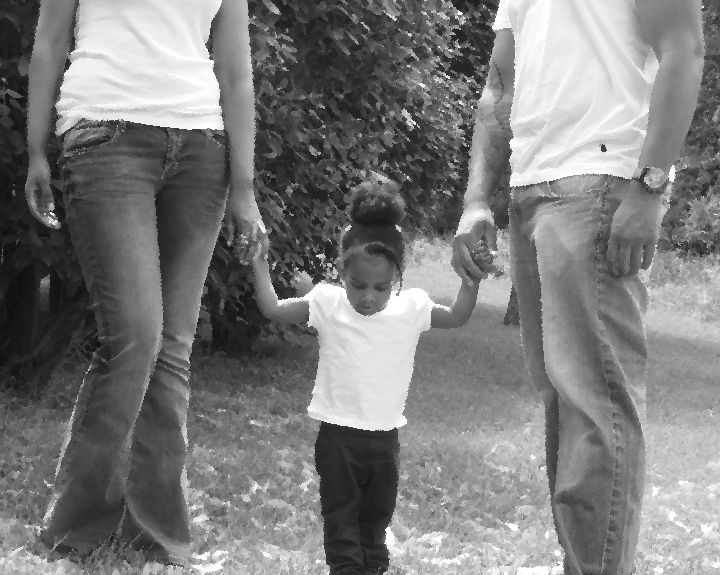
Crushes and Sundry: Advice in Advance of Your Second Birthday.

Beloved, as easily as if we were following a template of icing and gingerbread, we’ve erected an affectionate home. Lips brush skin here, as if it were canvas. I feel the daily tug of your arms ’round my neck. On occasion, out of nowhere, you place your palms on either side of my face and force my head forward so that we are eye to eye. You stare like a clairvoyant, hold my skull like a crystal ball, and kiss me square on the lips for as long as you see fit. Mmmwah! you exclaim afterward, wearing an expression that suggests you’ve just confirmed something for yourself.

It is not that you are loved; this needs no mouth-to-mouth reiteration. You feel love when I stroke your hair near the long, even part your granny has made. You feel it in the careful cornrows she weaves of your cottony tresses at night, hear it in our clicking, meticulous searches through a barrette tin for the perfect, color-matching clips to fasten to your ends. You are certain of it when you march up with urgent eyes and our hands stop, mid-motion, to direct food into your mouth rather than our own. And you listen with contentment to the melody of Ls, collect the uttered loves, stringing them ’round your neck like a strand of singing birds. You wrangle what’s left into a cage: love as a raging aviary. When that is overcrowded, the excess curls and crawls above our toes, wraps our wrists and stains our fingers: love as an intricate mendhi.

No, you needn’t kiss my lips to confirm my love–but you do it often, smiling secretly, knowingly, a punchline tucked behind your pucker. Perhaps you really are a seer; you understand that lips are to be read. In the blink of time between the buss and sound effect, you’ve ascertained a future.

Mine are the first in a line of lips you’ll kiss. A mother’s is merely the first of the many loves you’ll feel.

I will tell you this: crushes are the stones that skip seven times before sinking. They are never too heavy; they linger on a beautifully rippling surface. And when they leave your sight, any sadness you feel fades quickly.

Consider the older boy you met last week in Old Navy. He was four and alarmingly free, having broken away from his beleaguered parents and flirted his way through the children’s section, favoring brown girls with wrangled clouds of hair. I noted how close he got to the girl nearer his age, how he circled her, eager to impress, and how reticent her banter seemed by comparison.

When he lost her to the checkout line, he set his sights on you, bounding toward us with intense eyes and a delirious smile. This, you will find, is a tactic of boys at all ages.

Hi! he cried. Hi! you chirped back. He asked your name, asked your age, asked if you wanted to play. Hi, you said again, adding the string of nonsensical chatter you always employ back home. There was a pause when you’d exhausted your vernacular, and it was rapidly filling with the helpless disappointment that attends all language barriers.

Mmmwah! you declared, leaning toward him.

This wasn’t your first time attempting befriend an unfamiliar child with a kiss. You’d tried it on a tiny girl at the library and I’d pulled you gently back as horrified confusion rushed to her face.

This time, you tried something more intercontinental, opting for the cosmopolitan air kiss so popular in parts of Europe. This boy was similarly bewildered (but definitely not horrified), as I rushed you toward the flip-flop section.

When you’re older, I’ll assure you that it isn’t an error to make the first move but in the rare case when you do, it’s imperative you do not make the second.

The four-year-old we’d left behind caught up to us. He only looked away from you for a moment, and that was to turn his adorable face up toward me to ask in a tone both accusing and curious, “Where you going?”

I started talking to him like I would someone my own age. (I’ll admit having you hasn’t made my interactions with other children any less awkward.) But as I launched into a lengthy explanation about all the areas in the store we hadn’t hit yet, he was inching closer and closer to you. Before I knew what was happening, faster than I could react, he’d kissed your cheek.

Technically, it was your first non-family kiss. Technically, you and the four-year-old boy in Old Navy had just gone through an entire arc of courtship rituals in less than three minutes.

When you’re twelve, you will think I’m crazy, but this was a major McFly moment. In a flash, the future was now.

You will know your wiles early, will wield them with coyness, not cruelty. Men won’t be the mystery to you that they are to your mother. But seeing your own beauty as clearly as I do will not come as easily. It is simple for me: you are startling, the same as your father was. One minute, you’ve the stock cuteness all children hold. The next, at an angle, with a twinkle of eye or a baring of teeth, you are gorgeous in ways that will keep me up nights well into your thirties.

I am telling you this, my wondrous girl, because you’ll need to know it. In nine days, you’ll be two, and in what will feel like the space between sunrise and nightfall, you’ll be twenty. The rules do not change:

Be equal parts open and aloof. Do not falter in following your agenda; when you are valued, you are always followed forward. If an action is objectionable, protest then and there, but never pretend offense where there is none (you didn’t yelp at the kiss and because of that, neither did I). Mind your mother; more often than not, she knows of what she speaks. But above all, pay attention. Part ways when the time seems right, and do not think to tarry. 

The fact is that the time and the person will come from which you will never wish to part.

The Totem.

When you’re twenty, I’ll tell you what things were like just before you turned two: how I felt like a totem pole being whittled by the Carpenter, how the bits of my life that were once so green and life-giving began falling like scallops of wood ’round my feet. I will tell you how unsettling it was to watch them rest there. These shallow wisps that were once so inextricably affixed, firm ridges of root and of bark, were now curling, lifeless and inconsequential, lifted and scuttled farther away on even the mildest of winds. There, a longtime friend. There, an unfulfilled desire. There, an entire branch of the family tree.

I was once indistinguishable from other oaks. My functions were fully understood. I was beauty and shade and breaths of fresh air. I was considered suitable for climbing, a welcome place to rest. Stalwart, I could always be found where seekers of solace had left me. Immovable and silent, I was ever their refuge, their asylum.

No one considered this could change, least of all me. It wasn’t foreign, transformation–not entirely. Every autumn, I’d watch myself and others turn. We were rouges, then dusks, then maize. And soon we were naked and barren.

But this was nothing compared to the cracking of skies, to the virulent force that struck me as though I had wronged it. Perhaps I had. I spent those first days claiming fault: I wasn’t attentive enough. The shade I provided did too little to stave off the sun. Maybe my branches cracked and snapped under the weight and expectation of climbers. Maybe the lightning was lonely and cursed me for being so passively grounded, so unfailingly accessible.

It didn’t know these were not things that I wanted. It comprehended as little of my life as a tree as I knew of its need for a crackling rampage. I have heard that it does not aim, that it smites wheresover it will. But it is hard to believe, when I wince at the memory of a trunk rent in two, of the tremulous roots’ bewilderment, of the ground’s utter fright as it crumbled. It’s impossible to imagine that the bolts move without motivation, that they are not willing agents in such acts of irreparable destruction.

I nearly died when lightning toppled me. I can tell you this now that you’re twenty. When I was 32, I learned that the absorption and transmission of oxygen are necessary performances but are not the crux of a life. I lay there for hours, for days, still alive, but the purpose of life had eluded me.

It is never the lightning that kills.

For me, it was the pitying looks and the scorn, the whispers, the warnings of the fallen tree, with one perfect burst of fruit on its withering branches. Beware lest it obstruct your path. This kind of decay is contagious.

Were it not for the Carpenter’s carving, I am not sure you’d have much of a mother. I would’ve loved you on what was left of my confidence that, as a tree, I was capable of cradling the fruit I had borne. I would’ve gazed at you with rootless adoration. But I no longer knew who I was without sturdiness, greenness, or shade. I was little help to anyone then–and all those who’d once come to me for friendship or familial love began to notice. They’d pluck up the bits that hadn’t begun to rot and they’d try their hardest to replant me. But I was no longer amenable to their insistence that I thrive on their terms. I was starting, very steadily, to pull away.

None of us knew then what I would become–none save the omniscient Carpenter. His eye caught only what could be restored; His hand sloughed all evidence of harm. For a time I felt stripped; there was nothing. Even with you nearby, I felt alone.

Carefully, He swept away the excess. He pared and cored and whittled till I became a statuesque testament, a living narrative of restoration. I had been more than salvaged. I had been re-purposed.

Carnival.

In the gray Nissan Versa that’s hard to afford, my mother sits behind the wheel, our daughter in her lap. I am sprawled behind them, next to the car seat our girl has abandoned for a better view of the lot before us.

For the past ten days, the lot has been transformed from the desolate patch of asphalt outside a mall so skeletal the community keeps vigil around it, waiting for word of its death, to a blinking neon festival of thrills and frights and views from epic heights.

This is its last night in town. We have pulled up and parked just outside the wire fence that surrounds it, our last stop on a customary post-church evening joy ride.

Though we’d planned to bring Story here to see the lights and laughter, the curious gadgetry, acrobatic and colorful, we had no plans to enter. We’d decided she’s still too young. Even the carousel horses seems meant for bigger children. And truth be told, I am relishing the vestiges of her babyhood: the incoherent babbling that still overwhelms her plain-speech; the consternation that crosses her face when confronted with lid-less cups; the way her steady gait becomes a toddle when mounds of grass crumple under her feet. I am often relieved at how the brevity of her attention span exempts us from kids-movie-showings, and so too the carnival feels thankfully premature, the longer we watch the older children prance and twirl and cavort.

But it is the length of time we sit and keep watch that unravels me. The longer we’re there, the more I notice the single fathers, hoisting a child onto their shoulders or pushing a stroller toward lines, entering and exiting Ferris wheel cabins, tucking massive toys under their arms–all the spoils of overpriced games they’d battled and conquered. The longer we’re there, I am inundated with nuclear families: a father, a mother, a toddler and teen; two parents, their twins, and a goldfish.

It’s almost more than I can take, some days, your absence. And this may be because we hear from you each day. This may be because your voice echoes through us as though we are caves. Your email and texts and packages punctuate a kind of loss.

I know to be grateful; I know the work of practiced contentment. It is arduous and long. But it is fashioning within me a bemused patience, a poker face, so we can’t feel the rawness of nerves.

This is my predominant stance, but today there will be no masquerading. Today, the house of mirrors I’ve constructed, so my face will reflect the expressions of those who greet it, is closed.

I crawl out of the car and round the perimeter of the fence. My mother and I have spotted a ride within that is suitable for a girl as small as ours. It’s a series of green baby dragons that rise and go round and round. Each dragon’s hollowed torso holds a mother and child. This is a ride meant for us, a gargoyle built for two.

But I know, even as I near the ticket booth, that I can’t afford this, that I’ll remain on a strict and worrisome budget until my summer adjunct work begins in weeks to come.

Still, I squint at the signs. I take in the pricing: 15 dollars for a modest spool of tickets, 25 for a day-long wristband that would be useless two hours shy of closing.

I stand there, amid excited children, their capable parents, the cars where others sit weighing their options. And I am there far longer than it takes me to do the figuring. This requires no calculus: tonight, the carnival is a luxury I simply cannot afford.

Back in the car, it’s hard to read our daughter’s face. She is unnervingly precocious. Is it possible she’s old enough to be disappointed? Could she comprehend the ways that we have failed her?

It is just a carnival. Questionable rides, paltry parting gifts, empty calories. But is a microcosm of the world I want to give her, the world that recedes as we pull out of our parking spot moments later.

Once we are home, I write a scene in my latest attempt at a novel about conjoined twins wandering a carnival with their mother alone to insulate them. When the last word is typed, I send it to you. You call, having read it, and ask the inspiration. I tell you we stopped at a carnival. I tell you I nearly cried. But it’s hours before we finish the conversation.

— Why’d you almost cry at the carnival? you text.

I type back the description of fathers. I tell you about the budget and resignation.

— Next time, I can send you what you need for the cost of admission. Next time, you should come to me with this.

That isn’t entirely the point, I retort. In some ways, entering the thick of it would’ve been worse than not going in at all.

— It would’ve been a perfect storm of inadequacies.

I’ll be teaching a summer writing course through my freelance business, Wings to Write Consultation & Coaching for five weeks. I’d love for you to join us. 🙂

How Deep the Mother’s Love for You?

I think that, now, you may love me more. It is possible that the older you get, the more you understand our relationship, and how it’s predicated on the faith you seem, at times, to know far better than I do.

I have watched you at church, where I didn’t regularly take you until you were well over 18 months old. When you raise and wave your hands and your face is awash in beatific reverence, I know that you’re mimicking nothing, that whatever gestures of worship you extend are yours, untaught and unrehearsed. To your guileless toddler mind, I will never leave you or forsake you is less a stray line of dialogue in a holy narrative and more an earnest incantation, a promise, a governing tenet, a truth.

With every day that you open your eyes and find me here, inches away in a bed we share, your confidence grows. I can be your dim earthly reflection of God. Ours can be a fixed and unquestioned bond. Your mother can be immovable.

This confidence has been slow, gradual, earned, but the affection that now attends it is unabashed. I have waited for you to comprehend the fathoms of what I feel for you. Every embrace is an echosounder; every kiss is understood as another nautical mile. But I suspect it will be years yet before you discover the truth of this mystery.

How deep the mother’s love for you? Like the Father’s (and your father’s), it is floorless.

In just over a month, you will be two. But if anyone were to ask me, you’d be 200, a Highlander, a water sprite, a warrior, iridescent and timeless. You have been with me a kind of forever. This is the thing so few really know about children. You presage yourselves, whirling around in the twisters of DNA and dust that compose us. And we know, long before we know, that you might someday be and also that you may never exist as more than the cells that encase the nuclei of promise we could never live long enough to see fulfilled. In this way, when we are aware of ourselves and invested in you, we will always know more of you than you know of yourselves.

Every day, mothering you takes fresh meaning, issues new instruction. Consider, for instance, the meals and how we divide the portions. We eat in genial silence, exchange smiles around our chews. But when our allotments dwindle, you do not entirely trust that I will leave you with more than you need. You stuff all that remains into your tiny mouth, so that you become, for a moment, a puffin. Your eyes grow wide and unsure. You wonder if I will be angry, if I will mistake your self-interest for greed. You needn’t fear; it’s my job to know that you are not selfish, but hungry. It’s my mission to feed that which quickly hollows, a longing that is not meant for food.

At this age, you are insatiable, acquiring time, numbers, language, love and hoarding them for a future you’ve no way to know. I am beginning to understand that more than anything, my role is to reassure you:

I am not here to take but to give. 

Rejection, Pep Talks Involving Oil, and My Biggest Fan(s).

I spent yesterday starting a piece called “Everest,” about my constantly evolving relationship with my daughter’s dad, until around 4pm, when I got an email from the one publisher who requested my full pregnancy memoir manuscript, back in December ’11. I submitted it in mid-January, after coming up with an ending, and I’d checked in with the publisher twice over the past five months, since I was initially told to expect feedback in 6-8 weeks.

Now, here it was. Right in my inbox on a Sunday afternoon, a holiday. I knew it wasn’t good news, and I was right. They don’t want it.

I could stop here–and I almost did.

I hate rejection. I’m not one of those slick-backed people who roll criticism off themselves like water and never let it make them question their worth, ability, or purpose. I’m the opposite of that; I absorb every rejection–whether personal or professional, merited or baseless–and try to figure out how to become unimpeachable and beyond reproach. It’s what kept me from submitting to more than 20 agents and small presses in this initial run, and what kept me waiting on this last company’s decision before deciding whether the manuscript is viable at all.

Since everyone else said no or said nothing, it would come down to them. They seemed interested. After the first follow-up, they said they were very carefully considering it. I believe they did.

But I also knew they’d likely pass. I wrote the manuscript the way I write blog entries: stylistically, flowery, purple. And there isn’t much of a market for that in the category of memoir (or in general, I guess, unless you’re exceptional at it and use it sparingly).

In the end, the feedback suggested as much, that if I were willing to be less gauzy and second-person-y and provide a substantial amount more concrete detail, they’d give it a second look*. They said I’m a good writer (“very, very good” is the verbatim quote and thank God for it), but the diaristic nature of the book (which is, they said, in some ways, its strength) ultimately leaves the reader adrift. And worse: the work is too inwardly focused, too inside my head and not conscious enough of the reader.

Craft talk confession: this is my mortal flaw as a writer. Being too inside-my-own-head. I write in ways that make sense to me, not with an eye toward the reader, nor with much attention to time or space. I write what feels urgent and necessary and I’ll stop here before I veer further into that embarrassing self-assessing space that works to reinforce this point.

Anyway, I decided after reading the rejection, that I’d table the memoir (and memoir altogether). It’s the second one I’ve written, both were rejected, and for two reasons, I was partially relieved each time: 1. I was writing about very raw experiences with people impossibly close to me; publishing my ideas about them would damage too many relationships. And 2. Dozens of rejections must mean the work clearly wasn’t as good as I thought it was** and I could spare myself further rejection by moving on right now.

I am not a self-confident person. Most people can sense this about me right off. But I’m also used to achieving my goals with relative ease–except with this one I want most: to make my career as a literary writer (blogging/online writing, awesome as it sometimes is, isn’t quite the same***).

Couple the fact that I’m not used to needing tenacity with my compulsive uncertainty, and you have your reasons why I don’t already have a book or two published.

I was all too eager to go on to my novel-in-progress (because surely, this is the most commercially salable material I’ve ever written and all those other failed projects were just target practice, right?), after a brief existential depression, that is.

And then I read the rejection letter to my daughter’s dad last night. And I kid you not: he gave me the best. pep talk. EVER. It was all the more impressive because, if you’ve been following the excerpts I’ve written about him here in the past two years, you know that the memoir doesn’t flatter him.

Here’s where I should also point out that I am only brave when I’m writing. Afterward, a kind of cowardice kicks in. It’s one thing to blog or to publish. It’s quite another to open your door and field the complaints of a whole torch-bearing village, regarding the things that you’ve written. It doesn’t matter if your account is true; it’s still embarrassing for them and by extension, hurtful.

So though I told him repeatedly that I was writing this book, I never offered to let him read it, and he never asked. It was just another elephant, another bridge we’d cross when we got there. But occasionally, he’d let on that, during our months-long estrangement, he’d read things–things I didn’t know he’d read–so he had an idea of what to expect.

In short, he told me that, even though we’re in an amicable place now, that doesn’t invalidate what happened. “And if that pain can yield you a paycheck…”

He insisted it didn’t make sense to shelf it, because that rejection letter was filled with suggestions for making the manuscript more accessible.

Our conversation contained all kinds of extended metaphors (On conforming to genre expectations–which I don’t: “The industry is a machine that needs to be oiled. You just have a different grade of oil, and no one knows your brand yet. For now, you’ve got to change your formula.”) and plaudits (“I’m your biggest fan. Well, maybe your mom. And Story. We’re your biggest fans.”****)

Suddenly, this Father’s Day skyrocketed from bearable to awesome.

I know I’ve written a lot, but here’s an excerpt from the Everest piece I abandoned, once we got the rejection note:

I promised you the climb, without pomp, with no parade, without paper. I just looked up and saw above me an impossible height and, toward its apex, the specter of you beyond mist, in thinner air. You, insurmountable, a boy fully grown but under-parented, a man without map, baring nothing: a pinnacle. And as sure as the snow caps, the scant breath, the cliffs, I made vows.

I will tether myself to your side, will pull up or scale across or camp in your clefts, will hold fast to the immovable ridges that round you. I will bundle myself against your bite and warm myself with small victories.

These were unconsidered oaths, incalculable and foolish.

I may finish it later.

* More concrete detail would make it a different kind of project, one about which I’m less enthused. I wanted it to read like a kind of fable, not like a series of unfortunate straightforward incidents.

** A writer I follow on Twitter has told me repeatedly how few twenty rejections are. She had a friend who submitted a project to fifty or sixty agents before one said yes. It’s the kind of story you need to hear, but it also makes you queasy and moves you to paper-bag breaths.

*** As much as I love this blog and as much as writing for other sites has affording me a scantly larger audience, it’s the literary writing that will make me a contender for full-time college teaching positions, which is part of my endgame.

**** I’d add my dad to that list. He asks to read everything I write. And then he does.

The Irretrievable Word (or Mo’ Public, Mo’ Problems).

Words are everything. Words are empires; they are ruins. Words are the fiery dragon and the watery balm that extinguishes. They rouse the beast and tame the serpent. Words impress and belittle. They mock and exhort and destroy.

I am well acquainted with their import and how the hands that move them should be steadied, undefiled. But my work with them has always been doubled-edged: a dark art, a sacred vocation. I can rush them, for money, push them into a vice and turn them till they’re taut and succinct and serviceable. I can wring dry their water, make them acrid, isolating, detached. Or I can sit with them by a stream, till they glow and they flush and sustain. Words are pliable this way. And our motive, in using them, matters.

I used to have the luxury of preciousness, of doting over every blessed phrase until it sang, until I was certain I’d done it justice, until I knew I’d done no harm. But such luxuries wither away with daily deadlines, and the pageant I’d made of carefully parsing every thought has been slowly scaled down until there is little left at all: an errant simile twisting in the wind like a streamer, a string of once-electric vowels gone hollow like the echo of vuvuzelas.

This used to be what I wanted: wider readership, more frequent contributions to the funnel cloud that culls our culture’s words. But in the eye of the twister, I have clarity–and I know the significance of the work I once did: slow work, painstakingly constructed, and published only when I was pleased. Now, I know the vulnerability of dashing off words and watching them flutter quickly out of reach, rather than preening under the caress of my hand. And perhaps worst of all, I know what it is to have serious doubt that you’ve said what you mean, that you mean what you say. I know the cold sweat, the worry that wakes you at dawn and wonders: did that essay do more harm than good, did I injure the ones I hoped to help, did I do a disservice to my family, my friend, myself?

Words are everything. And when they leave the heart and they enter the air, they are no longer ours. This is hard to accept: like full-grown children, they have no choice but to reflect the way they were raised. And under the constant deluge of others’ assessment, I often feel I’ve failed them. But this is the burden of being not just noticed, but truly considered: you must always account for your way with words.

And Our Little Child Will Lead Us.

First confront the shame. Shame is the behemoth, the Goliath. Fell it, and anything else insurmountable will shrink to scale. The great transmogrifier, Shame takes any form you let it. It may shapeshift into a messy divorce, into unmarried coupledom gone awry, into the solemn head-shake of a disappointed God and the gloat of His more judgmental congregants, into pitying married couples arranging blind dates as though the sight of you alone is as heartbreaking as a one-eyed limping animal in an ASPCA commercial.

Shame, for me, is a vapor: insidious, poisoned, barbed. It is a twin air, near-indistinguishable from oxygen. In order to lessen its paralysis, I have fashioned an elaborate mask, a filter. It traps negative observations and complaints; it purifies the dark confession. It clears the air. But there is always seepage, in places where air is its thickest, in rooms with invisible elephants, in restaurants and grocery stores that become mini-high school reunions.

When the air is too thick to be cleared, when smugness is acute enough to smother, when the task of answering pointed questions threatens to close your throat, it is best to remove the mask. If Shame intends to suffocate, let it come. Let it stifle if it must, but hold deep with yourself, in flattened diaphragm, in taut, expanded lung, in blood that pounds what’s truest through the heart, the knowledge that you can withstand it.

Once you learn to circumvent the shame, develop convenient amnesia. Curtain the crueler scenes, the ones which hinder progress and impede impartiality. Do not rehearse the ugly dialogue, nor swell with the indignation necessary to deliver a self-righteous soliloquy. Forget the well-dressed set, with its four poster bed center stage, where you spent months weeping and rehashing in the fetal position. Retire the ticks you cling to, the shorthand you use to decide on an appropriate emotion. These things will not serve you well in the upcoming acts. Take a red pen to the past. Slash all things that do not matter. They will be many. Focus on the empty pages before you, on the ending that as yet unconceived.

This is how you’ll fill them: start with the loveseat you sat in together last weekend, with your toddler between you, turning bony somersaults across your laps. She stops and glances first at you, then at her father; she has only seen you together at length a handful of times, but never quite so cozily curled as the three of you are right now. She does a double-take, eyebrows raising, and the wisdom of all of her 21 months converge in the knowing curl of her lips. The smile she gives you both–appraising, befuddled, approving–speaks volumes of her expectations.

She wants you civil. Relaxed. At genuine peace with one another. She wants you statuesque and grinning within the white-edged confines of photos. She is not here for your bittersweet memory or mourning, cannot conceive of a life spent reminding each other of wrongs. What she wants is the loveseat. And she will not split hairs about the kind of love it offers, will not scrutinize whether her parents’ affections are romantic or filial, as long as their love for her is unconditional.

This is what you owe her, a relationship as uncomplicated as sitting. This is not something you would’ve been able to give her at birth. It has taken failed previews, missed openings, and more rewrites than you’re capable of counting. It has taken a meticulous removal of the cataracts of offense, which warp and color everything according to their own pain. It has taken admission of your own fault, of the strange revelation that there is more than one way for the two to become one flesh, of the recognition, stranger still, that your incarnation of one flesh streaks through sprawling fields of grass. She casts glances over her shoulder and expects both of you to follow.

As you do, first tentatively, then with reckless, laughing abandon, you forget all the rules you’ve assigned yourself. You are, more than a former couple, more than realigning allies, more than two people who’ve hurt each other profoundly. Your daughter has reminded you that, above all, you are a family.

In this manner, she will ever be your guide.

Things We Whisper, Things We Shout.

There are the nothings, either sweet or scolding, offered in the cool of an afternoon or hissed in the heat of a moment. There are the alleluias, the Celtic Gloria, the antiquated verses of crescendoing hymns. There is the fact that you are beautiful–without modifier, without exception–and that you are also capable. There is the secret to accepting compliments: be gracious and thankful; feel no obligation to volley them back to their givers. Your only imperative is not to be smug. There is the advice my mother gave me: there will always be someone more skilled or more lovely than you. And there is my amendment: that is an inconsequential thing. There are confessions, of risk, of a fluid faith, of profound uncertainty. (I do not often deal in absolutes; I have been, too often, proven wrong.) There is God as we imagine Him, in visions: yours is of a massive hand stroking the crowns of children’s heads and leaving streams of gold dust in its wake; mine is of a listener, a philosopher, whose riddles will woo and thrill and confound me well into eternity. There is the confession that I do not mind not knowing, that though I trade in scholarship, daily darkening the halls of academe, I feel safest when I am unsure, when I am not so arrogant as to claim that I know better than others what should be right for all. And there are the scraps that swirl on the wind, debris upon which the wisdom of ages is scrawled. We catch them, like lightning bugs, like butterflies, pull them apart, read their wings. Sometimes, love is haggard, one tells us. Its garments are sooty and tattered. We nervously pass it on sidewalks, afraid to open our purses as it dares to ask alms. It retreats into alleys under our scathing gaze. We deny it its work and its glory, unable to recognize it as it is, unwilling to touch it long enough to brush the embers from its medals. Love rarely comes in gleaming armor. Love hobbles up, discharged from war.

These are the things we whisper, when you’ve climbed my legs and torso like a tree, used my arms as sturdy limbs, and dangled.

The things we shout are fewer. We need only raise our voices in accordance with the stakes. And too few things in the life I’m fashioning for you prove dire enough to necessitate the noise. Still, we are more than able of turning ourselves into cannons. Our hearts are as volatile as powder kegs; they are riled by hate, ignited by injustice. We do not like to be told who we are; when we are underestimated, we are ferocious. If ever your rights are threatened, know that I will roar for you–and that sound that will escape this bodily cage where I’ve kept it corralled, will be like nothing you have heard or are likely to hear again. Of a truth, the time is nigh, the day is close at hand, when I will lower you from the limbs where you love to perch and tuck you safely into the cavern I’ve prepared. You will dip your fingers into the well of a mortar and streak my face with the indigo you find. We will kiss and, before we part, we will howl like Dahomey, like wolves up toward the open ears of moons.