Stretch.

The sky can be sliced, can be serrated. When we fly, clouds pull apart, the first heaven reconfigures, an unblemished celestial landscape forever alters with exhaust. It has become commonplace, flying. We view it not as an enchantment, but an inconvenience. We are not awed by the height we reach nor the speed with which we may exit one icy clime and find ourselves in the warm embrace of another. We forget that this is only possible — earbuds stuffed into auricles, pillows plumped under our heads — because someone stretched.

Someone enacted an idea with a reach that exceeded his grasp. With a pounding heart and a galloping mind, he sketched, he planned, he fashioned and tested and failed. He had help. He was lifted, both by those whose ideas dovetailed with his own and those who doubted his ability to ever reach higher than they could. He s t r e t c h e d, and in so doing, built something that serrates the sky.

I have gone whole days without stretching, gone full weeks, many years, a lifetime lifting toward spots much lower than those I could reach. I’ve been meek. Once my nana accused me of shrinking: you’re too young to be losing height and too old not to stand like you know you’re tall. Stretch.

Her mother was diminutive. She lived to be 95 and in her final years, when you entered any room where she stood, it felt hallowed. After decades of curling down, she felt close to heaven. My great-grandma trained as a teacher then married a factory man-turned-preacher and raised 10 children, quietly. Old photographs show her sitting, stoic and adolescent, amid her sassier sisters who would grow up to buy land, write poems, perform monologues, ride camels in Egypt.

I like to believe she was content. Perhaps family was her reach. Perhaps her laborious, love-glazed meals were all she needed to grasp. But it was only when her husband passed and left her with a decade alone that I saw her s t r e t c h. She ventured a joke, a smile, a risque repetition, and basked in the laughter that followed. She tested opinions on her tongue, rolled advice around her molars, conjured a voice more confident than I’d ever heard her use. By then, the bones in her back had calcified; her spine, not unlike a comma, separated her new and independent will from years of dependent clauses: if the children are well, if my husband allows, if the weather lets up, if the grandbabies need me. If I can.

Stretch.

My posture is not what it should be, nor is my opinion of myself. This, like my talents, desires, and eyes, is an inheritance. But so are long arms, a galloping mind, an appreciation of aircrafts and their ability to serrate the sky.

Stretch.

This year has been one of reaching, of fingertips pushing past practical possibility. I have stretched my perceptions. Stretched the confines of an INFJ personality. Stretched my patience till it was pulled thin and pliable as taffy. Stretched writing past entertainment, past preciousness, past secrecy till I reached activism. Stretched a dollar till it hollered, forgot its diminished value, and yielded to my will. Stretched beyond my agenda to help others reach an apex. This year has felt like a rack, like I was not so much the agent of my reach than a slave to it.

Stretching is rarely triumphal. It is born of discomfort, desperation. It is born of disgust and necessity. It comes from dangling: yours from the end of a rope and that of the thing you most desire, within sight but just above the air you can touch.

It aches, makes you painfully aware of the parts of yourself you neglect. Stretching intensifies your accountability: the stronger it makes you, the more you can carry.

I am carrying so much more than I ever believed I would.

S  t  r  e  t  c  h.
The Jesus Year.

At 33, she was no longer appalled by herself. She had taken self-inventory, considered her broken parts, set about mending them. For her opinions and decisions, she was beyond apology. She knew leanness, empty pantries, the anesthesizing tartness of liquor. She knew when to laugh. She did not quite recall the electric pulse of new lips against hers. She still had very little idea how to comport herself in the company of men; they were still hunting her gaze and trying to hold it, still asking with concern if she was all right. She still worried that her large, imploring eyes were an undertow: if she looked at men full on, she would drown them.

She was losing her taste for grease-soaked potatoes. Only certain pizza seemed palatable now. She understood the purpose of bicarbonate and Tums. Cold weather was beginning to set her joints ablaze. On occasion, the prospect of death, which she had never feared, began to unsettle her now. Breath caught in her throat whenever she imagined her daughter muddling through menstruation, sifting through racks of prom gowns, tackling FAFSA and early admissions applications, or readying her wedding without her. Death was no longer an abstraction; it had measurable consequence.

At 33, she began to pray a bit more for a longer life. She began to pray a bit more in general. She knew that most people who were raised in an insular faith, then ambled into a larger, less devout world, redoubled their belief as new parents. But hers was an inching back, rather than running. She wanted to be careful, discerning conjecture from catechism. She wanted a faith that felt self-possessed; she did not want her place in eternity determined by anyone else’s fears or cliches or convictions. She did not want to waffle.

If this was the year when her life would most fully parallel her Savior’s, she would spend it empathizing. How would she feel if she knew her fate was sealed, was clearly marked, was imminent? How well would she sleep, if she were apportioned — every day of this year– a greater measure of mankind’s fickleness and suffering? What would it mean to know that thousands of years after she shed this sinew and bone and skin, the streets she had once tread would be filled with the discarded bodies of others, that the sky which God had opened to receive her spirit, would be filled with the endless din of missiles and drones? How would she reconcile the selflessness being asked of her with the selfishness that would consume every corner of the earth later? Would she feel the injustice of it all, the colossal affront? Would she understand how very young she still was?

Since she was not Him, not without sin or fill with preternatural wisdom and unable to prostrate herself in humanity’s stead, what would she be able to do about it?

This is the mystery she’d spend the year solving, the question she’d spend her life answering.

Exeunt.

“Am I a mean person?” I ask, in the minutes after he tells me he isn’t sure he ever plans to marry. But what I mean is: did our relationship break something vital inside you? Are you ambling through this hereafter, ever aware that a cog is rattling, that a filament has burst leaving all in the corner of yourself I once occupied hollow and dark? Am I supposed to be doing something more about this? I will put forth a truncated version of these queries just before we end our call. He will not know how to answer.

Now, he stops short but recovers quickly. “No.”

“You paused.”

“I was trying to find the right word for what you are.”

So am I.

We are two-dimensional to each other now, a collection of sounds and footage, electronic data across thousands of miles. The realest artifact left of those years we spent in love can be heard squealing with glee in the background of our calls or else parroting the few eavesdropped words she can clearly pronounce.

She is the only memento I’ve kept.

It’s all this shifting. Our transitions have been swift and our space so limited. Each encampment is heavier to fold into itself and transport; at every pass, more must be sloughed.

It has always been difficult for me to determine what is worth salvaging.

The word he settles on is eccentric. “You’re very particular. You get upset when people behave in ways that you wouldn’t.”

“That’s fair,” is what I say, though I’m not sure how ‘eccentric’ his example makes me. I think he means ‘idiosyncratic.’ The strangest things cause me internal combustion: being followed by a student to the lectern as I’m entering a room, before I’ve set down my briefcase or taken off my coat; wet footprints on rugs in a bathroom; someone else opening or polishing off food that I’ve purchased; being told what I should and shouldn’t share online; the expectation that I should forget a rejection, when its din and ache still ripple through me like an echoing chime.

I have been mean to him. We both know it; this is not why I asked.

He tells me that he’s comfortable now, that he considers his role as a father to be an honor and a sacrifice, and it is all so familiar, this rhetoric. It’s similar enough to the phrase he’s turned so often before, an idea that, perhaps, every single father must utter a few times aloud, in order to fortify himself for the work that lay ahead: regardless of what happens with us, I’m going to be there for our child. 

I wonder how fully he understands the way this falls on my ears, how clearly the truer sentiment presents itself in the hearing: caring for our child is a point of pride in a way that caring for you was not. 

In all its iterations, I believe it. But it never gets easier to hear, not even now, after we’ve heard and said so much worse.

“Everything is harder, ” he muses more to himself than to me. Then we talk about changing careers, earning certifications, making ourselves more financially solvent. The naivety is seeping out of our dreams, and we hear too little of ourselves in the other’s aspirations.

It occurs to me that this has become an exit interview of sorts, the last and loosest of our ends being tied. All of what I’ve hoped and feared is converging. The years-long work at repairing the rattling cog has finally been exhausted.

My lips part. There are other things I want to say: as co-parents, what we get isn’t so much closure as cauterization — we sear our pain shut to survive our shared duty; there is more than one way for a family to be “intact;” if given a mutually exclusive choice, children will opt for their parents to be happy rather than together; and I am ready — so far beyond ready– to be happier than this. I know you are, too, and this is what we both deserve. Then I’d whisper the confession that always cripples me: no matter how anemic the possibility, I would’ve held on as long as you did.

Next time, things will be sweeter. I will not be coy. I will not secret parts of myself away. I will not offer a man decades when days will do.

This is all I can predict of the next time. But I feel a great sense of relief knowing there will be one. This is not a grace we would’ve been so easily afforded, had we married. This, I suppose, is part of why we never did.

The Ripple of Reelection: Thoughts on Voting as a New Mother.

I am imagining a teenage future. In it, you are inches taller than I, your WNBA-length fingers hovering over the hologram-enabled screen of the latest palm-sized tablet. You are engaged in no fewer than six conversations, aside from the one I am about to initiate. I will not know by looking at you if you are ready to listen.

We will have this talk two years before you’re old enough to register. My hope is that whoever has taken office then will bear some cultural, ideological, or experiential resemblance to the man we re-elected last Tuesday. If she does, what I have to  tell you will seem less like a tall tale or a fable. If he does not and if your memory is less than keen, you may believe I’m romanticizing an invented past.

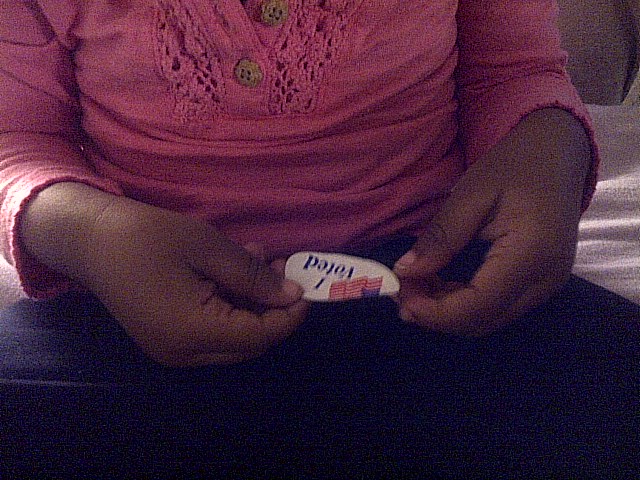
The truth is: when you were two, we voted for Barack Obama to reclaim the highest office in the land. I pressed a decisive finger on the electronic ballot screen, with you in my arms. You were as still and as quiet as you are when we first enter sanctuaries on Sunday mornings.

You have always understood when a moment calls for reverence.

By then, we had been standing in the hallway of a local middle school for two and a half hours. We were part of a serpentine trail of mostly brown bodies, a community very clearly comprised of members of the working and middle classes. The air around us pulsed with purposeful energy.

Though some complained at the length of the wait — projected, at first, to be three hours —  most were either patient, but steely, or bursting forth with optimistic banter: It’s good to see so many out, exercising their rights– and look at all these young folks!

The youth vote is cherished. Earning it makes us feel calmer about the imminent state of the world we’ll leave behind. An eighteen-year-old, regardless of whether she is won over by rhetoric, emotion, or careful study of each candidate’s platform, is a sapling in a marshland, a newly hatched chick in an aviary for the endangered. For the parents, the middle-aged, and the elders, you — more than any candidate or speech — are the hope of our nation.

I did not know this at your age. I’d heard it, but only as saccharine sentiment, as lyrics in a chart-topping Whitney Houston pop cover, as so much white noise amid the drone of my own angst. Even at 19, I could not be convinced that my participation was integral to the maintenance of a functioning democracy. But I still began to vote that year, like the dutiful descendant of a people once considered three-fifths human that I am.

It seemed a moral obligation, if mostly a ceremonial one, every ballot cast a pouring of libation for the brothers and sisters who are no longer here.
I wasn’t sure what it meant. Between the influence of the electoral college, the fact that my state rarely yielded close-call election results, and my general ambivalence about candidates and their concern for the needs of people like us, voting did little to make me feel less insignificant.

This changed, of course, with the 2004 Democratic National Convention, where Barack Obama, then a mere Senate candidate, delivered his iconic Audacity of Hope address. I suspect that, by these, your teenage years, this speech will have been canonized in history texts and delivered ad nauseum in youth oratory contests. But you will no more grasp what it meant to hear it in real time than I can ascertain how the marchers felt on the Mall, as the musings of Martin Luther King Jr. billowed around them like a baptismal tide.

For better or worse, politics that engage the emotions are most effective with the portion of the electorate whose attitudes most resemble mine. Political agents with the power to move you will always be able to compel you to act, even when you can’t entirely comprehend why. What moves you, however, is more a reflection on you than on them. And this election, this battle to retain incumbency, was a prime example of that.

Those moved toward the idea of a diverse and inclusive America, wherein citizens and lifelong residents can carve their home-shaped space, voted for progress and forward motion, voted with an eye toward an inevitably altering national landscape. Those wistful for the days of fewer liberties for all and a glut of power and wealth for those who’ve always held it cast their vote for the man who promised to redeem what they believed they’d lost. And more than in any other election during which I’ve been eligible to vote, the distance between those movements widened.

An hour after we’d entered the voting line, I looked down at you, absently smoothing wisps of your hair, and worried that you wouldn’t hold up for the slow march toward the school cafeteria.

But regardless of how long it took, you rallied. You played foot games with the elderly man behind us, got a cluster of first-time-voting teens to join you in a game of follow-the-leader. You peeked around my legs as though they were pillars and used them to hide your face from the family five feet back.

It occurred to me that, as a people, we have always known when to wait. Even when restless or resistant, we can intuit the import of tarrying. It  mean the difference between triumph or a trap.

Then, as has been the case with so many things in my life after you were born, my reasons for voting became crystalline. As we stood on that line together last week, I realized just how greatly what we were doing as a precinct, as a city, as a state, as a country would impact how you live, how you’re educated, how you’re employed, how much debt you’ll acquire, how high a tax you’ll pay for the life you lead, how you’ll retire, how you’ll view equality….

The ripples were endless.

Someday soon you will apprehend what it means to be American. It is to feel at once horrified and resplendent. It is knowing that your life is, in many ways, a summation of your country’s choices. Until then, vote for whichever reasons you wish. Wait until the revelations come to you.

Penance: On Teaching an At-Risk Populace.

Sometimes, the student is a felon. When this is so, he will likely tell me in the first draft of our first formal essay, a narrative. He may write it directly: When I was in prison… He may feel the need to finesse it with euphemism: For a while, I was away, and no one visited. He is, on average, seven years younger than I and used to disclosing this upfront, lest it come to preclude opportunity, lest it force him to temper his personal investment.

If you are to change your perception of me, the sentence seems to suggest, do it when we our in our separate homes. Give us both time to sit with this decision.

This is different, then, from the students who write during our first-day icebreaker, of who they’d like to meet, living or dead, then tell our small circle of strangers, “My father.” It is different, too, from the questions they say they’d ask: Why did you leave? Where have you been? Did you love my mother?

These, they have no problem saying aloud the first time ever I’ve seen their faces. They do not look up from the page or read our expressions as they speak. But airing the words enlivens and steels. The writing is for them. The sharing, also.

For the narrative, there is no such prompt. They give whatever self-definitions they will. The felons share their convictions. The privacy they afford me, in marking their pages alone, is not for empowerment but protection: a gift for me, a shield for them.

In either case, at the lectern or alone, I do not wince at their sentences. A College Composition course is a confessional, and you must never flinch when you take confession.

Sometimes, the work reduces the likelihood of recidivism; sometimes it reinforces it. The student whose eye is a lomographic lens, every reaching beyond the confines of campus, may have learned this way of seeing during his bid. The young man for whom a syllabus seems a cell and a sentence is not likely to make it to midterms.

Whether he serves or flees, he leaves something indelible: a smile, either wan or determined; an evocative paragraph or a series of curiously used words (impropriety, boastful, besmirches); an essay that, with a bit of commitment, could stand alongside the work of R. Dwayne Betts or Nathan McCall.

It is then that the distance closes. They are no longer abstractions for whom we advocate or persons we are taught to fear. They are not cinematic constructs nor guileless innocents devoured by their environments. For better or worse, they have become their own men, their identities writ large in decisions they will never forget, in charges they keep close to the vest, in quickly-scribbled statements of conviction.

But in my courses–for better or worse–no felony can define them as fully as their scholarly interests can liberate them. Like everyone else, they enter as blank slates. So do I.

Each term, we earn each other’s definitions.

Making Room.

“Women have sat indoors all these millions of years, so that by this time, the very walls are permeated by their creative force, which has, indeed so overcharged the capacity of bricks and mortar that it must needs harness itself to pens and brushes and business and politics.” — Virginia Woolf

What if the work does not reference slavery? What if it is not a tome of epistolary yearning between sisters flung far apart by callous white folks or cruel, womanizing black men? What if it does not speak of a revolution? What if we decide not to pay lip service to civil rights martyrs or paint vivid pictures of black pathology that resonate with liberal audiences and make them mourn over urban blight during awards season?

Will there be room for us?

What if we write of the unfamiliar and the work, foreign as it is to what is understood as black experience, is accused of inauthenticity, is labeled fraudulent, misguided, evocative but empty? What if we are told it is rhythmless–and we thought you people had soul, had souls? What if it is quiet and absent of baleful wailing?

Will there be room for us?

So many of our women have not been sitting indoors all these years. And it is these women with whom readers are well-acquainted: the enslaved, the political prisoners, the domestics. We were not being coddled, sheltered, or treated as delicate and pretty, if disposable, possessions. We were broodmares, carnival attractions, wet nurses to children who were not our own. We were whipping posts, cooks to those who owned us, cotton-pullers, one-room schoolteachers, laundresses. We were out earning when our husbands could not. No, we were not known for remaining indoors. So many of us have not worn corsets or pined in bay windows or rode in covered carriages. But some of us have. Ask Jessie Fauset and every woman character she constructed. Consult Phillis Wheatley, pre-freedom, post-fame. We are here in the suburbs, in academies. We are Eat, Pray, Loving, too–and dabbling in the dark arts of Tiger motherhood or putting into practice the French parenting principles outlined in Pamela Druckman’s Bringing Up Bebe.

And we want equal room. We do not wish to be relegated to a sliver of shelf space cleared to accommodate this country’s untidy racial history. We want space for a wide range of life experience. We want our expatriatism romanticized and our motherhood honored. We want to publish work about our boarding school upbringings as easily as we find publishers for our tales of being raised in boarding houses wherein fifteen families shared a washroom.

We want to confess that our creative force has never been hidden, diminished or repressed under the weight of household duty or a projection of feminine delicacy and virtue. We have carried it into the world, lifted it as song into the skies above cane fields, kneaded it, along with bread, into narratives we invented and told to the children we nannied, painted it in the sheds our husbands built in the back of our sharecropped farms, penned it in prison cells. We want to confess this without being called reverse racists, without being complimented for being so articulate, without fielding accusations that our creativity would not be so remarkable were it not for affirmative action. We want to confess this without being called traitors to feminism, without being told we’re minimizing white women’s struggle.

Sometimes we want to write about things other than struggle (and still be eligible for the big prize).

Is there room for us?

To Ida B. Wells-Barnett, Re: The Burning of Sharmeka Moffitt.

Revision: Like many who’ve attempted swift and supportive responses to the news of Sharmeka Moffitt’s burning, I took her at her word and wrote with the assumption that she’d been attacked. Frankly, the police investigators’ conclusion that the alleged attack was likely fabricated does little to change many of the views expressed in this essay: black lives are undervalued. And the fact that racism is still so overt and prevalent in Louisiana and surrounding Southern states made such a fabrication quite plausible. We may find that Moffitt suffers from mental illness (it would difficult to believe she’d immolate herself under any other circumstances), and we may never know what motivated her actions. Perhaps those motives are no longer our business. I hope she receives the treatment she may need, but more, I hope that her experience isn’t held up as rule that disproves the existence of racial animus, rather than the rare exception where it was not a factor or cause.

Immediately after the awful barbarism which disgraced the State of Georgia in April of last year, during which time more than a dozen colored people were put to death with unspeakable barbarity, I published a full report showing that Sam Hose, who was burned to death during that time, never committed a criminal assault, and that he killed his employer in self-defense.

Since that time I have been engaged on a work not yet finished, which I interrupt now to tell the story of the mob in New Orleans, which, despising all law, roamed the streets day and night, searching for colored men and women, whom they beat, shot and killed at will. […] We do not believe that the American people who have encouraged such scenes by their indifference will read unmoved these accounts of brutality, injustice and oppression. We do not believe that the moral conscience of the nation — that which is highest and best among us — will always remain silent in face of such outrages, for God is not dead, and His Spirit is not entirely driven from men’s hearts.

— Ida B. Wells, Mob Rule in New Orleans: Robert Charles and his Fight to the Death, 1900

Authorities say Sharmeka Moffitt, 20, called 911 from Civitan Park about 8 p.m. Sunday after she was allegedly attacked and burned by three men wearing white hoodies while she was on the walking trail in the southern end of the park.

The girl lives, burned. She is in critical condition, the flesh of her arms, her chest, one leg: wet and raw and unrecognizable. This is literal: the burn unit, the stench of singed skin and its tenderness.  But I imagine her consumed by a different fire: yours, an ancestral blaze, a blood memory she could hear whispering its recollections: they came for us on foot. They still come for us.

The girl is twenty. She was not old enough to vote in the last election. She has come of age in the era of Obama; they are selling her generation a fraudulent bill of goods, goading them into renouncing racism’s existence, forcing them to admit how much better they have it than you did. We are ever reminded of what we are now permitted to pursue. The you should be thanking us is still implied.

You and the girl are more than a century removed from one another. But in Louisiana, it is likely she has known the mob violence you risked yourself to expose. Segregation, for her, is not a construct flattened into outdated history texts. In her state and those surrounding, high schools are still struggling to house all their students’ races under one roof for senior proms; judges can still deny interracial couples marriage licenses; and Ole Miss is just electing its first black homecoming queen. In 2012.

I would hope she understands, as you did, that progress is amorphous. It is not a steady climb. And the success of one person of color does not ensure protection for all–even if that success comes in the package of a presidency.

I believe you were with her that Sunday night. You were on the path, as the three men approached, observing, as you so often must, the outcomes of your handiwork. You must have been telling her to hold her ground, to breathe and leave enough air in her lungs to call the police: You must make them see you; these days, their eyes, if not their hearts, are duty-bound.

If it was not you with her that night, it may have been one of the many whose stories you reported. It may’ve been Sam Hose himself–or the detective, Louis Le Vin, who thoroughly investigated his death, before saying, “I made my way home thoroughly convinced that a Negro’s life is a very cheap thing in Georgia.”

Much has changed, Ms. Wells-Barnett, but the value this country places on the Negro’s life has not. Blood still runs in streams along our streets, still stains the backseats of police cruisers, still splatters our suburban sidewalks. And the outrage, if it surges at all, is fleeting and underreported. It is easier to claim we are exaggerating, that these instances are the isolated exceptions to a post-racial rule, that this latest burning is an act of barbarism, the likes of which the country has seldom seen. We pretend that black women have always been safe walking paths, that crime scenes rife with obvious evidence need days and weeks of speculation before the heinous acts committed there can be labeled as hate crimes.

It is tempting to pretend. We long for a world where all that are left to fight are dusty institutions who still grapple with the idea of affirmative action or actors and comedians who doggedly insist on appropriating  blackface and racial slurs to enliven their flagging careers. Would that these were our biggest challenges!

Then we could say with certainty that your work was done.

But some of us still toss in the night, thrashing until our bedsheets become  our restraints. For us, it is impossible to feel free when our people are still being dragged and burned and shot unarmed. Our gains, however considerable, in politics, in media, at homecoming dances, do not serve to lessen the degree of Sharmeka Moffitt’s burns, do not act as a sufficient salve for our people’s suffering.

Like you, we cannot rest. We will not. We open our eyes. We publish the stories. We distribute them, even when they are met with squirming discomfort or outright denial. This is your legacy. This is the world you’ve left us: burning, but still alive.

The War on Shame.

1.

For some, it begins with the circled vulva on an ultrasound, a slow dawning in the doctor’s office. It isn’t just a girl; it’s a lifetime of guerrilla warfare, a draft that cannot be dodged, an avowal to safeguard her from the predators who could make them grandparents in as a few as 9-12 years.

Somewhere far deeper, it is a tacit admission that, despite their most valiant efforts, this insular protection may not be possible.

For some, it is an incremental unease, deepening with every diaper’s denuding. Even as these parents powder and wipe with precision, they are averting their eyes. When the baby reaches down, curious as to which organ or appendage is so difficult for her parents to face full-on, they swat her hand away, awakening her awareness that a part of her, some intrinsic part, can elicit an admonition, a sudden rebuke.

She cannot know that it isn’t the reaching that’s wrong; it is the world she’s inheriting. It isn’t her hand being roughly pushed aside; it is an idea, a recollection of a story, wherein a girl, not much older than she—a ten-month-old in Lesotho—was raped by a man who believed her virginity would cure his disease. It is the abhorrent day care facility, the abusive relative, the cracked-but-licensed caregiver that crops up ever so often on the evening news, alerting us that our girls and their bodies aren’t as safe as we’d hoped.

We parents are afraid, palpably afraid, not of our girlchildren but of the people they’ll pass in this life–on buses, in schools, in babysitters’ basements–apparitions we will not see, every friend of a friend of a friend we will never have occasion to meet, every stranger who may mean them harm, every forced and pressured child whose only mechanism for managing emotion is to apply equal force.

But none of this is clear to the baby. As she lies, freshly-diapered, on her changing table, she is not apprehending our fear. She’s understanding our gesture of rejection.

2.

Then there will be school; there will be boys and blood. This will be soon, so much sooner than we are prepared to accept. For some, it will begin in clothing stores, where every item seems a machination designed to hyper-sexualize their preteens. In their heads, the mothers will scrawl angry screeds to Justice and Delia’s. But aloud, before they can stop themselves, they’ll snap at their gangly girls, as they longingly pore over leopard print training bras: Don’t you have all these nasty little boys sniffin’ around you.

3.

For those who attend churches, it may begin in late adolescence, when a youth group decides it must say more to its members than, “True love waits.” and “Flee fornication.” The girls will be ushered into alcoves, the boys into back rooms and basements. There will be no overhearing. But this is what the daughters will be told: Be Esthers, Ruths, be Virgin Marys. Do not not be Jezebels. Do not be Hagars.

They will be told that men are weakened by their widening hips, their waists, their urges, that unsavory women–Salome, Delilah, the wife of Potiphar–have been beguiling them since the Beginning. They will be told that they are temptresses, even if they don’t intend to be, so they must be mindful of Lycra percentages and heel heights. They must blot their lip gloss, reduce the dips and rhythms in their walks, only speak to grown men at length when necessary or when spoken to, and even then, this should be done when their wives or another older woman is near.

They are told that if they get pregnant, they will owe the church an apology, that their bodies will become a permanent penance. If their mothers were unmarried when they were born, they will also be told their pregnancies are generational curses.

They are told that when they sleep with men, they ensnare their souls. It will take years, perhaps decades, to untangle themselves. They are advised that it is rarely okay to say yes or to confess aloud the palpable desires they should always pretend–even to themselves–not to have. If their yeses and confessions are followed by an abuse, it may be an unfortunate consequence of their own lusts. They can be healed and must forgive, in order to be forgiven.
They are only to be lauded and are easier to respect and love when their legs are closed. And on their wedding nights, if they’ve managed to retain their chastity, they are told that their grooms will instruct us in the fine arts of marital pleasure and, if by some natural fluke he is also a virgin, they will learn those arts together.

But in that other room, where the boys have been herded, the messaging diverges. They are being reassured about how difficult young women are to resist. They are being told that the just man falls seven times, and that women are often the stumbling blocks that account for those nasty spills. They are admonished to marry “good” girls–and the definition they are given is narrow. She must be willing to submit. She must be faithful, supportive, and–above all else–she should be chaste. She should be pure. The names of kings are evoked–David and Solomon, the father a man after God’s own heart, the son the wisest in the land. It is noteworthy, their youth leader insists, to mention that though David stole a man’s wife and had him killed and though Solomon wed 700 women and held a harem of 300 others, they are not cast aside for their weaknesses. They are not condemned for their failings.

4.

For girls, shame is an endless absorption. There are few messages that can act as sealants against it. Fewer still are the messengers willing to attempt such protection. But I will be one: we are not responsible for their urges. Our bodies are not talismans intended to topple great men. We needn’t conceal ourselves to ensure their moral fortitude. We are not, as a gender, responsible for the fall of humankind. Our faith can, at times, be difficult to reconcile with our womanhood; this does not make us reprobates. We are not pre-conversion Mary Magdalenes for questioning. In governing our own bodies, we must do what we believe is best; we are the only ones who will be called upon to ever give account. But in so governing, we should know that we needed bear responsibility for any assault or accusation that cites our clothing, our girl-aged bodies with woman-sized assets, our suggestive language, or our mixed signals as its cause. We are never to blame for being overpowered. We are not to blame when our no’s go unheeded. We are not to blame if we cannot eke out an audible no. 

We are not just girls. We are lifetime guerrilla warriors in a draft that cannot be dodged. We will need our fight. Every battle is wearying, for our opponents are not just men or patriarchy or institutions. Our adversary is shame, and it takes the form not just of legislators, but of intimates: our families, our friends, and, at times, our faith leaders.

It’s an uneven match but it isn’t unwinnable. Wage it first within; if it’s conquerable in there, where it feels all but inextricable, and you will be armed to win in any arena shame can ever conceive or construct.

A Thought on Love.

In those bygone years, when I walked about wide-eyed, regarding all as wondrous, I wrote, more than anything else, of you. I called you splendid, found ways to compare you, torso and limb, to the mighty oak. I wrote you roots so deep I almost convinced you you couldn’t be toppled and asserted your skin, at once coarse and susceptible, was a bark onto which God carved totems, making you–every one–a work of hallowed narrative.

I promised you love and a loyalty built less of perfumed kerchiefs, slipped into the satchels of soldiers off to war, and more of our commingled blood washing into the scent-cloaking river at slave-catchers’ approach.

I existed to ease your way through a hostile world, intended to use my body as a balm for bruises left by billy clubs, to use these words, however inadequate, to build you a safe house, a makeshift palace where, like the abdicated king that you were, you could feel you had something over which to reign.

This is the way the literary foremothers taught me, the women like Mari Evans who boasted, “I saw my mate leap screaming to the sea
and I/with these hands/cupped the lifebreath/from my issue in the canebrake,” like Mama Sonia, who claimed, ”you you black man/stretching scraping/the mold from your body./here is my hand./i am not afraid/of the night,” like Mama Nikki, who would would sooner seduce you than stomach your endless rhetoric, even as you labeled her intimacy “counterrevolutionary.”

I was taught to revere you; to hold you through heroin tremors, to kiss the resignation off your lips; to wait at the curb with car idling, while you were processed and–-finally–-released. I was either to ignore the haunted jaundice filming your eyes or to heal it.

And if I encountered you at your best, swaggering ‘cross the university green, chest puffed with a pretense of invincibility, I was to wait out all the other women you pretended (poorly) not to see. I was to sit podium-side at your addresses, to swoon with a kind of ecstasy as you rhapsodized with the men’s chorale, and if need be, to pen your thesis while you chased the pigskin to homecoming glory.

This was not a sustainable model. To preserve it, I would have to ignore the erosion of youth and to count the wisdom of experience as dung. I would have to pretend that you are all worthy of such unqualified devotion, that none of you are capable of identifying it for the delusion it is and exploiting it. I would need to believe that every black man’s spirit was too depleted by systemic oppression to draw on its own stores of strength; I would have to remain willing to loan you all of mine, understanding it was not a debt that could ever be fully repaid.

When this model of love imploded, I mourned. Old archetypes fall hardest. But I have been known to rise from rubble. And this time, that vaporous love I once bestowed will be reified. It is only then that I will summon you.

Stacia Reviews: Kenny Leon’s ‘Steel Magnolias.’

As you can imagine, teaching five classes and trying to get Beyond Baby Mamas off the ground is leaving me precious little time to update my personal blog–but I do have two entries in the works: one about love, one about motherhood. So stay tuned; I’m hoping to get to both before the end of the week.

In the meantime, I haven’t abandoned writing altogether. I wrote about Lifetime’s adaptation of Steel Magnolias for Postbourgie. It went live about an hour ago:

In recreating Steel Magnolias with an all-black cast, director Kenny Leon has underestimated the one thing that made a character like Shelby work: unchecked entitlement. As sweet a girl as she may be, the original Shelby was propelled her though life with jet propulsion; she would not be denied. That kind of entitlement is difficult to recreate within a black community, especially in the deep South. Historically, unchecked entitlement was a luxury blacks couldn’t afford. Even in black families whose money, status, and property dated back for generations, the kind of privilege that allowed Shelby to imagine herself as untouchable- — even by death —just doesn’t quite translate.

Read the rest of the review here.